Edivawer: What It Is, What the Name Means, and What Can Actually Be Verified

edivawer

If you searched for Edivawer expecting to find a clearly established app, company, or education platform, the online results can be confusing. Different websites describe it as an immersive learning platform, an AI education system, a digital transformation framework, a productivity tool, or even a general philosophy of innovation.

The strongest conclusion from the available evidence is more cautious: Edivawer is an emerging internet term with no consistently established definition or clearly verifiable commercial product behind it. A widely circulated presentation associates the name with immersive education involving digital learning, virtual reality, augmented reality, wearable technology, and experiential learning. However, the presentation’s specific claims about results and institutional deployments are not independently established by the evidence currently available.

That distinction matters. The technologies often associated with Edivawer are real and increasingly studied. The question is whether those technologies actually belong to a product or framework called Edivawer.

What is Edivawer?

Edivawer is best treated as an emerging or loosely defined term rather than a verified mainstream technology product.

The most consistent technology related interpretation connects Edivawer with immersive digital education. Under that interpretation, the concept combines several ideas:

Element Meaning in the Edivawer concept
Education Learning, teaching, and skills development
Digital Computer based educational content and platforms
Virtual reality Simulated environments for interactive learning
Augmented reality Digital information layered onto the physical environment
Wearable technology Headsets, smart glasses, sensors, and related devices
Experiential learning Learning through interaction, practice, and simulation

A SlideShare presentation titled Edivawer: Revolutionary Digital Learning Platform presents the term in this general context and describes immersive technology as a central part of the proposed system.

However, there is an important qualification. The presentation is evidence that this particular concept and description exist online. It is not sufficient evidence that Edivawer is an established commercial platform.

Other websites use the same name differently. Some describe Edivawer as a general digital transformation concept, while others present it as an AI learning platform or productivity system.

That inconsistency is itself significant.

Is Edivawer a real platform?

There is currently not enough reliable public evidence to treat Edivawer as a verified commercial platform.

Several websites describe features such as personalized learning, artificial intelligence, analytics, virtual classrooms, biometric monitoring, cloud infrastructure, API integrations, and immersive simulations. But these descriptions generally trace back to other articles or the same circulating presentation rather than independently verifiable product documentation.

A credible technology product would normally leave a stronger public footprint, such as:

  • An identifiable company or organization
  • Official product documentation
  • Named founders or executives
  • A verifiable corporate presence
  • A functioning official website
  • App listings where applicable
  • Technical documentation
  • Independent customer references
  • Reputable media coverage
  • Academic or institutional evidence for major research claims

The current Edivawer search landscape does not provide enough of that evidence to confidently describe the term as an established platform.

That does not prove that nobody is developing something called Edivawer. It means that the public evidence does not currently justify treating the claims as established facts.

Where did the Edivawer meaning come from?

The origin of the name is unclear.

One commonly repeated interpretation associates Edivawer with a combination of education, digital technology, virtual reality, augmented reality, wearable technology, experiential learning, and reality. That interpretation appears in material presenting Edivawer as an immersive education concept.

Other websites offer completely different interpretations. Some treat the word as an abstract concept involving adaptability and awareness, while others describe it as a digital innovation framework.

Because these definitions conflict, it would be misleading to say that Edivawer has one officially established etymology.

The safest description is therefore:

Edivawer is an internet term whose meaning depends heavily on the source using it, with immersive digital education currently being one of its most visible interpretations.

Why are so many websites describing Edivawer differently?

The search results show a striking pattern.

Multiple sites publish highly detailed explanations of Edivawer, yet they disagree about what it actually is. One article calls it an immersive learning concept. Another presents it as an educational platform. Others describe it as a digital transformation philosophy, productivity solution, or broad technology framework.

This creates an important problem for readers.

Once a newly coined term appears online, subsequent articles can repeat an earlier description without independently verifying its origin. After enough repetition, an invented or speculative description can begin to look like an established fact.

That is why the number of websites discussing Edivawer should not be confused with evidence that Edivawer is an established technology.

Search visibility demonstrates that people are publishing about the term. It does not establish that a company, product, study, or technology exists.

What does the Edivawer concept supposedly include?

The immersive learning interpretation of Edivawer typically combines several technologies.

Virtual reality

Virtual reality places a learner inside a simulated environment.

Instead of reading about an engineering system, for example, a learner could potentially enter a simulated environment and interact with components. In medical education, similar approaches allow students to rehearse procedures and scenarios without immediately requiring access to a real patient.

Research supports the broader educational potential of VR, although results vary by subject, implementation, learning objective, and study design.

A systematic review and meta analysis of VR in teacher education found a moderate overall positive effect, while also finding that outcomes varied according to factors such as immersion level, equipment, and learning objectives.

Augmented reality

Augmented reality differs from VR because it adds digital information to the user’s physical surroundings.

For example, a learner examining a machine could potentially see labels, instructions, diagrams, or contextual information overlaid on the equipment.

The educational value comes from connecting information with the physical object rather than simply presenting the information on a separate screen.

Wearable technology

Wearables can include head mounted displays, smart glasses, motion sensors, and other devices.

In an educational context, these technologies can support interaction with simulated environments or collect information about how a learner interacts with a training system.

But claims about biometric monitoring deserve particular caution. The existence of a technology capable of collecting a measurement does not establish that a particular product collects it, nor that the resulting measurement reliably represents attention, engagement, or learning.

Experiential learning

Experiential learning is the most important underlying idea because it explains why immersive technology could be useful.

Instead of merely receiving information, learners can potentially:

  1. Observe a situation.
  2. Interact with it.
  3. Make decisions.
  4. Experience consequences.
  5. Repeat the exercise.
  6. Reflect on the result.

That approach is particularly attractive for subjects where practice is difficult, expensive, dangerous, or impossible to reproduce frequently in the physical world.

Does research support the technology behind Edivawer?

Yes, research supports parts of the broader technology concept. It does not establish the specific claims made about Edivawer itself.

This distinction is essential.

For example, a systematic review of VR in health professions education analyzed 31 studies involving 2,407 participants. The meta analysis found that VR produced a small improvement in post intervention knowledge compared with traditional learning, although the certainty varied depending on the comparison and evidence base.

Research in nursing education has also found positive effects in some circumstances. A systematic review and meta analysis of randomized trials reported a small to medium improvement in knowledge from VR training, while concluding that VR was best regarded as a supplement to conventional teaching rather than a universal replacement.

More recent evidence remains encouraging but nuanced. A 2026 systematic review and meta analysis involving 20 randomized controlled trials and 2,063 nursing students found improvements in knowledge acquisition and self efficacy from immersive VR simulation, while evidence for skill performance and several other outcomes remained inconclusive.

So the evidence supports a reasonable statement:

Immersive technologies can improve some learning outcomes under appropriate conditions.

It does not support the stronger statement:

Edivawer has been proven to produce specific dramatic improvements in learning.

Those are different claims.

What about the famous 340 percent retention claim?

One of the most frequently repeated Edivawer claims is a 340 percent improvement in content retention after 30 days.

That figure appears in the Edivawer SlideShare presentation, alongside other claimed results such as faster problem solving, higher completion rates, and improvements at named educational institutions.

The problem is evidence quality.

The presentation attributes the figures to a “UC Educational Technology Institute Study,” but the available material does not provide enough information to independently establish the study’s methodology, participants, statistical analysis, publication record, or peer reviewed status. Other websites repeat the same numbers, but repetition does not provide independent confirmation.

Therefore, the 340 percent figure should be described as a reported claim, not as an established scientific finding.

That distinction is especially important because percentage improvements can also be misleading without knowing the underlying measurement.

For example, an increase from 1 unit to 4.4 units can technically represent a 340 percent increase, but that does not tell you whether the practical improvement was large, whether the measurement was reliable, or whether the result would generalize to another group.

Can Edivawer be compared with established learning platforms?

Not responsibly as though they were equivalent products.

Platforms such as learning management systems have identifiable providers, documented features, established user bases, and publicly available product information.

Edivawer does not currently have the same level of verifiable public identity.

The more useful comparison is between the idea associated with Edivawer and conventional digital learning.

Learning approach Main strength Main limitation
Text and documents Efficient for detailed information Limited practical simulation
Video learning Demonstrates processes clearly Usually passive
Standard online courses Structured and scalable Interaction can remain limited
Virtual reality Immersive practice and simulation Hardware and development requirements
Augmented reality Connects digital information with physical objects Device and content constraints
Experiential simulation Allows practice and decision making Can require substantial design effort

This comparison also reveals why immersive learning should not automatically replace conventional education.

A two minute explanation may be better delivered through text or video than through a headset. A complex physical procedure may benefit enormously from simulation.

The best medium depends on the learning task.

What are the potential benefits of an Edivawer style approach?

If Edivawer is used as a label for immersive, interactive education, its potential advantages are largely the same as those being investigated across VR, AR, and simulation research.

Safe practice

Simulations can allow learners to practice procedures where mistakes in the real world could be costly or dangerous.

Medical training is one obvious example. Learners can rehearse scenarios repeatedly before performing comparable tasks in real settings.

Repeatable experiences

A physical training opportunity may depend on equipment, instructors, patients, locations, or timing.

A digital simulation can potentially be repeated whenever the necessary hardware and software are available.

Greater interactivity

Interactive environments allow learners to make choices rather than simply receive information.

That can be particularly valuable when the goal is procedural knowledge or decision making.

Visualization of difficult concepts

Three dimensional environments can make certain spatial or mechanical concepts easier to understand.

This can be useful in areas such as anatomy, engineering, architecture, technical maintenance, and scientific visualization.

Practice without physical consequences

A simulated environment can provide an opportunity to make mistakes and learn from them before attempting the equivalent task in reality.

That does not eliminate the need for real world practice, but it can provide an additional stage between theory and physical performance.

What are the limitations?

The limitations are just as important as the potential benefits.

Hardware can be expensive

Headsets, computers, sensors, networking equipment, and maintenance can increase the cost of an immersive learning program.

Content development takes work

Buying hardware does not automatically create good educational experiences.

A poorly designed VR lesson can simply turn an ordinary lecture into a more complicated interface.

Immersion does not guarantee learning

A visually impressive experience is not necessarily an effective lesson.

Educational design still matters. Learners need appropriate objectives, practice, feedback, assessment, and opportunities to connect the simulation with real knowledge.

Some learners may experience discomfort

VR can cause symptoms such as visual or vestibular discomfort in some users.

The 2026 nursing meta analysis found that adverse effects associated with immersive VR were generally mild and primarily involved visual and vestibular symptoms.

Evidence varies by subject

The effectiveness of immersive learning is not identical across every educational setting.

A technology can work well for procedural training while offering little advantage for a subject where reading, discussion, or conventional instruction is already highly effective.

Accessibility matters

A learning system that requires specialized hardware may create barriers for learners who cannot use that equipment comfortably or affordably.

For that reason, accessibility should be considered during instructional design rather than treated as an afterthought.

Should you trust websites claiming Edivawer has specific features?

Only after checking where the claim originated.

Be particularly cautious when an article claims that Edivawer has:

  • A specific subscription price
  • A named corporate headquarters
  • A particular founder
  • Proprietary AI technology
  • Biometric monitoring
  • Guaranteed learning improvements
  • Major institutional customers
  • Specific security certifications
  • A particular number of users
  • API integrations
  • A mobile application

These are verifiable claims. A trustworthy article should be able to point to appropriate evidence.

A general article saying that “Edivawer uses biometric AI” is not evidence that such a system actually exists.

How can you verify whether Edivawer becomes a real product?

If a company eventually launches an Edivawer product, verification should become much easier.

Look for several independent signals rather than relying on one website.

1. Find the official organization

There should be an identifiable organization responsible for the product.

2. Check product documentation

A genuine technology platform should eventually have documentation explaining what it does and how it works.

3. Verify major claims independently

If an article says a university uses the platform, check whether the university itself confirms the relationship.

If a company claims a particular performance improvement, look for the underlying study or a credible independent evaluation.

4. Look for independent coverage

Reputable technology, education, academic, or business publications can provide useful confirmation.

5. Distinguish repetition from corroboration

Ten websites repeating the same paragraph may represent one original claim rather than ten independent sources.

This is one of the most important lessons from the Edivawer search results.

What does Edivawer mean in 2026?

As of 2026, Edivawer does not have one sufficiently established meaning to justify treating it as a standard technical term.

Its most substantial technology related interpretation connects it with immersive digital education and a combination of VR, AR, wearable technology, digital learning, and experiential learning.

At the same time, other websites use the name for unrelated conceptual ideas.

That makes “Edivawer” fundamentally different from established terms such as virtual reality, augmented reality, immersive learning, or learning management system.

Those established terms have recognizable definitions and substantial bodies of research behind them.

Edivawer currently has neither a stable definition nor comparable independent evidence.

Is Edivawer fake?

Calling it simply “fake” goes further than the evidence allows.

A better conclusion is that the specific commercial and performance claims surrounding Edivawer are not adequately verified.

There is clearly a real online presentation using the name and describing a proposed immersive education platform. There are also numerous websites discussing the concept.

What has not been adequately established is whether those descriptions correspond to a functioning, independently verified commercial product.

Likewise, the reported performance statistics should not be treated as scientific facts without accessible evidence supporting them.

The broader technologies are a different matter. Research continues to find useful applications for VR, AR, and immersive simulation in education, while also identifying limitations and areas where stronger evidence is needed.

Frequently asked questions

What is Edivawer?

Edivawer is an emerging and inconsistently defined internet term. Its strongest technology related interpretation describes an immersive digital learning concept combining education with VR, AR, wearable technology, and experiential learning.

Is Edivawer an established company?

There is not enough publicly verifiable evidence to confidently identify Edivawer as an established technology company or commercial platform.

Is Edivawer an AI learning platform?

Some websites describe it that way, but those descriptions are not sufficient evidence that a verified AI platform called Edivawer exists.

Does Edivawer really improve retention by 340 percent?

A 340 percent improvement is reported in an online Edivawer presentation, but the available evidence does not independently verify the underlying study or result. It should therefore be treated as a reported claim rather than an established scientific finding.

Is immersive learning itself supported by research?

Yes. Research on VR and immersive learning has found positive effects in several educational contexts, although results vary by subject, implementation, learner group, and outcome being measured.

Should schools or businesses invest in Edivawer?

Not on the basis of online claims alone. Before committing money or sensitive data, an organization should verify the provider, product, documentation, security practices, pricing, customer references, and independent evidence.

Why does Edivawer have so many different definitions?

The term appears across websites that use it for different purposes. Some connect it with immersive education, while others use it as a broader conceptual label. The lack of a clearly established official definition allows different interpretations to spread.

The bottom line

Edivawer is best approached as an emerging, poorly defined term rather than a proven commercial technology.

The most credible technology related interpretation is an immersive learning concept built around digital education, virtual reality, augmented reality, wearable technology, and experiential learning. That general direction is technologically plausible and supported in part by research into immersive education.

What remains unverified are the stronger claims frequently attached to the Edivawer name, particularly claims about a specific commercial platform, institutional deployments, proprietary features, and dramatic performance improvements.

The most useful way to understand Edivawer, therefore, is to separate the real technology from the unverified branding.

VR, AR, simulation, adaptive learning, and experiential education are genuine fields with substantial research behind them. Edivawer is a label appearing around some of those ideas, but the label itself has not yet acquired the clear identity, evidence base, and independently verifiable product history that would justify treating it as an established technology.

You may also read:Diedra Wayans


Diedre Wayans: Her Life, Career, Family, and Role in the Wayans Legacy

diedre-wayans

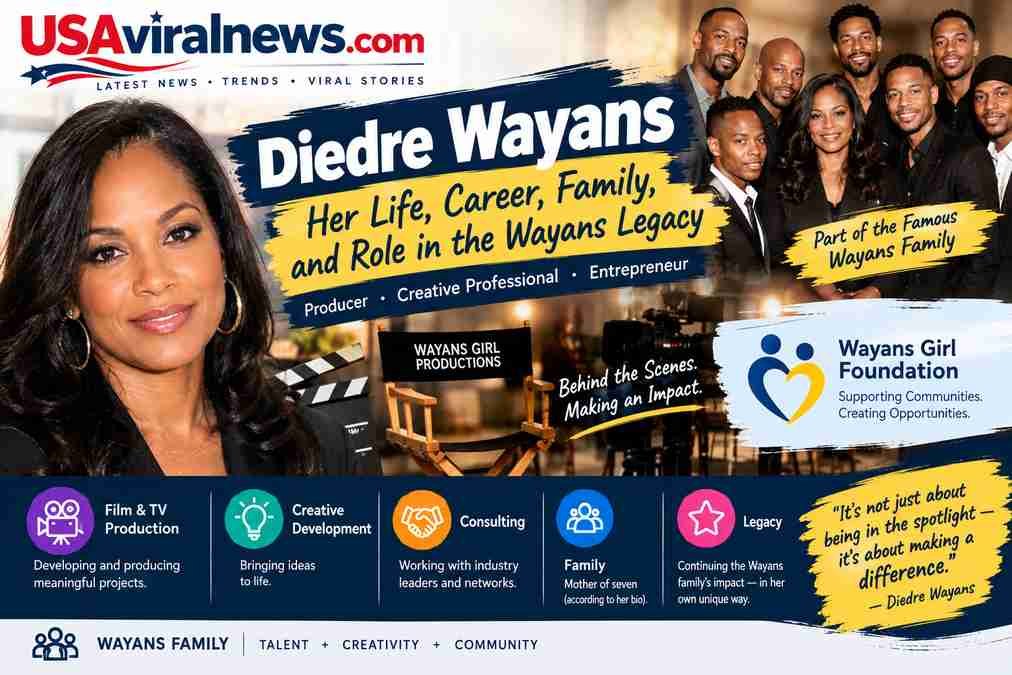
Diedre Wayans, also credited as Diedra Wayans, is a member of the family behind some of American comedy and entertainment’s best known television and film projects. Unlike siblings such as Keenen Ivory Wayans, Damon Wayans, Shawn Wayans, and Marlon Wayans, she has largely worked away from the spotlight.

Her public career is centered on production, creative development, consulting, and community work. She has also been involved in projects including A Polished Soul and Changing Steps with Belinda Baker. Her own professional biography identifies her as the CEO of Wayans Girl Productions and describes decades of behind the scenes work in entertainment.

What makes Diedre particularly interesting is that her story is not simply about being related to the famous Wayans entertainers. She developed her own production work, raised a large family, supported creative projects, and became involved in an organization focused on connecting people with community resources.

Who Is Diedre Wayans?

Diedre Wayans is an American entertainment producer and creative professional from the Wayans family.

She is the daughter of Howell Stouten Wayans and Elvira Alethia Green, and the sister of Dwayne, Keenen Ivory, Damon, Kim, Elvira, Nadia, Devonne, Shawn, and Marlon Wayans. Family and entertainment references consistently identify her as one of the ten Wayans siblings.

Diedre has generally maintained a much lower public profile than her brothers and sisters. Her own biography says she has worked behind the scenes with her family and other producers for many years rather than pursuing the same level of on-camera celebrity associated with some of her siblings.

That distinction is important. Calling her simply a “Wayans celebrity” misses much of what she has actually done.

Her work has primarily involved developing, producing, and supporting entertainment projects.

Diedre Wayans at a Glance

Detail Information
Name Diedre Wayans, also credited as Diedra Wayans
Profession Producer, creative professional, consultant
Parents Howell Stouten Wayans and Elvira Alethia Green
Family One of ten Wayans siblings
Production company Wayans Girl Productions
Known production work A Polished Soul, Changing Steps with Belinda Baker
Other involvement Wayans Girl Foundation
Children Her own professional biography names seven children
Public profile Predominantly behind the scenes

Some biographical websites give specific birth dates, ages, marital details, and other personal information that are not consistently supported by stronger sources. Diedre’s own professional biography deliberately says she does not give away her age, so those details should not be treated as firmly established without better documentation.

Is Diedre Wayans the Same Person as Diedra Wayans?

Yes. Public entertainment records use both Diedre Wayans and Diedra Wayans when referring to the same person.

IMDb lists her professional name as Diedra Wayans and specifically gives Diedre Wayans as an alternative name. Her production credits likewise appear under Diedra Wayans.

This spelling difference explains why searches for “Diedre Wayans” and “Diedra Wayans” can produce slightly different results.

It is also one reason some online biographies appear inconsistent. Several sites have copied information from one another while using different spellings, and some add personal details that are difficult to verify.

For career information, the professional name Diedra Wayans is particularly useful because that is the name appearing in her IMDb credits and her own production website.

Diedre Wayans and the Wayans Family

Diedre belongs to the first generation of the modern Wayans entertainment family.

Her parents, Howell and Elvira Wayans, raised ten children in New York City. Several of those children eventually entered entertainment, including Keenen Ivory Wayans, Damon Wayans, Kim Wayans, Shawn Wayans, Marlon Wayans, and others. IMDb family records independently identify Diedra as their sister.

The family’s influence on American comedy is unusually broad. Members of the family have worked as actors, comedians, writers, directors, producers, composers, and television creators.

Diedre’s contribution is less visible because much of her work has happened behind the camera.

Her own biography describes her as the eldest female sibling in the family, positioned between Keenen Ivory Wayans and Damon Wayans in birth order.

What Does Diedre Wayans Do?

Diedre’s career is best described as a combination of television and film production, creative development, consulting, and entrepreneurship.

Her professional website identifies her as CEO of Wayans Girl Productions and says she has worked with her family and other veteran producers on entertainment projects. It also says she has developed relationships with executives connected with networks and entertainment companies including Warner Bros., FOX, ABC, BET, and Lifetime.

Her LinkedIn profile similarly identifies her with Wayans Girl Production and describes her as an experienced chief executive with a background in entertainment.

This makes her role within the Wayans family somewhat different from the public image many people associate with the name. She has been involved in the business and creative side of entertainment rather than relying primarily on acting or stand up comedy.

Her Production Work

Diedra Wayans has received producer credits on several projects.

A Polished Soul

One of her clearest documented credits is the 2022 drama A Polished Soul.

IMDb lists Diedra Wayans as a producer, while Rotten Tomatoes also credits her among the film’s producers. The film was directed and written by Mike Rae Anderson and tells the story of a film producer whose life changes after surviving death row and imprisonment.

The credit matters because it provides a verifiable example of Diedre’s work rather than relying on generic claims that she is involved in entertainment.

Changing Steps with Belinda Baker

Diedra is also credited as a producer on Changing Steps with Belinda Baker, a television project associated with her production work. IMDb lists the program among her previous producer credits.

Other and Current Projects

IMDb currently lists Diedra Wayans in connection with In the Matchbox, LLC, where she is credited as an executive producer, and Dr Julian Wright Show, where she is listed as a producer. The database describes the former as post production and the latter as pre production at the time of its current listing.

Because production statuses can change, these credits are best understood as current database listings rather than guarantees about eventual release dates.

Diedre Wayans and Wayans Girl Productions

Diedre’s own professional site identifies Wayans Girl Productions as her company and describes the business as focused on production, development, and consulting within entertainment.

Her website presents the company as an outlet for creative development rather than simply a vehicle for exploiting the Wayans name.

That distinction helps explain why her career can be difficult to find through mainstream celebrity coverage. Much of her work has been business and production oriented.

The company also connects her entertainment career with projects involving family members and emerging creative ideas.

Diedre Wayans and Her Children

Diedre’s family life is another major part of the available biographical record.

Her own professional biography says she raised seven children and names them as Craig Wayans, Tisha, Summer Wayans, Gregg Wayans, Justin, Jamel, and Brandee.

This is more reliable than the many celebrity biography sites that list different numbers of children.

Her son Craig Wayans is particularly well documented in entertainment records. Craig is a writer, television producer, and actor, and IMDb identifies Diedra Wayans as his mother.

Craig’s career has included work connected with productions such as My Wife and Kids and Scary Movie 2. His connection to the Wayans family therefore represents another generation of the family’s involvement in entertainment.

Her daughter Summer Wayans has also pursued entertainment and public-facing work while becoming involved in psychology and philanthropy.

A 2017 interview with Summer describes Diedra as her mother and discusses their joint work with the Wayans Girl Foundation.

Diedre Wayans and Summer Wayans

The relationship between Diedre and Summer is particularly significant because it extends beyond family.

The two worked together on the Wayans Girl Foundation, an organization established to help people connect with support and community resources.

In an interview, Summer explained that she and her mother wanted to help people access resources that already existed but were often difficult for people to find.

That goal gives some useful context to Diedre’s public work. Her career has not been limited to entertainment production. It has also included efforts focused on empowerment and community support.

What Was the Wayans Girl Foundation?

The Wayans Girl Foundation was established by Diedre and her daughter Summer as a nonprofit organization focused on empowerment and access to resources.

A 2016 description published by Diedre explains that the foundation was intended to provide support for people dealing with different forms of crisis. Its proposed services included access to companionship, nutritional support, therapeutic services, childcare, educational workshops, and other resources.

Summer described the foundation’s philosophy in similar terms. Rather than assuming that people always lacked resources, she emphasized that people often did not know what resources were available or where to find them.

That approach is notable because it frames the organization’s purpose around connecting people with existing support, rather than simply providing one narrow service.

Is Diedre Wayans a Screenwriter?

Diedre Wayans is frequently described online as a screenwriter, but the strongest current professional evidence more clearly establishes her as a producer and entertainment executive.

Her IMDb profile primarily lists producer credits, including A Polished Soul, Changing Steps with Belinda Baker, Roxi Blews, and other projects.

Some biography websites call her a screenwriter, but those descriptions are not consistently backed by specific writing credits.

For that reason, it is more accurate to describe her primarily as a producer, creative professional, and entertainment consultant, while recognizing that she has also been described as a writer or storyteller in biographical material.

How Old Is Diedre Wayans?

The exact answer is less certain than many online biographies suggest.

Several secondary sources report that Diedre was born on August 17, 1959, which would make her 67 in 2026.

However, her own biography explicitly says that she does not disclose her age.

Because the date is not established by a strong primary biographical source, it is better to describe August 17, 1959 as a commonly reported date, rather than present it as an unquestionable fact.

This is a useful distinction because many celebrity biography sites repeat the same date without demonstrating where it originated.

Who Are Diedre Wayans’ Parents?

Diedre’s parents were Howell Stouten Wayans and Elvira Alethia Green.

IMDb identifies both as her parents, and the same family relationship appears throughout biographies of her siblings.

Her mother, Elvira Wayans, became an important figure in the family’s history. Several of her children went on to successful entertainment careers, while the family’s upbringing in New York helped shape the environment from which the Wayans creative dynasty emerged.

Elvira died in 2020 at age 81. Marlon Wayans publicly paid tribute to his mother following her death and described the important role she played in holding the family together.

Is Diedre Wayans Related to Damon, Keenen, Shawn, and Marlon Wayans?

Yes.

Diedre is the sister of Dwayne, Keenen Ivory, Damon, Kim, Elvira, Nadia, Devonne, Shawn, and Marlon Wayans. IMDb family records explicitly list these relationships.

That means:

Family member Relationship to Diedre
Dwayne Wayans Brother
Keenen Ivory Wayans Brother
Damon Wayans Brother
Kim Wayans Sister
Elvira Wayans Sister
Nadia Wayans Sister
Devonne Wayans Sister
Shawn Wayans Brother
Marlon Wayans Brother
Craig Wayans Son

The family’s unusually large number of entertainers can make the family tree confusing, particularly because cousins and second generation performers have also entered the industry.

Why Diedre Wayans Is Less Famous Than Her Siblings

The simplest explanation is that her career has largely been behind the camera.

Keenen Ivory Wayans became famous as a comedian, actor, writer, director, and creator. Damon Wayans became a major stand up comedian and actor. Shawn and Marlon became recognizable performers. Diedre instead concentrated on production, development, consulting, entrepreneurship, and family projects.

Her own biography supports that distinction, describing years of behind the scenes work before she began moving more visibly into her own production efforts.

So the lack of mainstream celebrity coverage should not be confused with a lack of professional activity.

Diedre Wayans’ Career in Perspective

Diedre’s significance within the Wayans family is easier to understand when her career is separated into three areas:

Entertainment production: She has documented producer credits and continues to appear in industry databases in production roles.

Entrepreneurship: She identifies herself as the CEO of Wayans Girl Productions and has used the company as a platform for creative development and consulting.

Community work: She co-founded the Wayans Girl Foundation with her daughter Summer, with an emphasis on empowerment and helping people connect with useful resources.

Together, those roles paint a more complete picture than simply labeling her as one of the Wayans siblings.

What Is Known About Diedre Wayans’ Personal Life?

Diedre has kept much of her private life away from mainstream media.

Her own professional biography confirms that she raised seven children, while other sources provide additional claims about her marriage and household. However, those details are not consistently documented by strong primary sources.

For that reason, claims about a specific spouse, exact household arrangements, or private financial circumstances should be treated cautiously.

This is particularly relevant to online searches for Diedre Wayans because many low quality celebrity biography pages publish precise figures and personal details without reliable sourcing.

Diedre Wayans’ Net Worth

There is no reliable public figure for Diedre Wayans’ net worth.

Some celebrity biography websites publish estimates, including claims of a net worth around $1 million, but these numbers are not supported by audited financial records, authoritative business disclosures, or credible financial reporting.

A responsible biography should therefore avoid presenting a specific dollar amount as fact.

Her documented work as a producer, business owner, and entertainment consultant establishes professional activity, but it does not provide enough information to calculate her personal wealth.

Frequently Asked Questions About Diedre Wayans

Is Diedre Wayans still alive?

Current professional information indicates that Diedra Wayans is active in entertainment and business. IMDb currently lists her with production projects including In the Matchbox, LLC and Dr Julian Wright Show.

Some websites have incorrectly published claims about her death. Those claims conflict with her current professional presence and should not be treated as reliable.

What is Diedre Wayans known for?

She is primarily known as a member of the Wayans family and as an entertainment producer. Her documented credits include A Polished Soul and Changing Steps with Belinda Baker.

Is Diedre Wayans the same as Diedra Wayans?

Yes. Diedra Wayans is the spelling used in several professional records, while Diedre Wayans is an alternative name associated with the same person.

How many children does Diedre Wayans have?

Diedre’s own professional biography says she raised seven children and names Craig, Tisha, Summer, Gregg, Justin, Jamel, and Brandee.

Some secondary websites give different numbers, so her own published account is the stronger reference for this detail.

Is Craig Wayans Diedre Wayans’ son?

Yes. IMDb identifies Diedra Wayans as Craig Wayans’ mother, and Craig’s biographical record identifies her as his parent.

Did Diedre Wayans work on A Polished Soul?

Yes. She is credited as a producer on the 2022 drama A Polished Soul. Both IMDb and Rotten Tomatoes list her among the film’s producers.

Did Diedre Wayans work with her daughter Summer?

Yes. Diedre and Summer Wayans worked together on the Wayans Girl Foundation. Summer has publicly discussed her mother as her partner in establishing the organization.

What is Diedre Wayans’ relationship to Marlon Wayans?

Marlon Wayans is her younger brother. Diedra’s IMDb family record lists Marlon among her siblings.

The Bigger Picture

Diedre Wayans is an example of how the Wayans family’s entertainment legacy extends beyond its most recognizable performers.

Her career has developed primarily through production, creative development, consulting, and entrepreneurship. She has also raised children who entered creative fields, including Craig Wayans, and collaborated with her daughter Summer on community focused work.

The most reliable picture of Diedre is therefore not that of a celebrity trying to compete with her famous siblings. It is that of a behind the scenes entertainment professional who built her own role within an unusually creative family.

That distinction also explains why information about her can be confusing online. Her name appears in two spellings, her private life is not extensively documented, and secondary biography sites frequently repeat unverified details. The strongest evidence points to a producer and entrepreneur whose work has remained considerably quieter than the public careers of many other members of the Wayans family.
You may also read:Fascisterne


Fascisterne: Meaning, Danish Grammar, History, and the Fascists It Refers To

fascisterne

Fascisterne is a Danish word that means “the fascists” in English. It is the definite plural form of fascist, so it refers to a particular or identifiable group of people described as fascists. It is not the name of a specific political party, organization, or ideology by itself.

That distinction matters because the word can appear in very different contexts. A Danish history text might use fascisterne when discussing Italian Fascists, Danish fascists, or fascist movements elsewhere in Europe. A modern political discussion may use the same word more loosely as a political accusation. The surrounding context determines exactly whom the writer means.

What Does Fascisterne Mean?

The simplest translation is:

Fascisterne = the fascists

The word comes from the Danish noun fascist, which refers primarily to a person who supports fascism. Danish expresses grammatical definiteness through noun endings, which is why the English word “the” is represented by the ending in fascisterne. Historical Danish dictionaries also document the word in this form.

A useful breakdown is:

Danish English Meaning
fascist a fascist One fascist
fascisten the fascist One specific fascist
fascister fascists Fascists generally
fascisterne the fascists A specific or identifiable group
fascisme fascism The ideology or political movement

The key distinction is between people and ideology. Fascisterne refers to people. Fascisme refers to fascism itself.

This is easy to overlook if the word is encountered outside Danish.

Why the Ending “erne” Matters

The ending is grammatical, not ideological.

In Danish, nouns can take endings that indicate number and definiteness. In this case, fascister is the plural form, while fascisterne is the definite plural.

So the progression is:

fascist → fascister → fascisterne

The English equivalent changes from “a fascist” to “fascists” to “the fascists.”

This means Fascisterne should not be interpreted as though it were the proper name of a movement called “Fascisterne.” It is an ordinary Danish noun form. The exact group being discussed has to be established from the sentence or wider text.

Older Danish dictionary material provides historical examples of fascisterne in descriptions of fascists in Italy and elsewhere, demonstrating that the form has long been used as a normal plural noun rather than as the name of a single organization.

Fascisterne Is Not the Same as Fascism

One of the most important distinctions is:

Fascisterne means “the fascists.”

Fascisme means “fascism.”

The first describes people. The second describes a political ideology and movement.

Fascism emerged as a major political force in early twentieth century Europe. The United States Holocaust Memorial Museum describes it as a far right political philosophy that places the nation above the individual and opposes liberal democratic political traditions. It became particularly successful in Italy and Germany.

This distinction helps prevent a common translation error. If a Danish text says that fascisterne did something, the original writer is talking about people or a group of people. Translating it simply as “fascism” changes the grammatical and historical meaning.

Where Did Fascism Come From?

Modern fascism is most closely associated with Benito Mussolini and Italy.

Mussolini founded the first major fascist movement in Italy after the First World War. The movement eventually became a governing force, and Mussolini ruled Italy as its dictator. The Holocaust Encyclopedia identifies Mussolini as the founder of Italian Fascism and notes that his takeover became an important inspiration for Adolf Hitler and the Nazi Party in Germany.

Fascism developed in a period marked by political instability, social conflict, economic uncertainty, and widespread fear of revolutionary communism. Fascist movements presented themselves as alternatives to parliamentary politics and class conflict. They emphasized national unity, authority, discipline, and strong leadership while suppressing political opposition.

The exact form of fascism differed between countries. That is why it is misleading to treat every authoritarian government or nationalist movement as identical to Italian Fascism.

What Did Fascists Believe?

Historical fascist movements differed from one another, but several recurring features are important for understanding the term.

These commonly included:

  • intense nationalism
  • rejection or destruction of liberal democratic institutions
  • strong centralized leadership
  • suppression of political opposition
  • glorification of national unity and political loyalty
  • acceptance or promotion of political violence
  • hostility toward communism and other perceived political enemies
  • extensive propaganda
  • subordination of individual interests to an idealized national community

The exact combination varied by country and period. Nazism, for example, developed a particularly radical racial and antisemitic worldview that cannot simply be treated as interchangeable with every other form of fascism. The Holocaust Encyclopedia classifies Nazi Germany as a fascist government while also describing the distinctive ideological characteristics of Nazism.

That historical distinction is important when interpreting the Danish word fascisterne. The word itself does not tell you whether the writer means Italian Fascists, Danish fascists, Nazis, or another group described as fascist.

Fascisterne and Denmark

The word has a particularly relevant historical context in Denmark because Denmark had its own Nazi political movement during the interwar period and German occupation.

The most important organization was Danmarks Nationalsocialistiske Arbejderparti, usually abbreviated DNSAP. The party was founded on November 16, 1930, by Cay Lembcke. Frits Clausen became its leader in 1933. The organization was strongly modeled on Adolf Hitler’s German NSDAP, including its organizational structure, symbols, nationalism, antisemitism, and opposition to parliamentary democracy.

DNSAP remained politically marginal despite its growth in membership.

At the 1939 Danish parliamentary election, the party won about 1.8 percent of the vote and three seats. During the German occupation, it failed to turn its increased organizational activity and German support into a national political breakthrough. At the 1943 election, it again won only three parliamentary seats, with about 2.1 percent of the vote.

This is an important part of the Danish context. Not every reference to fascists in Denmark means that DNSAP controlled Denmark or represented the majority of Danish society. The historical record shows that the party remained a minority movement.

DNSAP and the German Occupation

Germany occupied Denmark beginning in 1940, creating a complicated political environment for Danish Nazi activists.

DNSAP hoped to use the occupation to gain political power. The party also participated in recruitment for German military formations, including Waffen SS units and Frikorps Danmark. Its dependence on Germany became one of the central contradictions of its political identity because it presented itself as a Danish nationalist movement while closely following German Nazism.

The party’s failure to achieve a decisive political breakthrough became especially clear in 1943. After its poor election result, its political influence declined further, and the organization ultimately disappeared in 1945.

This history explains why fascisterne may appear in Danish historical writing alongside terms concerning Nazism, occupation, resistance, collaboration, antisemitism, and political violence. But those terms should not automatically be treated as synonyms.

Fascism and Nazism Are Related, but Not Identical

It is common to see fascism and Nazism discussed together because Nazi Germany shared important characteristics with other fascist movements.

There are nevertheless important differences.

Fascism is a broader category associated historically with movements such as Italian Fascism and other authoritarian nationalist movements.

Nazism refers specifically to the ideology and political movement associated with Adolf Hitler and the German National Socialist German Workers’ Party. Nazi ideology placed an exceptionally strong emphasis on racial hierarchy, antisemitism, racial purity, territorial expansion, and the persecution and destruction of groups defined as racial or political enemies.

Therefore, if a Danish source uses fascisterne, you should not automatically translate the term as “Nazis.”

Context decides the reference.

How Fascisterne Is Used in Modern Danish

The historical meaning is not the only possible use.

Political language sometimes extends words beyond their strict historical definitions. Danish dictionary evidence records a broader transferred use of fascist associated with strongly authoritarian or nationalist political attitudes and suppression of people who disagree.

That means a contemporary sentence containing fascistians may not be describing members of a historical fascist organization.

It could instead be using the term rhetorically.

This creates an important interpretive rule:

Do not assume that every modern use of “the fascists” is a precise historical classification.

Ask who is being described, what actions or beliefs are being discussed, and what evidence supports the label.

A historical text identifying members of an established fascist organization is making a different kind of statement from a political commentator calling opponents fascistened during a modern argument.

Why Context Is Essential

Suppose you encounter fascisterne in a Danish article without knowing the surrounding paragraph.

The word tells you that the writer means “the fascists,” but it does not tell you:

  • which country they belong to
  • which organization they belong to
  • which historical period is being discussed
  • whether the term is being used historically or rhetorically
  • whether the writer means fascists in the strict ideological sense
  • whether the reference concerns Italian Fascism, German Nazism, Danish Nazism, or another movement

The surrounding text supplies that information.

For example, a sentence about Mussolini and Italy points toward Italian Fascists. A discussion of DNSAP and the German occupation points toward Danish Nazism. A modern newspaper debate may use the term as a political description that requires additional scrutiny.

The grammar stays the same. The historical reference changes.

How to Translate Fascisterne Correctly

In most contexts, the safest English translation is:

“the fascists”

Avoid translating it automatically as:

  • fascism
  • fascist ideology
  • Nazis
  • the Fascist Party
  • a specific Danish fascist organization

Those translations add information that is not necessarily contained in the word itself.

A translator should first preserve the grammatical meaning, then use context to determine the historical reference.

This is especially important when translating historical documents. A precise translation should not turn a general reference to fascists into the name of a specific organization that the original Danish text never identified.

Why the Term Can Be Misleading Online

Search results for fascisterne can make the word look like the name of a specific historical movement because many pages discuss the term alongside fascism, Mussolini, Nazism, Denmark, and the Second World War.

The distinction is simpler:

Fascisterne is a Danish grammatical form.

It means “the fascists.”

It does not independently identify one political party.

The historical subject behind the word must be established from context.

That small distinction produces a much more accurate understanding of Danish historical and political writing.

Frequently Asked Questions

What does fascisterne mean in English?

Fascisterne means “the fascists.” It is the definite plural form of the Danish noun fascist.

What language is fascisterne?

Fascisterne er danske.

Is fascisterne a political party?

No. Fascisterne is a grammatical noun form meaning “the fascists.” It is not, by itself, the name of a political party or organization.

What is the singular form of fascisterne?

The indefinite singular is fascist. The definite singular is fascisten. The indefinite plural is fascister, and the definite plural is fascisterne.

What is the Danish word for fascism?

The Danish word is fascisme. Fascisterne refers to people, while fascisme refers to the ideology or political movement.

Does fascisterne always mean Nazis?

No. Fascism and Nazism are historically related, but they are not identical terms. Fascisterne can refer to different groups depending on the context.

Was there a fascist or Nazi movement in Denmark?

Yes. Denmark had the DNSAP, a Nazi political party founded in 1930 and strongly modeled on Hitler’s NSDAP. It remained a marginal electoral force despite gaining members and operating during the German occupation.

When was DNSAP founded?

DNSAP was founded on November 16, 1930, initially under Cay Lembcke. Frits Clausen became its leader in 1933.

Why does fascisterne end with “erne”?

The ending marks the definite plural. It changes fascister, meaning “fascists,” into fascisterne, meaning “the fascists.”

Can fascisterne be used in modern political discussion?

Yes. The term can appear in contemporary political language, including broader or rhetorical uses of the word fascist. Such usage should be distinguished from a precise historical identification of a fascist organization or movement.

The Bottom Line

Fascisterne means “the fascists” in Danish. It is the definite plural of fascist, not the name of a particular ideology or organization.

Its meaning becomes more specific only when you examine the surrounding context. In historical writing, it may refer to followers of Italian Fascism, Danish fascists, Nazi activists, or another group identified as fascist. In modern political language, it can also function as a broader label.

The most reliable way to understand the word is therefore to separate three things: the Danish grammar, the people being described, and the historical or political context. Once those are kept distinct, fascisterne is much less mysterious and much easier to translate accurately.
You may also read:Tulip Victoria Khaury


Wixtee: What Is It, How Does It Work, and What Should Freelancers Know?

wixtee

Freelancing offers freedom, flexible hours, and the chance to work with clients worldwide. However, managing several projects at once can quickly become challenging. Freelancers must organize tasks, remember deadlines, communicate with clients, and keep their work moving forward.

This is why people often look for online tools that make daily work easier. Wixtee is a name appearing in articles about freelance work management and productivity. If you have searched for Wixtee, you may want to understand what it is, how it may help, and whether it deserves your attention.

In this guide, we explore Wixtee, freelance productivity, project organization, possible benefits, and important things to verify before using an unfamiliar platform. We will also explain how to evaluate work-management tools and choose one that fits your needs.

What Is Wixtee?

Wixtee is described in some online articles as a tool associated with freelance work management. These descriptions connect the name with organizing projects, handling tasks, and improving everyday workflows. However, detailed, independently verified information about its ownership, official features, and service availability remains limited.

This distinction matters when researching a relatively unfamiliar platform. An article may describe what a service is intended to do without proving that every mentioned feature is currently available. Readers should therefore confirm important details through an official website or other reliable sources before relying on those descriptions.

If you are exploring Wixtee for your freelance business, begin by identifying its official online presence. Check whether it provides a clear product explanation, working demonstrations, documentation, and customer support. These details can help you understand what the service actually offers.

Why Are People Searching for Wixtee?

People search for unfamiliar online names for several reasons. Some want a simple definition, while others want to know whether a platform can solve a particular problem. A freelancer might discover Wixtee through a blog post and then search for more information before deciding what to do next.

Search intent is important because readers need direct answers. Someone searching for “What is Wixtee?” probably wants a clear explanation first. A person searching for “Wixtee features” may need verified product details. Meanwhile, someone searching for “Is Wixtee safe?” needs reliable information about privacy, security, and the company behind the service.

A useful Wixtee guide should address these questions without inventing answers. When information is missing, explaining how to verify it is more helpful than presenting assumptions as confirmed facts.

How Could Wixtee Fit Into Freelance Work?

Freelancers often manage several responsibilities beyond their main professional skills. A writer may prepare articles for multiple clients, while a designer may work on several branding projects. Developers, consultants, and virtual assistants face similar planning challenges.

A work-management tool can help when it provides practical ways to organize these responsibilities. However, the exact benefits depend on the platform’s real features. Wixtee users should confirm which functions are available before choosing it for important business tasks.

Organizing Daily Tasks

A clear task list helps freelancers understand what needs attention first. It can separate urgent work from tasks that can wait until later. This simple habit makes a busy schedule easier to manage.

For example, a freelance writer might need to finish two articles, revise an older draft, and answer client messages. Organizing these tasks helps create a realistic plan for the day. Before using Wixtee for this purpose, check whether its current version supports the task-management features you need.

Keeping Projects Organized

Project organization becomes more important when deadlines overlap. Freelancers need to understand each project’s status, next steps, and remaining work. A useful system should make these details easy to review.

Consider a designer managing a logo project and a website redesign simultaneously. Each project has separate requirements and deadlines. A suitable management tool should help prevent confusion between them. Confirm whether Wixtee offers the project views or tracking options your workflow requires.

Managing Deadlines

Missing a deadline can damage client trust and create unnecessary pressure. A reliable planning process helps freelancers track delivery dates and allow time for revisions. Calendar reminders and deadline lists can make this process easier.

Before depending on Wixtee for deadline management, check whether it supports due dates, notifications, and recurring tasks. These are common features in work-management software, but they should not be assumed to exist on every platform.

Potential Benefits of a Freelance Work-Management Tool

The value of any productivity platform depends on how well it addresses real problems. A tool should simplify work rather than introduce another complicated system. The following benefits explain what freelancers should look for when evaluating Wixtee or a similar service.

Better Organization

Keeping project information in a structured place can reduce confusion. Freelancers may otherwise spread important details across notebooks, emails, spreadsheets, and messaging apps.

A central workspace can make it easier to review priorities and find project information. However, the usefulness of that workspace depends on its actual design and capabilities. Check whether Wixtee provides a practical way to organize your work before moving important information into it.

More Efficient Work Routines

A consistent routine can help freelancers avoid spending too much time planning the same tasks repeatedly. They can review their workload, identify priorities, and start important work sooner.

A digital tool may support this routine through task lists, calendars, or project dashboards. Still, technology alone cannot guarantee better productivity. Freelancers must create realistic schedules and use their chosen system consistently.

Clearer Client Communication

Client communication becomes difficult when several projects are active. Freelancers may need to remember feedback, track requested changes, and provide progress updates. A structured process helps keep these responsibilities under control.

When researching Wixtee, look for verified information about collaboration, comments, notifications, and client access. Do not assume these features are available without checking the platform’s official documentation.

Easier Workload Planning

Freelancers sometimes accept more work than they can complete comfortably. A clear overview of existing commitments can help them make better decisions before accepting another project.

Workload planning involves understanding deadlines, estimating task duration, and leaving time for unexpected revisions. A suitable tool can support this process, but accurate estimates and sensible scheduling remain essential.

Who Might Benefit From Wixtee?

The usefulness of Wixtee depends on its confirmed features and the needs of the person considering it. Different freelancers require different tools, so there is no single solution for every professional.

Freelance Writers and Editors

Writers often manage briefs, research, drafts, revisions, and publication deadlines. A clear organizational system helps keep these stages separate and easy to follow.

Before choosing Wixtee, writers should check whether it supports their preferred workflow. They may also need document storage, client notes, or integrations with writing tools. Confirm each requirement rather than relying on general descriptions.

Graphic Designers

Designers frequently work with feedback, creative revisions, and several versions of the same project. Keeping client requests organized can prevent misunderstandings and reduce unnecessary rework.

A designer evaluating Wixtee should look for suitable project tracking and collaboration options. File handling may also matter when projects include large images or design documents.

Developers

Developers often divide larger projects into smaller tasks. They may need to track bugs, review changes, record requirements, and communicate progress.

A general productivity platform may suit simple projects, while complex development work may require specialized tools. Developers should confirm whether Wixtee supports their technical workflow before switching from an existing system.

Virtual Assistants and Consultants

Virtual assistants handle schedules, research, administrative work, and client requests. Consultants may manage meetings, reports, recommendations, and project milestones.

Both groups benefit from reliable organization. They should examine whether Wixtee supports the tasks they perform most often and whether its privacy practices meet their clients’ requirements.

What Should You Check Before Using Wixtee?

Researching an unfamiliar platform is important before creating an account or sharing business information. A professional-looking article or website does not automatically establish that a service is trustworthy.

Find the Official Website

Start by identifying the platform’s official website. Check whether its branding, product information, and contact details are consistent across its official channels.

Avoid assuming that a third-party article is the official source. If you cannot confidently identify the service’s operator, continue researching before signing up.

Verify Its Features

Look for a current feature list, product demonstration, help center, or user documentation. These resources should explain what the platform actually does.

If a feature is mentioned only in promotional articles, treat it as unconfirmed. This is especially important for integrations, automated workflows, payment functions, and collaboration tools.

Review Privacy and Security Information

Freelancers may handle confidential client information, business documents, and project details. Any platform used for this work should explain how it collects, stores, and processes data.

Review its privacy policy and security information before uploading sensitive files. Check available account protections and understand how to delete your information if you stop using the service.

Never provide passwords, financial details, or confidential client documents without a clear reason and sufficient confidence in the service.

Check Pricing and Account Terms

A platform may offer free access, paid plans, or limits on particular features. Pricing can also change over time.

Look for current information about subscription costs, renewal terms, cancellation procedures, and refunds. Do not rely on an old article for prices or account conditions.

If pricing information is unclear, contact the provider before committing to a paid plan.

Look for Independent Feedback

Independent reviews can help reveal common problems or useful experiences. However, a small number of reviews may not represent the full picture.

Compare several sources and check their publication dates. Look for specific experiences rather than repeated promotional statements. Be cautious when reviews make strong claims without explaining how the reviewer tested the service.

Wixtee Compared With Traditional Productivity Methods

Freelancers do not always need a dedicated online platform. A notebook, spreadsheet, calendar, or simple task list may be enough for a small workload.

Traditional methods can be inexpensive and easy to customize. They also allow freelancers to work without learning another application. However, managing many clients through separate documents may become harder as a business grows.

Digital work-management tools can offer a more structured approach when their features match the user’s needs. Some provide reminders, shared workspaces, project views, and integrations. The exact options vary between products.

Wixtee should be evaluated using the same practical criteria. Compare its verified capabilities, ease of use, pricing, privacy information, and compatibility with your existing tools. Do not assume that a newer platform is automatically better than a familiar alternative.

Wixtee: Advantages and Limitations to Consider

An objective evaluation should consider both possible benefits and unanswered questions. This helps readers make decisions based on evidence rather than marketing language.

Possible Advantages

If Wixtee provides the work-management features described in available articles, it may appeal to freelancers who want a more organized routine. A suitable system can help users review tasks, plan projects, and maintain clearer workflows.

A straightforward interface would also be useful for beginners. Freelancers generally need tools that reduce administrative work instead of adding unnecessary steps.

These are potential benefits, not verified guarantees about Wixtee’s current performance.

Important Limitations

Publicly available information about Wixtee’s exact capabilities appears limited. Its official ownership, complete feature set, pricing, and independent user feedback should be confirmed before making a recommendation.

Another limitation is that every freelancer has different requirements. A tool that suits a writer may not meet a developer’s needs. Even a well-designed platform may be unsuitable if it lacks essential integrations or appropriate privacy protections.

For these reasons, verify the product first and compare it with established alternatives before moving your entire workflow.

How to Choose the Right Freelance Management Tool

Choosing a productivity tool becomes easier when you start with your actual problems. Make a short list of the tasks that currently take the most time. These might include tracking deadlines, collecting feedback, managing client requests, or organizing files.

Next, identify the features needed to solve those problems. Avoid paying for advanced functions you will rarely use. A simple tool may be enough when your workload is small.

Test a platform with a low-risk project before moving important work into it. This lets you assess its interface, reliability, and usefulness without disrupting your business.

Finally, review the cost and privacy terms. The best tool is not necessarily the one with the most features. It is the one that meets your needs, fits your budget, and handles your information appropriately.

Frequently Asked Questions About Wixtee

What is Wixtee?

Wixtee is described by some online articles as a tool related to freelance work management and productivity. Its exact features and official service details should be verified through reliable, current sources.

Is Wixtee a freelance productivity tool?

Online articles associate Wixtee with freelance organization and work management. However, readers should confirm the platform’s actual functions through an official product page or documentation.

Who may find Wixtee useful?

Freelancers who want better organization may be interested in evaluating Wixtee. Writers, designers, developers, and virtual assistants should first confirm that its features match their specific workflows.

Is Wixtee free to use?

Reliable, current pricing information should be checked directly with the service. Do not assume Wixtee is free or paid based on descriptions from unrelated websites.

Is Wixtee safe?

Its safety cannot be confirmed from a name or promotional article alone. Review the official website, privacy policy, security details, contact information, and credible independent feedback before sharing personal or client data.

Does Wixtee help improve productivity?

A suitable work-management system can support better planning and organization. However, actual results depend on the available features, the user’s workflow, and consistent use. Wixtee’s specific effectiveness should not be assumed without reliable evidence.

What should I check before signing up for Wixtee?

Confirm the official website, available features, pricing, privacy policy, security practices, support options, and cancellation terms. Start with a low-risk test if the service appears suitable.

Final Thoughts on Wixtee

Wixtee is a name associated with freelance work management in several online articles. The topic is relevant to freelancers who want clearer project planning, better task organization, and more consistent routines. However, important details about the platform should be verified before treating it as an established solution.

If you are considering Wixtee, begin with its official information and confirm the features you need. Compare its terms, pricing, security practices, and independent feedback with other available tools. Avoid relying on unsupported claims or assuming that every advertised benefit is guaranteed.

Ultimately, successful freelance work depends on more than choosing an application. Clear priorities, realistic deadlines, good client communication, and consistent habits matter just as much. The right tool should support these habits and make your daily work easier to manage.
You may also read:wixtee

Unity Leather Card Wallet: A Practical Review of the Postbox Unity Card and Cash Wallet

unity-leather-card

The Unity Leather Card Wallet is the name commonly used for The Postbox’s Unity Card and Cash Wallet, a compact leather wallet designed for people who want to carry a small number of cards, some folded cash, and little else.

Its appeal is fairly straightforward. You get genuine Nappa leather, a magnetic closure, RFID protection, an external quick access card sleeve, and enough room for everyday cards and a few notes. The manufacturer currently lists it at ₹1,799 including taxes in four colors: Black, Blue, Dark Tan, and Moss Green.

The more important question is not whether the Unity has useful features. It does. The real question is whether its deliberately limited capacity matches what you actually carry.

Unity Leather Card Wallet specifications

Here are the details that matter most when deciding whether the wallet fits your everyday carry.

Feature Unity Card and Cash Wallet
Brand The Postbox
Material Genuine Nappa leather
Exterior Soft pebbled Nappa leather
Interior Smooth Nappa leather
Dimensions 7.2 cm × 1.3 cm × 10.6 cm
Cards with cash 4 to 5 cards plus 4 to 5 folded notes
Cards without cash 7 to 8 cards
Closure Magnetic
RFID protection Yes
Quick access slot External card sleeve
Coin compartment No dedicated coin section
Current listed price ₹1,799
Current colors Black, Blue, Dark Tan, Moss Green
Warranty One year for hardware defects under stated normal use conditions

The dimensions and carrying capacity come directly from The Postbox product information. The manufacturer describes the wallet as a minimalist card and cash wallet rather than a conventional high capacity wallet.

That distinction is important. The Unity is not trying to replace a traditional wallet filled with receipts, coins, numerous cards, and a thick stack of currency. Its design makes much more sense when you treat it as an everyday essentials wallet.

What is the Unity Leather Card Wallet?

The Unity is a compact leather wallet that sits somewhere between a simple card holder and a traditional bifold.

A basic card sleeve may give you a few pockets but little room for cash. A conventional wallet offers considerably more storage but can become bulky. The Unity takes a middle position by providing space for cards and folded notes while keeping the overall format relatively compact.

Its layout includes a main storage area, a magnetic closure, and an external quick access slot. The latter is intended for the card you use most often, so you can reach it without opening the wallet and searching through the other cards.

That arrangement makes the product particularly logical for someone who regularly uses one primary payment or travel card.

Genuine Nappa leather is one of its main advantages

The Postbox specifies genuine Nappa leather for the Unity wallet. The exterior uses soft pebbled Nappa leather, while the interior uses smoother Nappa leather.

That gives the Unity a different character from rigid metal wallets and inexpensive synthetic card holders.

The choice of a pebbled exterior is also practical for an everyday item. A wallet is constantly handled and moved between pockets, bags, desks, and hands. A textured surface can be less visually unforgiving than an extremely smooth finish when it develops small marks from regular use.

The manufacturer says its leather is hydro treated and resistant to water, but it still recommends wiping the wallet with a dry cloth after exposure to water. It also says the leather can develop additional shine or patina through interaction with air and sunlight.

That should not be interpreted as meaning the wallet is waterproof. Water resistance and waterproof construction are different things.

The capacity tells you who this wallet is for

Capacity is probably the most important consideration before buying the Unity.

The manufacturer states that it can carry:

4 to 5 cards with 4 to 5 folded notes, or

7 to 8 cards without notes.

That is a useful specification because it makes the intended use unusually clear.

If your everyday setup is something like an identification card, debit card, credit card, work card, and one additional card, the Unity has enough room for the essentials while leaving space for a modest amount of cash.

If you carry seven or eight cards and rarely use cash, it can accommodate that arrangement as well.

The tradeoff appears when you try to combine maximum card capacity with cash. The wallet is compact because it is not designed to accommodate both large amounts of currency and a large collection of cards.

That is not necessarily a weakness. For a minimalist wallet, the capacity limit is part of the design philosophy.

How the magnetic closure works

Unlike an open card sleeve that relies primarily on the tension of its leather pockets, the Unity uses a magnetic closure.

The Postbox says the magnetic closure snaps shut to keep cards and cash contained when the wallet is not being used.

In everyday use, this gives the wallet a more contained feel than an open sleeve.

There is one point worth considering, however. One customer review on The Postbox’s product page reported that the positioning of the magnets can make inserting cards into the pockets slightly awkward, requiring the wallet to be bent a little. This is an individual customer experience rather than an independent product test, so it should not be treated as a universal problem.

Other customers specifically praise the magnetic closure and the wallet’s slim design, so experiences are not completely uniform.

The external quick access slot is more useful than it sounds

A small but practical feature is the external card sleeve.

Instead of opening the wallet every time you need your most frequently used card, you can keep that card in the outside slot. The Postbox describes this as a way to access the most used card without searching through the rest of the wallet.

This makes particular sense if you repeatedly use the same payment card or travel card.

It also reflects a good minimalist design principle. The wallet does not need more compartments simply for the sake of having more compartments. One easily accessible slot can solve a specific everyday problem.

RFID protection: useful, but not a reason to buy the wallet by itself

The Unity is listed as RFID secure.

RFID, or Radio Frequency Identification, allows compatible cards and devices to communicate wirelessly over short distances. The wallet’s RFID protection is intended to shield compatible cards while they are stored inside it.

It is a useful additional feature, particularly for people who specifically want an RFID protected wallet.

Still, RFID protection should not be confused with complete payment security. It does not replace ordinary precautions such as monitoring transactions, protecting payment information, and reporting lost cards promptly.

The stronger reason to choose the Unity is the combination of its physical design, leather construction, capacity, and quick access layout. RFID protection is an extra benefit rather than the entire value proposition.

What colors does the Unity wallet come in?

The current Unity collection includes four variants:

Black: Black pebbled leather with Black Nappa leather.

Blue: Blue exterior with Dark Tan Nappa leather.

Dark Tan: Dark Tan pebbled leather with Dark Tan Nappa leather.

Moss Green: Moss Green exterior with Dark Tan Nappa leather.

The Postbox currently lists all four at ₹1,799.

The choice is therefore mainly aesthetic rather than functional. The underlying wallet concept remains the same.

What are the biggest advantages?

The Unity makes the most sense when its features match your actual carrying habits.

Compact size: The wallet measures 7.2 cm by 1.3 cm by 10.6 cm, giving it a relatively small footprint.

Genuine Nappa leather: The leather construction gives it a softer, more traditional wallet character than rigid minimalist alternatives.

Card and cash storage: It can accommodate folded notes as well as cards, which makes it more versatile than a simple card sleeve.

Quick access: The external sleeve gives you a dedicated place for your most frequently used card.

Magnetic closure: The wallet closes securely rather than remaining completely open like some card holders.

RFID protection: Compatible cards receive RFID shielding while stored in the wallet.

Four color choices: Black, Blue, Dark Tan, and Moss Green give buyers several styles without changing the basic design.

What are the limitations?

The same minimalist design that makes the Unity attractive also creates its limitations.

There is no dedicated coin compartment in the listed design. If you regularly carry coins, this is not the most natural wallet format.

It is also not designed for a large amount of cash. Notes need to be folded, and the manufacturer’s stated capacity is only 4 to 5 folded notes alongside 4 to 5 cards.

The wallet is therefore a poor match for someone who carries many receipts, numerous identification cards, business cards, coins, or a thick stack of banknotes.

Trying to overcome that limitation by stuffing additional cards into it would also undermine the reason for buying a compact wallet in the first place.

Unity Leather Card Wallet vs a traditional bifold

The choice is less about which wallet is universally better and more about how much you carry.

If you usually carry Better fit
3 to 5 essential cards and a few notes Unity
6 to 8 cards and little or no cash Unity
One frequently used card that needs fast access Unity
Coins Traditional wallet with coin storage
Many receipts Traditional wallet
Large amounts of cash Traditional wallet
Numerous cards and IDs Traditional wallet
Minimal everyday carry Unity

The Unity wins when reducing bulk is the priority.

A bifold wins when storage flexibility matters more than compactness.

That distinction is more useful than simply calling the Unity a minimalist wallet. The important question is whether your existing wallet contains things you actually need.

Is ₹1,799 a good price for the Unity Leather Card Wallet?

The Postbox currently lists the Unity at ₹1,799 including taxes.

Whether that is good value depends on what you are buying it for.

If your only objective is to find the cheapest possible card holder, the Unity is probably more wallet than you need. Its value comes from combining genuine Nappa leather, cash storage, RFID protection, magnetic closure, and an external quick access sleeve in one compact design.

The Postbox also lists several other card and cash products, including the Palma Wallet at ₹1,699 and the Sterling Card Holder at ₹1,599, so the Unity sits slightly above some of the brand’s simpler alternatives.

That makes the Unity most compelling for someone who specifically wants its combination of features rather than simply wanting a leather card holder at the lowest possible price.

What do customer reviews suggest?

The manufacturer’s product pages show generally positive customer feedback.

On the Black version, The Postbox currently displays 12 reviews, with 10 rated five stars and 2 rated four stars.

Reviews commonly mention the wallet’s slimness, leather quality, finish, and suitability for everyday use. One reviewer specifically praised its usefulness for payment cards, a commute card, and a small amount of cash. Another raised a concern about the long term durability of the magnets, although that is an individual expectation rather than evidence of an established durability problem.

There is also some independent community discussion around the wallet. In an Indian Everyday Carry discussion, a user said they had used the Unity for more than six months and recommended it to someone looking for a similar vertical wallet. That is useful as anecdotal ownership evidence, but it is still an individual experience rather than controlled testing.

The fairest conclusion is that available customer feedback is encouraging, while long term durability claims should not be overstated.

How to care for the Unity leather wallet

The Postbox recommends relatively simple care.

If the leather is exposed to water, wipe it with a dry cloth. When the wallet is not being used, the company recommends wiping the leather with a dry cloth. It also says a light wax polish can be used when additional shine is desired.

The most important practical habit is probably to avoid overloading it.

If the wallet is intended for a small collection of cards and a few notes, keeping it close to that configuration should help preserve the compact shape and make the wallet easier to use.

Leather naturally changes through handling. The manufacturer specifically notes that its leather can develop shine or patina through exposure to air and sunlight.

Who should buy the Unity Leather Card Wallet?

The Unity is a strong choice for someone who wants a small leather wallet for essential cards and modest cash.

It is particularly well suited to people who:

  1. Carry around four or five primary cards.
  2. Usually carry only a few banknotes.
  3. Prefer leather over metal or synthetic minimalist wallets.
  4. Want a dedicated quick access slot.
  5. Want a magnetic closure.
  6. Prefer a compact pocket friendly format.
  7. Like the idea of reducing unnecessary wallet contents.

It is less suitable for someone who:

  1. Regularly carries coins.
  2. Needs many cards and IDs.
  3. Carries substantial amounts of cash.
  4. Keeps receipts and other paper items in a wallet.
  5. Wants a large number of dedicated compartments.

Final verdict

The Unity Leather Card Wallet succeeds because it has a clearly defined purpose.

It is not a miniature replacement for a large traditional wallet. It is a compact card and cash wallet for people who have already decided that they do not need to carry everything with them.

Its genuine Nappa leather, magnetic closure, RFID protection, external quick access sleeve, and modest cash capacity give it more functionality than a basic card sleeve. At the same time, its 4 to 5 card capacity with cash and 7 to 8 card capacity without cash keep the design firmly in minimalist territory.
You may also read:Pasonet

Leash CodeHS Answers: 9.7.4 Solution, Explanation, and Common Fixes

leash-codehs

If you are looking for Leash CodeHS answers, you are most likely working on the 9.7.4 Leash exercise in CodeHS Introduction to Computer Science in JavaScript. CodeHS places Leash inside the Drawing Lines lesson, after its mouse movement and line drawing material.

The exercise combines a few simple ideas: a graphical object, X and Y coordinates, a mouse movement event, and a line whose endpoint changes as the mouse moves.

The important part is not simply getting the program to run. You need to keep the moving object and the end of the line synchronized.

What Is the CodeHS Leash Exercise?

The Leash exercise is an interactive JavaScript Graphics problem.

The basic behavior is:

  1. Create a ball or circle.
  2. Place it at the starting point.
  3. Create a line connected to that point.
  4. Detect mouse movement.
  5. Move the ball to the mouse coordinates.
  6. Move the line’s endpoint to those same coordinates.

CodeHS officially lists 9.7.4 Leash in its JavaScript curriculum. The same exercise appears under different section numbers in some other CodeHS courses, so the number shown in your classroom may not always be 9.7.4.

A Working JavaScript Solution

A compact implementation using the CodeHS Graphics API looks like this:

var ball;

var leash;


function start() {

    var centerX = getWidth() / 2;

    var centerY = getHeight() / 2;


    ball = new Circle(20);

    ball.setPosition(centerX, centerY);

    add(ball);


    leash = new Line(centerX, centerY, centerX, centerY);

    add(leash);


    mouseMoveMethod(moveBall);

}


function moveBall(e) {

    var x = e.getX();

    var y = e.getY();


    ball.setPosition(x, y);

    leash.setEndpoint(x, y);

}

The exact starter code in your CodeHS assignment can vary, so preserve any required constants, colors, object names, or starter structure that your particular exercise provides.

The important logic is the relationship between these two updates:

ball.setPosition(x, y);

leash.setEndpoint(x, y);

Both use the same mouse coordinates.

CodeHS documents mouseMoveMethod() as the callback used for mouse movement, and its mouse event object provides getX() and getY() for retrieving the cursor coordinates.

How the Solution Works

The easiest way to understand Leash is to think of the program as two objects connected by coordinates.

The fixed point is the anchor.

The ball is the moving object.

The line connects the anchor to the ball.

When the mouse moves, the program receives a new pair of coordinates:

(x, y)

Those coordinates are then used twice:

Mouse position

      |

      +—-> Ball position

      |

      +—-> Line endpoint

Because both objects receive the same coordinates, the line remains attached to the ball.

That is the central idea behind the exercise.

Why mouseMoveMethod() Matters

The program needs to react whenever the mouse moves.

CodeHS provides:

mouseMoveMethod(functionToCall);

This registers a function that CodeHS will call when mouse movement occurs. The function is passed without parentheses because you are registering it for later execution.

For example:

mouseMoveMethod(moveBall);

is correct.

A common mistake is writing:

mouseMoveMethod(moveBall());

That calls the function immediately instead of giving the event system the function to run when the mouse moves.

This distinction is a basic example of event-driven programming.

The program does not need to continuously ask whether the mouse moved. Instead, it registers a callback and responds when the event occurs.

Understanding e.getX() and e.getY()

The function receives an event object:

function moveBall(e) {

The event contains information about the mouse movement.

e.getX()

returns the mouse’s horizontal coordinate.

e.getY()

returns its vertical coordinate.

You can store them in variables:

var x = e.getX();

var y = e.getY();

Then use those values wherever the moving position is needed:

ball.setPosition(x, y);

leash.setEndpoint(x, y);

CodeHS’s own JavaScript documentation demonstrates this same event pattern, including e.getX(), e.getY(), setPosition(), and setEndpoint().

Why setPosition() and setEndpoint() Are Different

This is one of the most important details in the Leash problem.

For the circle:

ball.setPosition(x, y);

changes the circle’s position.

For the line:

leash.setEndpoint(x, y);

changes the line’s ending point.

CodeHS documents setPosition(x, y) for graphical objects such as circles, while its Line documentation specifically defines setEndpoint(x, y) as changing the ending point of a line.

That distinction matters because the leash needs one end to stay anchored while the other end follows the ball.

Conceptually:

Fixed anchor —————- Ball

                              ^

                              |

                           Mouse

The anchor stays where it was created.

The endpoint changes.

Why the Objects Should Be Created Only Once

A tempting but incorrect approach is to create a new ball or line every time the mouse moves.

For example, you should not repeatedly do this inside the mouse event:

function moveBall(e) {

    var ball = new Circle(20);

    add(ball);

}

Every mouse movement could create another object.

The cleaner pattern is:

Create the objects once

        ↓

Store references to them

        ↓

Update those same objects repeatedly

That is why the solution keeps ball and leash available outside the event function.

The event function changes existing objects instead of continuously creating new ones.

The Most Common Leash Errors

1. The ball does not move

Check that the mouse event is registered:

mouseMoveMethod(moveBall);

Then check that the event function actually changes the ball:

ball.setPosition(e.getX(), e.getY());

If either part is missing, the ball will remain in its original location.

2. The ball moves but the leash stays still

The ball and line need to receive the same mouse coordinates.

You need both:

ball.setPosition(e.getX(), e.getY());

leash.setEndpoint(e.getX(), e.getY());

Moving only the ball does not automatically move the line.

3. The wrong end of the line moves

Remember the difference between:

leash.setPosition(x, y);

and:

leash.setEndpoint(x, y);

In CodeHS’s Graphics API, setPosition() on a Line changes its starting point, while setEndpoint() changes its ending point.

If the starting point is supposed to remain fixed, changing it will produce the wrong visual behavior.

4. You used parentheses when registering the event

Use:

mouseMoveMethod(moveBall);

not:

mouseMoveMethod(moveBall());

The first version passes the function as the callback. CodeHS specifically notes that the parentheses are left out when passing the function name to a mouse event method.

5. You created the line inside the event function

The line should normally be created during setup and then updated.

Use the pattern:

leash = new Line(…);

once, followed by:

leash.setEndpoint(…);

whenever the mouse moves.

Why Global Variables Are Useful Here

Consider:

var ball;

var leash;

These variables are declared outside start().

Then start() assigns the objects:

ball = new Circle(20);

leash = new Line(centerX, centerY, centerX, centerY);

The mouse callback can then access those same objects later:

function moveBall(e) {

    ball.setPosition(e.getX(), e.getY());

    leash.setEndpoint(e.getX(), e.getY());

}

The reason is simple: the callback needs references to the objects that were created during setup.

If you declare the objects only as local variables inside start(), they are not automatically available inside a separate function.

A Better Way to Think About the Problem

Instead of memorizing a finished answer, remember this four-step pattern:

  1. Find the fixed anchor.
  2. Create the moving object.
  3. Create the connecting line.
  4. On every mouse movement, update both with the mouse X/Y.

The key relationship is:

mouse X → ball X

mouse Y → ball Y


mouse X → line endpoint X

mouse Y → line endpoint Y

Once that relationship makes sense, most of the code becomes straightforward.

Is Leash Really 9.7.4 in CodeHS?

For the standard Introduction to Computer Science in JavaScript curriculum, yes. CodeHS lists:

9.7 Drawing Lines

9.7.1 Example: Drawing Lines

9.7.2 Drawing Lines Quiz

9.7.3 Drawing Lines

9.7.4 Leash

9.7.5 Advanced Animator Badge

However, CodeHS reuses curriculum material across different courses. For example, another CodeHS course lists Leash as 15.2.4, while another version places it at 18.2.4.

So if your assignment says something like 15.2.4 Leash rather than 9.7.4 Leash, that does not necessarily mean you are looking at a different programming problem.

Where to Get the Official CodeHS Solution

If you are a verified CodeHS teacher, CodeHS provides official assignment solutions through its platform. Its current documentation says verified teachers can access assignment answers through the Assignments page, Resources, the Solutions tool, or the Code Editor.

CodeHS also provides Problem Guides that explain the motivation behind exercises and common questions and errors.

For students, the more useful approach is usually to use the solution logic as a debugging reference rather than replacing the entire exercise with a copied submission.

What Leash Teaches You

The exercise looks small, but several important programming ideas are packed into it.

Concept What you learn
Coordinates How X and Y describe a position
Graphics objects How shapes and lines are represented in code
Variables How to keep references to objects
Functions How to organize behavior
Event handlers How programs respond to user actions
Mouse events How to read cursor movement
Object updates How existing graphics can change while the program runs
Line endpoints How one part of a graphical object can move independently

These ideas are useful well beyond this particular exercise.

Mouse-driven movement is a foundation for interactive graphics, games, drawing applications, dragging interfaces, and other event-driven programs.

Quick Checklist Before You Run Your Code

If your Leash program is failing, check these items in order:

  1. Is the circle created?
  2. Is the circle added to the canvas?
  3. Is the line created?
  4. Is the line added to the canvas?
  5. Is the starting point of the line fixed correctly?
  6. Is mouseMoveMethod() registered?
  7. Does the callback receive the event object?
  8. Are you using e.getX() and e.getY()?
  9. Does the ball use those coordinates?
  10. Does the line endpoint use the same coordinates?
  11. Are you updating existing objects rather than creating new ones?
  12. Are you using the method appropriate to each object?

If all of those pieces are correct, the core Leash behavior should be in place.

Frequently Asked Questions

What programming language does CodeHS Leash use?

The commonly referenced 9.7.4 Leash exercise is part of CodeHS’s Introduction to Computer Science in JavaScript curriculum and uses CodeHS’s JavaScript Graphics environment.

What does the Leash exercise teach?

It combines mouse events, coordinates, graphical objects, functions, and line manipulation. The central programming idea is updating a graphical object in response to user input.

What does mouseMoveMethod() do?

It registers a function that CodeHS calls when the mouse moves. The callback receives an event object containing information such as the mouse’s X and Y coordinates.

What does setEndpoint() do?

For a CodeHS Line object, setEndpoint(x, y) changes the line’s ending point. This lets one end remain anchored while the other follows the mouse.

Why does my line move from the wrong side?

You may be changing the line’s starting point instead of its ending point. CodeHS distinguishes setPosition() for the starting point from setEndpoint() for the ending point on a Line.

Can I use the same idea in other CodeHS exercises?

Yes. The pattern of registering an event, reading coordinates from the event, and updating an existing graphical object is broadly useful in interactive JavaScript programs. CodeHS documents mouse movement, clicking, dragging, pressing, and releasing as different mouse event callbacks.

Why doesn’t CodeHS JavaScript always work outside CodeHS?

Functions and objects such as add(), Circle, and setPosition() are part of the CodeHS library rather than standard JavaScript. CodeHS notes that programs using its JavaScript library require that library when run outside the CodeHS environment.

The Main Idea to Remember

The Leash exercise is fundamentally a synchronization problem.

The mouse supplies the current coordinates. The ball moves to those coordinates, and the moving endpoint of the line moves to the same coordinates.

In its simplest form:

Mouse coordinates

       ↓

   Ball position

       +

   Line endpoint

       ↓

Connected leash effect

Once you understand that relationship, 9.7.4 Leash stops being a problem to memorize and becomes a small example of event-driven graphics programming.
You may also read:
Pasonet


Josh Winterhalt: What Is Known About Sarah Wayne Callies’ Husband

josh-winterhalt

Josh Winterhalt is best known publicly as the husband of actress Sarah Wayne Callies, but the most reliable information about his own life is surprisingly limited.

Winterhalt has largely stayed outside the entertainment spotlight. What can be established from stronger public sources is that he attended Dartmouth College, belonged to the Class of 1997, became a teacher, and has been described as a martial arts instructor. His marriage to Callies began long before her best-known television roles, and Callies has said that he later took a major role in running their household and caring for their children.

That distinction matters because many online biographies provide detailed claims about Winterhalt’s age, martial arts credentials, career and net worth without showing equally strong evidence. A useful profile of him therefore has to separate what is documented from what is merely repeated.

Who Is Josh Winterhalt?

Josh Winterhalt is an American teacher and martial arts instructor who became publicly known primarily through his marriage to Sarah Wayne Callies.

Callies is recognized for television roles including Sara Tancredi in Prison Break and Lori Grimes in The Walking Dead. Winterhalt, by contrast, has maintained a much lower public profile.

One of the strongest sources for understanding his background is Dartmouth Alumni Magazine. In a 2021 interview, Callies identified her husband as “Josh Winterhalt ’97,” confirming his Dartmouth class year. She also said that they met only two weeks before he graduated and that he subsequently became a teacher.

That direct account is more useful than many celebrity biography sites because it comes from Callies herself and gives specific context for both his education and their relationship.

Where Did Josh Winterhalt Meet Sarah Wayne Callies?

Josh Winterhalt and Sarah Wayne Callies met at Dartmouth College.

The timing is particularly interesting. Callies said they met two weeks before Winterhalt graduated in 1997.

Their relationship therefore began before Callies became internationally recognized as an actress. At the time, neither person’s public identity was built around celebrity.

Callies graduated from Dartmouth in 1999 and later earned an MFA from the National Theatre Conservatory. Her acting career subsequently expanded into television, film, writing, directing and producing.

Winterhalt’s career developed in a different direction. Callies has specifically described him as becoming a teacher.

When Did Josh Winterhalt Marry Sarah Wayne Callies?

Josh Winterhalt and Sarah Wayne Callies married in 2002.

IMDb currently lists June 21, 2002, as the beginning of their marriage, while other secondary sources have published slightly different dates.

The year is much more consistently reported than the exact date, so 2002 is the safest way to state the milestone without giving undue certainty to conflicting secondary records.

Their marriage began before Callies’ best-known television work had made her a household name. She went on to become widely recognized as Sara Tancredi on Prison Break and Lori Grimes on The Walking Dead.

What Does Josh Winterhalt Do?

The clearest publicly documented description of Winterhalt’s professional background is teacher.

Callies herself said in Dartmouth Alumni Magazine that he became a teacher.

He is also widely described as a martial arts teacher or instructor. IMDb’s biographical information concerning Callies identifies Winterhalt as a martial arts teacher, and the description has been repeated by numerous secondary profiles.

There is considerably less reliable evidence for more specific claims sometimes attached to his name.

Various websites have described him as an MMA fighter, professional combat specialist, stunt expert, celebrity trainer or practitioner of numerous individual martial arts. Those descriptions should not automatically be treated as established facts. The public evidence does not provide a sufficiently strong basis for assigning him a detailed professional fighting résumé or specific martial arts ranks.

The distinction is important:

Description Public evidence
Teacher Strongly supported by Callies’ own description
Martial arts teacher/instructor Widely reported and supported by biographical references
Professional MMA fighter Not sufficiently established by strong sources
Specific black belts or martial arts ranks Not reliably established
Major Hollywood stunt career Not sufficiently established

In other words, “teacher and martial arts instructor” is a more defensible description than the much more elaborate career profiles found on some biography sites.

What Is Known About His Role in the Family?

One of the most revealing public comments about Winterhalt came from Callies herself.

In her Dartmouth Alumni Magazine interview, she explained that after becoming a teacher, Winterhalt eventually took responsibility for running much of their household. She described him as making sure their children were cared for, fed and educated.

That comment provides more meaningful information about his role than speculation about his income or private career.

Callies has had a demanding entertainment career involving television productions, film work and other creative projects. Winterhalt’s contribution to their family appears to have included substantial responsibility at home.

It also helps explain why so little conventional celebrity information exists about him. His public identity has not been built around acting, interviews or maintaining a highly visible entertainment career.

How Many Children Do Josh Winterhalt and Sarah Wayne Callies Have?

Josh Winterhalt and Sarah Wayne Callies have two children. IMDb identifies them as daughter Keala Wayne Winterhalt and son Oakes Wayne Winterhalt.

Their daughter, Keala, was born in 2007. Their son, Oakes, joined the family through adoption in 2013, according to IMDb’s biographical information for Callies.

Callies has also spoken publicly about Winterhalt’s involvement in the children’s upbringing, describing him as the person who was running their household during the period discussed in her Dartmouth interview.

Because the children are private individuals rather than public figures, there is little reason to go beyond these basic, publicly documented facts.

Was Josh Winterhalt Involved in Hollywood?

There is one entertainment-industry credit associated with a Josh Winterhalt that is worth distinguishing from the broader claims sometimes made online.

IMDb lists Josh Winterhalt in the sound department of The Girl Who Escaped: The Kara Robinson Story (2023), specifically with a foley artist credit.

Foley work involves creating and recording everyday sound effects for film and television.

That credit demonstrates a connection to a production, but it should not be turned into evidence of a larger Hollywood career without additional documentation. In particular, a foley credit does not establish that Winterhalt was an actor, stunt coordinator, fight choreographer or on-set martial arts consultant.

This is a good example of why precision matters when discussing someone with a limited public record.

How Old Is Josh Winterhalt?

Josh Winterhalt’s exact age is not firmly established by the strongest public sources.

Several celebrity biography websites give August 18, 1975 as his birthday, which would make him 51 in 2026. Famous Birthdays, for example, publishes that date.

However, the more authoritative sources available for his life and relationship do not independently confirm that exact birth date. For that reason, it is better to describe the date as commonly reported rather than definitively verified.

The same caution applies to other detailed personal information sometimes published about him, including his birthplace, parents, childhood and exact professional history.

What Is Josh Winterhalt’s Net Worth?

There is no reliable public figure that establishes Josh Winterhalt’s personal net worth.

Celebrity biography sites frequently publish estimated net worth figures for people connected to famous actors, but such estimates are generally difficult to verify unless they are based on documented financial records, disclosed business interests or credible reporting.

In Winterhalt’s case, there is not enough trustworthy public financial information to give a meaningful number.

It is therefore more accurate to say that his net worth is not publicly verified than to repeat an attractive but unsupported estimate.

Why Is There So Little Information About Josh Winterhalt?

The lack of information is largely a consequence of his low public profile.

Callies became a recognizable television actress, while Winterhalt did not build a comparable career in front of the camera. He has not developed the extensive public biography associated with an actor, politician, athlete or other highly visible public figure.

Even recent profiles acknowledge that important details about his current work and personal life remain difficult to verify.

That creates a common problem with celebrity-spouse biographies: once a few basic facts appear online, later websites may repeat them, expand them and eventually present repeated claims as though they were independently verified.

For Winterhalt, the safer approach is to give greater weight to direct statements from Callies and established records, while treating unsupported details cautiously.

Josh Winterhalt and Sarah Wayne Callies: The Key Facts

Detail What can be established
Name Josh Winterhalt
Education Dartmouth College
Dartmouth class 1997
How they met At Dartmouth College
When they met About two weeks before his graduation
Spouse Sarah Wayne Callies
Marriage 2002
Profession Teacher; widely described as a martial arts instructor
Children Two
Entertainment credit Foley artist on The Girl Who Escaped: The Kara Robinson Story
Exact birth date Commonly reported, but not strongly independently verified
Net worth Not publicly verified

The Dartmouth information is particularly strong because Callies herself supplied the details in the alumni magazine interview.

What Should You Be Careful About When Reading Josh Winterhalt Biographies?

The biggest issue is the difference between documented information and repeated internet claims.

For example, it is reasonable to say that Winterhalt became a teacher because Callies directly said so. It is also reasonable to describe him as a martial arts instructor because that description appears consistently in biographical records.

It is much harder to establish his precise martial arts credentials, current employment, personal wealth or detailed childhood history.

That means a careful biography should avoid presenting uncertain details as facts.

The same principle applies to his reported birthday. A date appearing on multiple websites does not necessarily mean those sites independently verified it. Several may simply be copying the same original claim.

For a relatively private person, what is not known is part of an accurate biography.

Frequently Asked Questions

Who is Josh Winterhalt?

Josh Winterhalt is a teacher and martial arts instructor who is best known publicly as the husband of actress Sarah Wayne Callies. Callies identified him as a Dartmouth Class of 1997 graduate and said he became a teacher.

When did Josh Winterhalt and Sarah Wayne Callies meet?

They met at Dartmouth College, approximately two weeks before Winterhalt graduated in 1997, according to Callies’ interview with Dartmouth Alumni Magazine.

When did Josh Winterhalt marry Sarah Wayne Callies?

They married in 2002. IMDb lists June 21, 2002, although some secondary sources give slightly different dates.

What does Josh Winterhalt do?

The strongest public description is that he became a teacher. He is also widely described as a martial arts instructor.

Does Josh Winterhalt have children?

Yes. Josh Winterhalt and Sarah Wayne Callies have two children, Keala and Oakes.

Is Josh Winterhalt an MMA fighter?

Some online biographies describe him that way, but the available stronger sources do not establish a detailed professional MMA career. “Martial arts instructor” is a safer description.

What is Josh Winterhalt’s net worth?

His personal net worth has not been reliably established by public sources. Online estimates should therefore be treated as speculation rather than verified financial information.

Is Josh Winterhalt an actor?

There is no strong evidence that acting is his profession. IMDb does list a Josh Winterhalt as a foley artist on the 2023 production The Girl Who Escaped: The Kara Robinson Story, which is a sound-production role rather than an acting credit.

The Bottom Line on Josh Winterhalt

Josh Winterhalt is best understood not as a conventional celebrity, but as a private person whose public visibility comes largely from his long marriage to Sarah Wayne Callies.

The strongest available record establishes several useful facts: he attended Dartmouth College, graduated with the Class of 1997, met Callies shortly before graduation, became a teacher, and has been widely identified as a martial arts instructor. Callies has also publicly described him as taking substantial responsibility for their household and children.

Beyond those facts, the public record becomes much thinner.

His exact birth date is not firmly verified. His current professional position is not well documented. Detailed claims about martial arts rankings, professional fighting and wealth are difficult to substantiate.

That may seem like a limitation, but it is actually the most useful way to understand Josh Winterhalt. His relative absence from the public record is not evidence that there is a hidden celebrity career waiting to be uncovered. It reflects a person who has largely remained outside the spotlight while his wife built a highly visible career.

And in this case, the most reliable story is also the simplest one: Dartmouth graduate, teacher, martial arts instructor, husband and father, living a considerably quieter public life than the actress whose career made his name searchable in the first place.
You may also read:Francine Lucas-Sinclair 


Francine Lucas-Sinclair: The Life of Frank Lucas’s Daughter Beyond American Gangster

francine lucas sinclair

Francine Lucas-Sinclair is best known as the daughter of Frank Lucas, the Harlem heroin trafficker whose life became the basis for the 2007 film American Gangster. But reducing her story to her father’s criminal reputation misses the part of her life that became most meaningful: her work to support children whose parents are incarcerated.

Lucas-Sinclair grew up surrounded by extraordinary wealth, criminal activity, parental incarceration, and eventually intense public attention. She later used those experiences to establish Yellow Brick Roads, an organization focused on children affected by parental imprisonment. She has also spoken publicly about her childhood and authored the children’s book Daddy Be Good.

Who is Francine Lucas-Sinclair?

Francine Lucas-Sinclair is an American advocate and public speaker who became known publicly because of her connection to Frank Lucas. She is the daughter of Frank Lucas and Julianna Farrait, and her childhood was profoundly affected by her parents’ involvement in the drug trade and subsequent imprisonment.

Unlike her father, whose public identity is tied primarily to organized crime, Lucas-Sinclair has spent much of her public life addressing the consequences that incarceration can have on children and families.

Her story became particularly visible around the release of American Gangster in 2007. Rather than simply embracing the notoriety surrounding her father’s name, she used the renewed attention to discuss an issue that was personal to her: what happens to children when a parent disappears into the criminal justice system.

Francine Lucas-Sinclair at a glance

Detail What is reliably reported
Full name Francine Lucas-Sinclair
Known for Advocacy concerning children of incarcerated parents
Father Frank Lucas
Mother Julianna Farrait
Organization Yellow Brick Roads
Book Daddy Be Good
Public work Speaking about her childhood and incarceration’s effect on families
Profession reported in earlier profiles Mortgage broker
Husband Mark Sinclair, according to contemporary profiles
Public birth date Not reliably established by strong sources

A number of websites publish an exact birth year, age, net worth, height, and other personal details about Lucas-Sinclair. Those figures are frequently repeated online, but they are not supported by sufficiently reliable primary or major biographical sources. They should therefore not be treated as established facts.

Her childhood with Frank Lucas

Lucas-Sinclair’s childhood was dramatically different from an ordinary family upbringing.

A 2007 Glamour profile described her as a young child living in a wealthy New Jersey household while her father operated his drug business. She remembered expensive toys, designer clothing, and large amounts of cash around the family home, while she had little understanding of where the money came from.

That life changed when law enforcement raided the family home in 1975.

Lucas-Sinclair was only a young child when her father’s criminal operation collapsed. Her mother, Julianna Farrait, also became involved in the resulting legal proceedings and served time in prison. Lucas-Sinclair consequently spent part of her childhood being raised by her grandparents.

The important point is that incarceration did not affect only Frank Lucas and his wife. It reshaped the childhood of their daughter.

That distinction later became central to Lucas-Sinclair’s work.

What happened to Francine Lucas-Sinclair’s parents?

Her father, Frank Lucas, was a major heroin trafficker who operated in Harlem during the 1960s and 1970s. He was arrested in 1975 and ultimately received a lengthy prison sentence. After cooperating with authorities, his sentence was reduced, and he was released in 1981. He later returned to prison after another drug-related conviction and was eventually released in 1991.

His wife, Julianna Farrait, also faced imprisonment connected to drug activity. Contemporary accounts describe the effect of both parents’ incarceration on Francine’s childhood.

Frank Lucas died on May 30, 2019, at the age of 88, in Cedar Grove, New Jersey.

The family’s history later received another layer of public attention through American Gangster, which dramatized Frank Lucas’s life.

Francine Lucas-Sinclair and American Gangster

Ridley Scott’s American Gangster, released in 2007, stars Denzel Washington as Frank Lucas and Russell Crowe as Richie Roberts.

The film brought considerable renewed attention to the Lucas family. For Francine, however, the publicity was complicated.

She had spent decades keeping her family’s history private. In her 2007 interview with Glamour, she described the emotional difficulty of having her father’s criminal past suddenly become public entertainment and conversation.

That publicity eventually gave her an opportunity to discuss something broader than her father’s biography.

She began speaking about children who, like her, had to cope with an incarcerated parent.

This is an important distinction when understanding her public identity. She is not primarily known because she participated in her father’s criminal enterprise. She became publicly visible because she experienced its consequences as a child and subsequently chose to talk about them.

Why did Francine Lucas-Sinclair create Yellow Brick Roads?

Lucas-Sinclair founded Yellow Brick Roads to support children with incarcerated parents.

The organization was described as a nonprofit initiative intended to give affected children a safe environment in which they could express their feelings, receive guidance and develop practical and academic skills.

Her motivation was personal.

Lucas-Sinclair had experienced the sudden absence of her parents herself. Contemporary reporting from Temple University described how she spent part of her childhood with her grandparents while her parents were serving prison sentences. Her experience eventually influenced her decision to create a program for children facing similar circumstances.

The significance of Yellow Brick Roads is therefore less about its connection to a famous criminal and more about the perspective behind it.

Lucas-Sinclair understood that when a parent is incarcerated, the child has not committed the offense. Yet the child can still experience separation, confusion, stigma, financial disruption, instability and emotional distress.

Her organization attempted to address that often overlooked part of incarceration.

What is Daddy Be Good?

Lucas-Sinclair also wrote Daddy Be Good, a children’s book designed to help young children understand the absence of an incarcerated parent.

The book was aimed at children roughly four to seven years old and used a fictional family of bees to discuss consequences, parental absence and difficult choices in language intended to be accessible to young readers. It was co-written with British author Alison Henderson.

The idea behind the book reflects the same problem Lucas-Sinclair addressed through Yellow Brick Roads: children need an explanation they can understand when a parent suddenly disappears from their everyday life.

Instead of presenting incarceration purely as a legal issue, the book approaches it as a family and childhood issue.

That perspective is one of the most distinctive parts of Lucas-Sinclair’s public work.

What is known about Francine Lucas-Sinclair’s career?

Older profiles identify Lucas-Sinclair as a mortgage broker while also describing her work as the founder of Yellow Brick Roads and a public speaker. A 2008 account, for example, described her as living in the Atlanta area and working as a mortgage broker while developing her nonprofit work.

Her public career should therefore be understood as having more than one dimension.

Area Role associated with Lucas-Sinclair
Financial services Mortgage broker in earlier profiles
Advocacy Support for children of incarcerated parents
Public speaking Personal presentations about her childhood and family history
Writing Co-author of Daddy Be Good
Nonprofit work Founder of Yellow Brick Roads

Because much of the available reporting about her dates from the late 2000s, it is difficult to establish her present-day professional activities with confidence. Recent biography websites often fill this gap with unsupported claims, so those claims should be treated cautiously.

What happened to Francine Lucas-Sinclair after her father’s death?

Frank Lucas died in 2019, but Francine Lucas-Sinclair’s public identity had already developed independently of him.

Her connection to Frank Lucas remains the reason many people first encounter her name, particularly because of American Gangster. However, her own documented public work centers on the experience of growing up with incarcerated parents and helping other children dealing with similar circumstances.

There is comparatively little reliable recent reporting about her private life.

That matters because many online biographies present highly specific claims about her current age, income, net worth, family circumstances and location without demonstrating where those details came from. A responsible biography should distinguish between information documented in contemporary reporting and details repeated by low-quality biography sites.

Is Francine Lucas-Sinclair still alive?

There is no reliable evidence in the sources reviewed that Francine Lucas-Sinclair has died.

She has maintained a considerably lower public profile than her father, and current, authoritative information about her personal life is limited. She should not be confused with Frank Lucas or with characters based on the Lucas family in American Gangster.

Did Francine Lucas-Sinclair appear in documentaries?

Yes. Lucas-Sinclair has appeared as herself in documentary and television productions concerning her father and his criminal history.

IMDb credits her as a participant in Mobsters and in the documentary series Narco Wars. In these appearances, she is identified as Frank Lucas’s daughter rather than as an actor portraying a fictional character.

Her appearances are significant because they allow her perspective to sit alongside accounts from law-enforcement officials, journalists and other people connected with Frank Lucas’s story.

Francine Lucas-Sinclair’s relationship to Frank Lucas’s legacy

The most interesting part of Lucas-Sinclair’s story is the contrast between inheritance and choice.

She inherited a famous surname and a deeply troubled family history. She also inherited the consequences of decisions she did not make herself.

Instead of building her public identity around the criminal mythology surrounding Frank Lucas, she used that history to discuss children who can become invisible victims of incarceration.

That does not erase the harm associated with her father’s activities. Nor does it require romanticizing his story.

It does, however, show why a person’s identity cannot always be reduced to the most notorious member of their family.

Francine Lucas-Sinclair and the real story behind American Gangster

It is also important to separate the movie from the historical record.

American Gangster is a dramatized film, not a documentary. Contemporary reporting about Frank Lucas has pointed out that the movie took substantial liberties with real events and relationships.

Consequently, details involving Francine, her parents and their family life should not automatically be assumed to have happened exactly as shown or implied by the film.

Lucas-Sinclair’s own interviews are more useful for understanding her childhood than fictional scenes created for a Hollywood production.

What can actually be verified about Francine Lucas-Sinclair?

The strongest documented picture is relatively straightforward:

  1. She is Frank Lucas’s daughter. Multiple biographical and contemporary sources identify her as his daughter.
  2. Her childhood was affected by her parents’ incarceration. She spent part of her childhood with her grandparents while her parents served prison sentences.
  3. She founded Yellow Brick Roads. The organization focused on children with incarcerated parents.
  4. She wrote Daddy Be Good. The book was designed to help young children understand parental incarceration.
  5. She has spoken publicly about her experiences. Her presentations and media appearances have addressed her childhood and the effects of parental incarceration.
  6. She has appeared in documentary programming. She has been credited as herself in productions covering Frank Lucas and his criminal history.

By contrast, claims about a precise birth year, current net worth, physical measurements and other highly specific personal details are not sufficiently established by the strongest available evidence.

Frequently asked questions about Francine Lucas-Sinclair

Who is Francine Lucas-Sinclair?

Francine Lucas-Sinclair is the daughter of former Harlem drug trafficker Frank Lucas and Julianna Farrait. She became publicly known through her family’s history and later through her advocacy for children affected by parental incarceration.

Is Francine Lucas-Sinclair Frank Lucas’s daughter?

Yes. She is identified in multiple sources as one of Frank Lucas’s daughters.

What does Francine Lucas-Sinclair do?

Earlier public profiles identify her as a mortgage broker, nonprofit founder and speaker. Her best documented advocacy work concerns children whose parents are incarcerated.

What is Yellow Brick Roads?

Yellow Brick Roads was an organization founded by Lucas-Sinclair to provide support and resources for children with incarcerated parents. Its stated aims included emotional support, guidance, educational assistance and opportunities for children to express their experiences.

Did Francine Lucas-Sinclair write a book?

Yes. She co-wrote Daddy Be Good, a children’s book intended to help young children understand the absence of an incarcerated parent.

How old is Francine Lucas-Sinclair?

A precise current age cannot be established confidently from strong, reliable public sources. Several websites publish a birth year, but those claims are not adequately documented and should not be treated as verified.

What is Francine Lucas-Sinclair’s net worth?

There is no reliable public figure establishing her net worth. Online estimates are speculative and should not be presented as fact.

Is Francine Lucas-Sinclair in American Gangster?

The 2007 film dramatizes her father’s life, but Francine Lucas-Sinclair is not the principal character portrayed in the movie. She has instead discussed her real-life experiences in interviews and documentary appearances connected with her father’s story.

The larger meaning of Francine Lucas-Sinclair’s story

Francine Lucas-Sinclair’s story is ultimately about what happens to a family after the headlines fade.

Frank Lucas became famous because of his criminal empire and the Hollywood film inspired by his life. Francine experienced that history from a completely different position. She was the child who had to live with the consequences.

Her later advocacy gave that experience a different purpose. Through Yellow Brick Roads, public speaking and Daddy Be Good, she directed attention toward children who can suffer the effects of incarceration without having any responsibility for the crime that caused it.

That is why Francine Lucas-Sinclair is worth understanding as more than simply Frank Lucas’s daughter. Her public story is not only about a notorious father. It is about a child growing up inside the consequences of his choices, and eventually choosing to make those experiences useful to other families.
You may also read:Harry Joseph Letterman

Harry Letterman: What Is Known About David Letterman’s Son

harry-letterman

Harry Joseph Letterman is the only child of television host and comedian David Letterman and Regina Lasko. He was born on November 3, 2003, and was named after David Letterman’s father, Harry Joseph Letterman.

Unlike his father, Harry has largely stayed out of the entertainment business and public spotlight. That makes the reliable information about his adult life relatively limited. The clearest public record covers his family background, childhood, his move to college in 2022, and the occasional stories David Letterman has shared about their relationship.

Who is Harry Letterman?

Harry Joseph Letterman is David Letterman’s son with Regina Lasko. He was born in November 2003, when David Letterman was 56. His birth was announced on The Late Show, where Letterman said his son had been named after his own father.

Harry is David Letterman’s only child. His parents began their relationship in the 1980s and married in March 2009, when Harry was five years old. He was present at their wedding, although David later joked that Harry initially thought the ceremony was related to getting a driver’s license.

Detail Information
Full name Harry Joseph Letterman
Known as Harry Letterman
Born November 3, 2003
Age 22 as of October 2026
Father David Letterman
Mother Regina Lasko
Siblings No publicly known siblings
Name origin Named after David Letterman’s father
Public profile Predominantly private

His age is calculated from his publicly reported November 3, 2003 birth date. He will turn 23 on November 3, 2026.

Why was Harry Letterman named after his grandfather?

The name has a direct family connection.

David Letterman’s father was also named Harry Joseph Letterman. He was a florist in Indianapolis and died in 1973 at age 57. David had spoken about his father’s influence on him and the impact of losing him when David was young.

When Harry was born in 2003, David explained publicly that he had chosen the name in honor of his late father. The decision therefore was not simply a celebrity naming choice. It was a way of carrying the family name into the next generation.

Who is Harry Letterman’s mother?

Harry’s mother is Regina Lasko, David Letterman’s longtime partner and later wife.

Lasko and Letterman had been together for many years before marrying in 2009. Their son was born in 2003, six years before the couple’s marriage.

Lasko has generally maintained a much lower public profile than David. Harry consequently grew up in a family where one parent was one of America’s most recognizable television personalities while the family itself generally kept its private life away from constant publicity.

What was Harry Letterman’s childhood like?

Public information about Harry’s childhood is limited, partly because his parents tried to protect his privacy.

David occasionally talked about his son on television, but Harry was not raised as a child celebrity. In interviews and entertainment coverage, David has mentioned ordinary details about fatherhood and Harry’s interests rather than building a public career around him.

Harry also made occasional public appearances with his parents. One particularly visible appearance came in 2017, when David Letterman received the Mark Twain Prize for American Humor at the Kennedy Center. Harry was photographed with his father at the event.

The broader pattern is more significant than any individual appearance: Harry inherited a famous family name without becoming a public entertainer himself.

Did Harry Letterman go to college?

Yes. David Letterman publicly discussed Harry leaving home for college in 2022.

In a September 2022 appearance on Jimmy Kimmel Live!, David talked about the emotional effect of his son moving away. He joked about the practical experience of moving Harry’s belongings into his dorm, but also described the separation as surprisingly difficult. Contemporary reporting confirms that Harry had begun college that year.

What is less certain is where Harry went to college.

Some biography websites claim that he attended Brown University and subsequently graduated. However, those claims are not supported by a comparably strong primary or major-media source in the available public record. Because of that, it would be misleading to present Brown University or a graduation date as firmly established fact.

The reliable point is simpler: David Letterman said his son had left home for college in 2022.

What does Harry Letterman do now?

Harry’s current profession has not been reliably established in major public sources.

There is no solid evidence that he has followed his father into late-night television, comedy, acting, or another entertainment career. Recent coverage continues to describe him primarily as a private person rather than a public performer.

That distinction matters because numerous websites publish detailed celebrity biographies containing claims about private people’s jobs, education, relationships, locations, income, or physical characteristics without showing strong evidence.

For Harry, the more responsible answer is that his current career and professional plans are not publicly confirmed.

Is Harry Letterman a comedian or television personality?

There is no established public evidence that Harry has pursued a professional entertainment career.

His father built a decades-long career in comedy and television, first becoming famous through Late Night with David Letterman and later hosting Late Show with David Letterman. David eventually returned to interview television through Netflix’s My Next Guest Needs No Introduction with David Letterman.

Harry has taken a different path. The available reporting indicates that he has generally remained outside the entertainment spotlight.

Being David Letterman’s son therefore does not mean Harry is a television personality himself.

Does Harry Letterman have a close relationship with David Letterman?

Public comments from David suggest that the two have a close father and son relationship.

In 2019, David described wanting to be a good friend to his son and spoke warmly about how secure he felt around him. Later, when Harry left for college, David openly discussed how difficult the separation was for him.

That combination is revealing. David’s public comments about Harry are often humorous, but underneath the jokes is a recurring theme: fatherhood became an important part of Letterman’s life after decades of being known primarily for his television career.

Was Harry Letterman ever the target of a kidnapping plot?

Yes, but an important distinction is necessary: Harry was not kidnapped.

In 2005, when Harry was a toddler, authorities uncovered an alleged plot involving an attempt to kidnap David Letterman’s son and seek a ransom. The incident became part of the public record surrounding Letterman’s family.

Harry was reportedly only about 16 months old at the time. The plot was discovered before it could be carried out.

Because Harry has otherwise lived a private life, this incident is sometimes given disproportionate attention in online biographies. It is a notable event in his childhood, but it does not define his life or provide evidence about his adult career.

Where is Harry Letterman now?

There is no reliable public information that establishes Harry’s current residence, daily activities, relationship status, or career.

What can be said with confidence is that he has continued to maintain a much lower public profile than his father. David Letterman’s career has kept him in the public eye for decades, while Harry has not developed a comparable media presence.

That privacy is worth recognizing rather than filling the gaps with speculation.

Does Harry Letterman have social media?

There is no reliably verified public social media presence that should be presented as Harry Letterman’s official account.

Celebrity family members are frequently surrounded by unofficial profiles and accounts using their names. Without direct confirmation, those accounts should not automatically be attributed to the person.

For someone who has deliberately maintained a private life, the absence of a verified public presence is not surprising.

Harry Letterman and the Letterman family name

Harry’s name connects three generations of the family.

David Letterman’s father was Harry Joseph Letterman, the Indianapolis florist whose death in 1973 affected David deeply. Decades later, David gave the same name to his own first child.

The younger Harry therefore carries the name of his grandfather as well as his father’s surname.

There is also an interesting contrast between the two generations. The elder Harry was known primarily within his family and Indianapolis community, David became an internationally recognized entertainer, and the younger Harry has largely chosen a private life despite being born into celebrity.

Frequently asked questions about Harry Letterman

How old is Harry Letterman?

Harry Letterman was born on November 3, 2003. As of October 4, 2026, he is 22 years old. He turns 23 on November 3, 2026.

Who is Harry Letterman’s father?

His father is David Letterman, the American comedian and television host who presented Late Night with David Letterman and Late Show with David Letterman.

Who is Harry Letterman’s mother?

His mother is Regina Lasko. She and David Letterman have been together since the 1980s and married in 2009.

Is Harry Letterman David Letterman’s only child?

Yes. Harry is David Letterman’s only publicly known child.

When was Harry Letterman born?

He was born on November 3, 2003.

Why did David Letterman name his son Harry?

David named his son after his own father, Harry Joseph Letterman, who died in 1973.

Did Harry Letterman go to college?

Yes. David Letterman publicly said in 2022 that Harry had left home for college. The specific university is not sufficiently established by the strongest publicly available sources to state it as fact.

What does Harry Letterman do for a living?

His current profession has not been reliably confirmed in major public reporting. He has largely remained outside the entertainment industry and public spotlight.

Was Harry Letterman kidnapped?

No. An alleged kidnapping plot targeting him was uncovered in 2005 when he was a toddler, but the kidnapping itself did not occur.

Is Harry Letterman famous like his father?

He is recognizable primarily because he is David Letterman’s son, but he does not have a comparable public career. His life has remained substantially more private than his father’s.

The bottom line

Harry Joseph Letterman is best understood as David Letterman’s private son rather than a celebrity in his own right.

The well-supported facts are straightforward. He was born on November 3, 2003, to David Letterman and Regina Lasko. He was named after his paternal grandfather, grew up largely away from the spotlight, attended his parents’ 2009 wedding, and left home for college in 2022.

Beyond those facts, the public record becomes considerably thinner. His current career, private relationships, exact present circumstances, and other personal details have not been reliably established.
You may also read:pasonet

Pasonet: What It Means, Which Pasonet You May Be Looking For, and What the Evidence Shows

pasonet-meaning-usaviralnews

If you searched for pasonet, there is an important catch: the word does not currently identify one universally recognized technology, networking standard, or single company.

Current search results point to several different uses of the name. The clearest exact-match result is PASONET.org, an informational website covering technology, business, lifestyle, and blog topics. A separate entity called Pasonet Technologies Private Limited appears in Indian corporate records. And some searches may actually be referring to PisoNet, the Philippine term for coin-operated internet access.

So the most accurate answer depends on where you encountered the term.

What is Pasonet?

Pasonet is best understood as a context-dependent name rather than a single established technology.

There is no reliable evidence that “Pasonet” is a universal networking protocol comparable with Wi-Fi, Ethernet, Bluetooth, HTTP, or TCP/IP. Current web results instead associate the name with different websites, businesses, and technical references.

The most visible exact-match web presence is PASONET.org, which describes itself as a “Smart Digital Network for Learning, Collaboration & Growth.” Its public website contains sections for Technology, Business, Lifestyle, and Blog, along with regularly published articles.

That description should be treated as the site’s own positioning, however. The public pages reviewed do not establish that Pasonet is a standardized networking technology or a sophisticated collaboration platform with documented features such as enterprise accounts, APIs, file storage, or messaging.

The simplest way to interpret the search

If you encountered “pasonet” in… It may refer to…
A website or article PASONET.org or another website using the name
Indian company information Pasonet Technologies Private Limited
IT services A business using the Pasonet Technologies name
Philippine internet discussions Possibly PisoNet or Pisonet
A technical document A product specific or organization specific name
A vague technology article A loosely used brand or descriptive term

The spelling and surrounding context matter more than the word by itself.

PASONET.org appears to be an informational website

The strongest exact-match result currently points to pasonet.org.

Its own website describes Pasonet as a digital network intended for learning, collaboration, and growth. The site’s visible structure is more consistent with a broad online publication than with a documented telecommunications protocol. It has categories including Tech, Business, Lifestyle, and Blog, plus articles, subscription elements, and a guest-post contact.

Recent posts cover subjects such as healthcare initiatives, remote work, AI image editing, computer maintenance, electrical certification, and software testing. That range reinforces the impression that the site functions primarily as a general content publication rather than as a narrowly defined networking service.

This distinction matters because several third-party pages describe Pasonet in much broader technical terms. A site’s marketing description should not automatically be converted into claims about capabilities that the site does not document.

What can be established from the website itself?

The public site establishes that:

  • Pasonet.org presents itself as a digital network focused on learning, collaboration, and growth.
  • It publishes content across technology, business, lifestyle, and general blog categories.
  • It provides article and subscription functionality.
  • It provides a contact address for guest posts.
  • Its public pages do not establish Pasonet as a standardized networking protocol.

That is a much safer description than assuming Pasonet is a particular software platform simply because some articles call it one.

Pasonet Technologies is a separate entity

Another important use of the name is Pasonet Technologies Private Limited, an Indian company associated with Chennai, Tamil Nadu.

Public corporate records identify the company by CIN U72200TN2007PTC064638 and show an incorporation date of September 6, 2007. The records classify its business under software publishing, consultancy, and related computer activities.

This is significant because the company name can easily be confused with the Pasonet.org website.

There is not enough evidence to assume that PASONET.org and Pasonet Technologies Private Limited are the same organization. Similar names alone do not establish common ownership or affiliation.

Is Pasonet Technologies currently active?

This is one area where publicly available company databases conflict.

ZaubaCorp’s record, dated July 13, 2026, currently identifies Pasonet Technologies Private Limited as Strike Off.

Other commercial company databases have displayed the company as active. For example, Tofler’s record, updated in August 2026, describes the company as active.

Because those sources disagree, it would be inappropriate to state simply that the company is definitely active or definitely inactive without checking the latest authoritative Ministry of Corporate Affairs record directly.

That distinction is especially important if you are considering doing business with an entity using the Pasonet Technologies name.

Pasonet Technologies should not be confused with the newer PASONET TECHNOLOGIES website

There is also a website at pasototal.com presenting itself as PASONET TECHNOLOGIES.

Its website advertises services including cloud computing, cybersecurity, software development, IT consulting, medical billing, medical transcription, data science, and other technical services.

However, the site’s public information contains inconsistencies. For example, its pages use the PASONET TECHNOLOGIES name while also displaying other branding such as “KAT-TECH,” and the contact information shown on the homepage includes unusual location and email details.

That does not by itself prove that the site is fraudulent. It does mean that the website’s claims should not automatically be treated as proof of its relationship to the older Indian company with the same or similar name.

If you are evaluating the business for employment, purchasing, contracting, or sharing sensitive information, verify the legal entity independently rather than relying on the name alone.

Could “pasonet” actually mean “PisoNet”?

Yes.

This is one of the most useful distinctions for anyone searching the term.

PisoNet, also written Pisonet, refers to a low-cost, coin-operated form of internet or computer access associated with the Philippines. Research on the system describes coin-operated computers that provide internet access for a limited period, making the service accessible to people who may not have conventional home internet access.

The concept is different from the Pasonet name discussed above.

A Pisonet typically works by connecting a coin mechanism to a computer and timer. A user inserts a coin, receives a set amount of access time, and can insert additional coins to continue using the machine. Academic research has documented Pisonet as a form of inexpensive internet access and a locally developed response to the cost and availability of conventional internet cafés.

There is also Piso WiFi, a related model that allows users to connect their own phones or other devices to a coin-operated wireless network.

Pasonet vs. PisoNet

Term What it generally refers to
Pasonet A name used by multiple websites, businesses, and other contexts
PASONET.org An informational website presenting itself as a digital network for learning, collaboration, and growth
Pasonet Technologies An Indian company name associated with software and computer-related activities
PisoNet / Pisonet Coin-operated internet or computer access in the Philippines
Piso WiFi Coin-operated Wi-Fi access for personal devices

The spelling is therefore not a trivial detail. If your search involves Philippine internet cafés, coins, pesos, vending machines, or timed Wi-Fi access, PisoNet is probably the term you want.

Is Pasonet a networking protocol?

There is no good evidence that Pasonet is a generally recognized networking protocol.

Established networking technologies such as Ethernet, Wi-Fi, TCP/IP, HTTP, and Bluetooth have well-defined technical specifications and extensive documentation. The current evidence around “Pasonet” does not establish a comparable standardized technology.

Some online articles use phrases such as digital network, connectivity system, communication framework, or online platform when describing Pasonet. Those descriptions should be treated cautiously unless they are supported by documentation from the organization responsible for the technology.

A name can sound technical without representing a formal technical standard.

Is Pasonet a company?

Sometimes, but the answer depends on which Pasonet you mean.

Pasonet Technologies Private Limited is a real company recorded in Indian corporate databases under CIN U72200TN2007PTC064638. It was incorporated in 2007 and registered with the Registrar of Companies in Chennai.

Separately, a website operating under the PASONET TECHNOLOGIES name currently markets IT and business services.

There is not enough evidence to treat every website or business using the word “Pasonet” as the same organization.

Is Pasonet safe?

There is no universal safety verdict for “Pasonet” because the term can refer to different websites or organizations.

If you are evaluating a specific Pasonet website, check the exact domain name, not merely the brand name.

Before entering a password, uploading documents, installing software, or making a payment, consider:

  • Who operates the website?
  • Is the organization independently verifiable?
  • Does the domain match the organization you intended to contact?
  • Does the site clearly explain its privacy practices?
  • Are contact details consistent?
  • Does the organization have a verifiable corporate or institutional presence?
  • Are claims about products or services supported by primary documentation?
  • Is the requested payment method appropriate for the transaction?

HTTPS is useful because it encrypts the connection between your browser and the website, but HTTPS alone does not prove that the operator is trustworthy.

The same principle applies to Pasonet. A familiar-looking name is not sufficient evidence of legitimacy.

What should you do if you found Pasonet in a message or website?

Start with the exact context.

If someone sent you a Pasonet link, inspect the domain before doing anything else. A link to pasonet.org is materially different from a link to a company website, a Philippine PisoNet service, or an unrelated domain using the same word.

If the site asks for:

  • a password,
  • identity documents,
  • banking information,
  • cryptocurrency,
  • software installation,
  • remote computer access,
  • or an unusual payment,

verify the organization independently first.

Do not assume that two sites are connected simply because both use the Pasonet name.

Why is information about Pasonet so inconsistent?

The main problem is name ambiguity.

Search engines can retrieve pages containing the same unusual word even when those pages represent unrelated entities. Once several websites begin publishing explanations of an ambiguous term, the problem can become worse because later articles may repeat earlier descriptions without independently verifying them.

That creates a feedback loop:

unusual name → speculative definition → repeated articles → apparent consensus

But repeated wording is not the same thing as independent evidence.

The safest approach is to work backward from the underlying entity. Identify the domain, organization, product, country, or technical document associated with the word before accepting a definition.

The bottom line

Pasonet does not currently have one universally accepted meaning.

The strongest exact-match web presence is PASONET.org, which presents itself as a digital network for learning, collaboration, and growth and operates publicly as a broad informational website.

A separate Pasonet Technologies Private Limited was incorporated in Chennai in 2007 and appears in Indian corporate records, although current third-party databases disagree about its status.

And if you encountered the word in connection with inexpensive internet access in the Philippines, you may actually be looking for PisoNet, a coin-operated internet access model documented in academic and reporting sources.

So the most useful definition of pasonet is not a single technical description. It is a name whose meaning depends on context. Checking the exact website, organization, country, and surrounding terminology is the quickest way to determine which Pasonet you have actually encountered.
You may also read:Syrenis strategic initiatives