
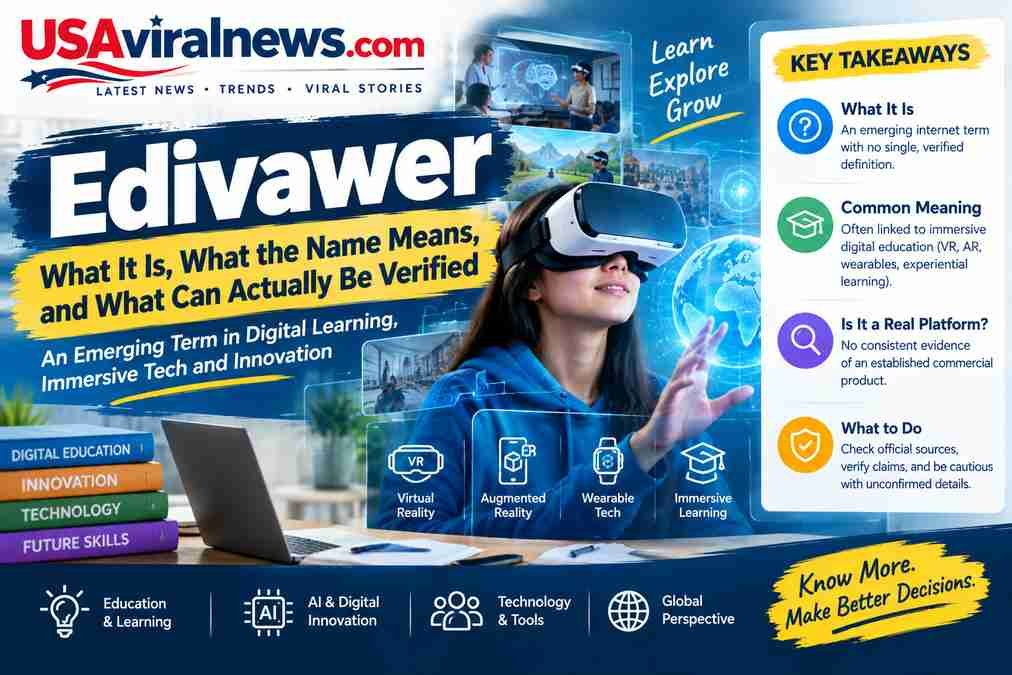
If you searched for Edivawer expecting to find a clearly established app, company, or education platform, the online results can be confusing. Different websites describe it as an immersive learning platform, an AI education system, a digital transformation framework, a productivity tool, or even a general philosophy of innovation.
The strongest conclusion from the available evidence is more cautious: Edivawer is an emerging internet term with no consistently established definition or clearly verifiable commercial product behind it. A widely circulated presentation associates the name with immersive education involving digital learning, virtual reality, augmented reality, wearable technology, and experiential learning. However, the presentation’s specific claims about results and institutional deployments are not independently established by the evidence currently available.
That distinction matters. The technologies often associated with Edivawer are real and increasingly studied. The question is whether those technologies actually belong to a product or framework called Edivawer.
What is Edivawer?
Edivawer is best treated as an emerging or loosely defined term rather than a verified mainstream technology product.
The most consistent technology related interpretation connects Edivawer with immersive digital education. Under that interpretation, the concept combines several ideas:
| Element | Meaning in the Edivawer concept |
| Education | Learning, teaching, and skills development |
| Digital | Computer based educational content and platforms |
| Virtual reality | Simulated environments for interactive learning |
| Augmented reality | Digital information layered onto the physical environment |
| Wearable technology | Headsets, smart glasses, sensors, and related devices |
| Experiential learning | Learning through interaction, practice, and simulation |
A SlideShare presentation titled Edivawer: Revolutionary Digital Learning Platform presents the term in this general context and describes immersive technology as a central part of the proposed system.
However, there is an important qualification. The presentation is evidence that this particular concept and description exist online. It is not sufficient evidence that Edivawer is an established commercial platform.
Other websites use the same name differently. Some describe Edivawer as a general digital transformation concept, while others present it as an AI learning platform or productivity system.
That inconsistency is itself significant.
Is Edivawer a real platform?
There is currently not enough reliable public evidence to treat Edivawer as a verified commercial platform.
Several websites describe features such as personalized learning, artificial intelligence, analytics, virtual classrooms, biometric monitoring, cloud infrastructure, API integrations, and immersive simulations. But these descriptions generally trace back to other articles or the same circulating presentation rather than independently verifiable product documentation.
A credible technology product would normally leave a stronger public footprint, such as:
- An identifiable company or organization
- Official product documentation
- Named founders or executives
- A verifiable corporate presence
- A functioning official website
- App listings where applicable
- Technical documentation
- Independent customer references
- Reputable media coverage
- Academic or institutional evidence for major research claims
The current Edivawer search landscape does not provide enough of that evidence to confidently describe the term as an established platform.
That does not prove that nobody is developing something called Edivawer. It means that the public evidence does not currently justify treating the claims as established facts.
Where did the Edivawer meaning come from?
The origin of the name is unclear.
One commonly repeated interpretation associates Edivawer with a combination of education, digital technology, virtual reality, augmented reality, wearable technology, experiential learning, and reality. That interpretation appears in material presenting Edivawer as an immersive education concept.
Other websites offer completely different interpretations. Some treat the word as an abstract concept involving adaptability and awareness, while others describe it as a digital innovation framework.
Because these definitions conflict, it would be misleading to say that Edivawer has one officially established etymology.
The safest description is therefore:
Edivawer is an internet term whose meaning depends heavily on the source using it, with immersive digital education currently being one of its most visible interpretations.
Why are so many websites describing Edivawer differently?
The search results show a striking pattern.
Multiple sites publish highly detailed explanations of Edivawer, yet they disagree about what it actually is. One article calls it an immersive learning concept. Another presents it as an educational platform. Others describe it as a digital transformation philosophy, productivity solution, or broad technology framework.
This creates an important problem for readers.
Once a newly coined term appears online, subsequent articles can repeat an earlier description without independently verifying its origin. After enough repetition, an invented or speculative description can begin to look like an established fact.
That is why the number of websites discussing Edivawer should not be confused with evidence that Edivawer is an established technology.
Search visibility demonstrates that people are publishing about the term. It does not establish that a company, product, study, or technology exists.
What does the Edivawer concept supposedly include?
The immersive learning interpretation of Edivawer typically combines several technologies.
Virtual reality
Virtual reality places a learner inside a simulated environment.
Instead of reading about an engineering system, for example, a learner could potentially enter a simulated environment and interact with components. In medical education, similar approaches allow students to rehearse procedures and scenarios without immediately requiring access to a real patient.
Research supports the broader educational potential of VR, although results vary by subject, implementation, learning objective, and study design.
A systematic review and meta analysis of VR in teacher education found a moderate overall positive effect, while also finding that outcomes varied according to factors such as immersion level, equipment, and learning objectives.
Augmented reality
Augmented reality differs from VR because it adds digital information to the user’s physical surroundings.
For example, a learner examining a machine could potentially see labels, instructions, diagrams, or contextual information overlaid on the equipment.
The educational value comes from connecting information with the physical object rather than simply presenting the information on a separate screen.
Wearable technology
Wearables can include head mounted displays, smart glasses, motion sensors, and other devices.
In an educational context, these technologies can support interaction with simulated environments or collect information about how a learner interacts with a training system.
But claims about biometric monitoring deserve particular caution. The existence of a technology capable of collecting a measurement does not establish that a particular product collects it, nor that the resulting measurement reliably represents attention, engagement, or learning.
Experiential learning
Experiential learning is the most important underlying idea because it explains why immersive technology could be useful.
Instead of merely receiving information, learners can potentially:
- Observe a situation.
- Interact with it.
- Make decisions.
- Experience consequences.
- Repeat the exercise.
- Reflect on the result.
That approach is particularly attractive for subjects where practice is difficult, expensive, dangerous, or impossible to reproduce frequently in the physical world.
Does research support the technology behind Edivawer?
Yes, research supports parts of the broader technology concept. It does not establish the specific claims made about Edivawer itself.
This distinction is essential.
For example, a systematic review of VR in health professions education analyzed 31 studies involving 2,407 participants. The meta analysis found that VR produced a small improvement in post intervention knowledge compared with traditional learning, although the certainty varied depending on the comparison and evidence base.
Research in nursing education has also found positive effects in some circumstances. A systematic review and meta analysis of randomized trials reported a small to medium improvement in knowledge from VR training, while concluding that VR was best regarded as a supplement to conventional teaching rather than a universal replacement.
More recent evidence remains encouraging but nuanced. A 2026 systematic review and meta analysis involving 20 randomized controlled trials and 2,063 nursing students found improvements in knowledge acquisition and self efficacy from immersive VR simulation, while evidence for skill performance and several other outcomes remained inconclusive.
So the evidence supports a reasonable statement:
Immersive technologies can improve some learning outcomes under appropriate conditions.
It does not support the stronger statement:
Edivawer has been proven to produce specific dramatic improvements in learning.
Those are different claims.
What about the famous 340 percent retention claim?
One of the most frequently repeated Edivawer claims is a 340 percent improvement in content retention after 30 days.
That figure appears in the Edivawer SlideShare presentation, alongside other claimed results such as faster problem solving, higher completion rates, and improvements at named educational institutions.
The problem is evidence quality.
The presentation attributes the figures to a “UC Educational Technology Institute Study,” but the available material does not provide enough information to independently establish the study’s methodology, participants, statistical analysis, publication record, or peer reviewed status. Other websites repeat the same numbers, but repetition does not provide independent confirmation.
Therefore, the 340 percent figure should be described as a reported claim, not as an established scientific finding.
That distinction is especially important because percentage improvements can also be misleading without knowing the underlying measurement.
For example, an increase from 1 unit to 4.4 units can technically represent a 340 percent increase, but that does not tell you whether the practical improvement was large, whether the measurement was reliable, or whether the result would generalize to another group.
Can Edivawer be compared with established learning platforms?
Not responsibly as though they were equivalent products.
Platforms such as learning management systems have identifiable providers, documented features, established user bases, and publicly available product information.
Edivawer does not currently have the same level of verifiable public identity.
The more useful comparison is between the idea associated with Edivawer and conventional digital learning.
| Learning approach | Main strength | Main limitation |
| Text and documents | Efficient for detailed information | Limited practical simulation |
| Video learning | Demonstrates processes clearly | Usually passive |
| Standard online courses | Structured and scalable | Interaction can remain limited |
| Virtual reality | Immersive practice and simulation | Hardware and development requirements |
| Augmented reality | Connects digital information with physical objects | Device and content constraints |
| Experiential simulation | Allows practice and decision making | Can require substantial design effort |
This comparison also reveals why immersive learning should not automatically replace conventional education.
A two minute explanation may be better delivered through text or video than through a headset. A complex physical procedure may benefit enormously from simulation.
The best medium depends on the learning task.
What are the potential benefits of an Edivawer style approach?
If Edivawer is used as a label for immersive, interactive education, its potential advantages are largely the same as those being investigated across VR, AR, and simulation research.
Safe practice
Simulations can allow learners to practice procedures where mistakes in the real world could be costly or dangerous.
Medical training is one obvious example. Learners can rehearse scenarios repeatedly before performing comparable tasks in real settings.
Repeatable experiences
A physical training opportunity may depend on equipment, instructors, patients, locations, or timing.
A digital simulation can potentially be repeated whenever the necessary hardware and software are available.
Greater interactivity
Interactive environments allow learners to make choices rather than simply receive information.
That can be particularly valuable when the goal is procedural knowledge or decision making.
Visualization of difficult concepts
Three dimensional environments can make certain spatial or mechanical concepts easier to understand.
This can be useful in areas such as anatomy, engineering, architecture, technical maintenance, and scientific visualization.
Practice without physical consequences
A simulated environment can provide an opportunity to make mistakes and learn from them before attempting the equivalent task in reality.
That does not eliminate the need for real world practice, but it can provide an additional stage between theory and physical performance.
What are the limitations?
The limitations are just as important as the potential benefits.
Hardware can be expensive
Headsets, computers, sensors, networking equipment, and maintenance can increase the cost of an immersive learning program.
Content development takes work
Buying hardware does not automatically create good educational experiences.
A poorly designed VR lesson can simply turn an ordinary lecture into a more complicated interface.
Immersion does not guarantee learning
A visually impressive experience is not necessarily an effective lesson.
Educational design still matters. Learners need appropriate objectives, practice, feedback, assessment, and opportunities to connect the simulation with real knowledge.
Some learners may experience discomfort
VR can cause symptoms such as visual or vestibular discomfort in some users.
The 2026 nursing meta analysis found that adverse effects associated with immersive VR were generally mild and primarily involved visual and vestibular symptoms.
Evidence varies by subject
The effectiveness of immersive learning is not identical across every educational setting.
A technology can work well for procedural training while offering little advantage for a subject where reading, discussion, or conventional instruction is already highly effective.
Accessibility matters
A learning system that requires specialized hardware may create barriers for learners who cannot use that equipment comfortably or affordably.
For that reason, accessibility should be considered during instructional design rather than treated as an afterthought.
Should you trust websites claiming Edivawer has specific features?
Only after checking where the claim originated.
Be particularly cautious when an article claims that Edivawer has:
- A specific subscription price
- A named corporate headquarters
- A particular founder
- Proprietary AI technology
- Biometric monitoring
- Guaranteed learning improvements
- Major institutional customers
- Specific security certifications
- A particular number of users
- API integrations
- A mobile application
These are verifiable claims. A trustworthy article should be able to point to appropriate evidence.
A general article saying that “Edivawer uses biometric AI” is not evidence that such a system actually exists.
How can you verify whether Edivawer becomes a real product?
If a company eventually launches an Edivawer product, verification should become much easier.
Look for several independent signals rather than relying on one website.
1. Find the official organization
There should be an identifiable organization responsible for the product.
2. Check product documentation
A genuine technology platform should eventually have documentation explaining what it does and how it works.
3. Verify major claims independently
If an article says a university uses the platform, check whether the university itself confirms the relationship.
If a company claims a particular performance improvement, look for the underlying study or a credible independent evaluation.
4. Look for independent coverage
Reputable technology, education, academic, or business publications can provide useful confirmation.
5. Distinguish repetition from corroboration
Ten websites repeating the same paragraph may represent one original claim rather than ten independent sources.
This is one of the most important lessons from the Edivawer search results.
What does Edivawer mean in 2026?
As of 2026, Edivawer does not have one sufficiently established meaning to justify treating it as a standard technical term.
Its most substantial technology related interpretation connects it with immersive digital education and a combination of VR, AR, wearable technology, digital learning, and experiential learning.
At the same time, other websites use the name for unrelated conceptual ideas.
That makes “Edivawer” fundamentally different from established terms such as virtual reality, augmented reality, immersive learning, or learning management system.
Those established terms have recognizable definitions and substantial bodies of research behind them.
Edivawer currently has neither a stable definition nor comparable independent evidence.
Is Edivawer fake?
Calling it simply “fake” goes further than the evidence allows.
A better conclusion is that the specific commercial and performance claims surrounding Edivawer are not adequately verified.
There is clearly a real online presentation using the name and describing a proposed immersive education platform. There are also numerous websites discussing the concept.
What has not been adequately established is whether those descriptions correspond to a functioning, independently verified commercial product.
Likewise, the reported performance statistics should not be treated as scientific facts without accessible evidence supporting them.
The broader technologies are a different matter. Research continues to find useful applications for VR, AR, and immersive simulation in education, while also identifying limitations and areas where stronger evidence is needed.
Frequently asked questions
What is Edivawer?
Edivawer is an emerging and inconsistently defined internet term. Its strongest technology related interpretation describes an immersive digital learning concept combining education with VR, AR, wearable technology, and experiential learning.
Is Edivawer an established company?
There is not enough publicly verifiable evidence to confidently identify Edivawer as an established technology company or commercial platform.
Is Edivawer an AI learning platform?
Some websites describe it that way, but those descriptions are not sufficient evidence that a verified AI platform called Edivawer exists.
Does Edivawer really improve retention by 340 percent?
A 340 percent improvement is reported in an online Edivawer presentation, but the available evidence does not independently verify the underlying study or result. It should therefore be treated as a reported claim rather than an established scientific finding.
Is immersive learning itself supported by research?
Yes. Research on VR and immersive learning has found positive effects in several educational contexts, although results vary by subject, implementation, learner group, and outcome being measured.
Should schools or businesses invest in Edivawer?
Not on the basis of online claims alone. Before committing money or sensitive data, an organization should verify the provider, product, documentation, security practices, pricing, customer references, and independent evidence.
Why does Edivawer have so many different definitions?
The term appears across websites that use it for different purposes. Some connect it with immersive education, while others use it as a broader conceptual label. The lack of a clearly established official definition allows different interpretations to spread.
The bottom line
Edivawer is best approached as an emerging, poorly defined term rather than a proven commercial technology.
The most credible technology related interpretation is an immersive learning concept built around digital education, virtual reality, augmented reality, wearable technology, and experiential learning. That general direction is technologically plausible and supported in part by research into immersive education.
What remains unverified are the stronger claims frequently attached to the Edivawer name, particularly claims about a specific commercial platform, institutional deployments, proprietary features, and dramatic performance improvements.
The most useful way to understand Edivawer, therefore, is to separate the real technology from the unverified branding.
VR, AR, simulation, adaptive learning, and experiential education are genuine fields with substantial research behind them. Edivawer is a label appearing around some of those ideas, but the label itself has not yet acquired the clear identity, evidence base, and independently verifiable product history that would justify treating it as an established technology.
You may also read:Diedra Wayans