
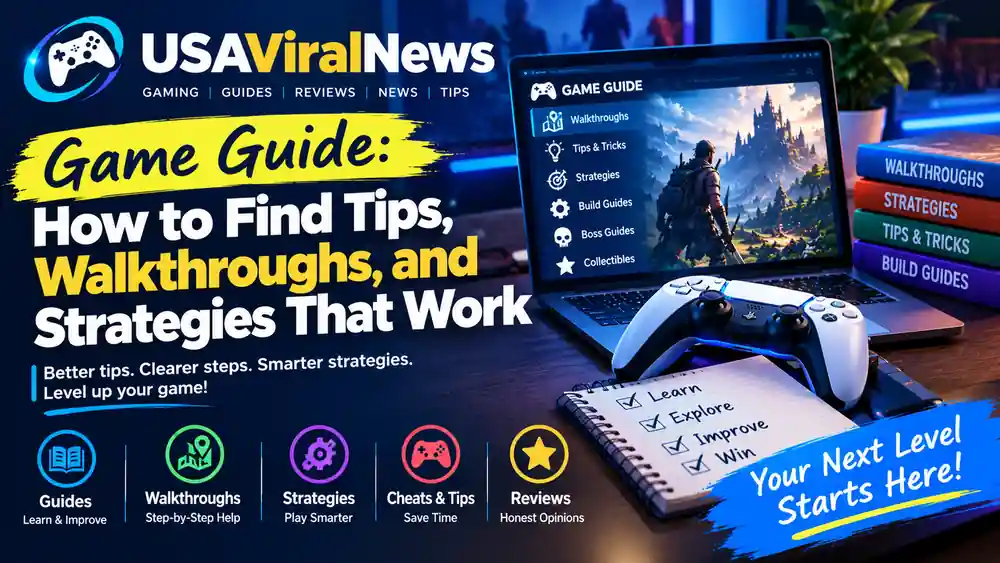
A game guide helps players understand a game, overcome difficult challenges, discover hidden content, and make better decisions while playing. It can be a short explanation of one puzzle, a step-by-step walkthrough of an entire campaign, or a detailed strategy for improving a character build in a competitive game.
The most useful game guide does more than tell you which button to press. It explains what to do, why the approach works, and when you might need to adapt it. Finding the right guide can save time, reduce frustration, and help you enjoy more of a game without removing the satisfaction of figuring things out yourself.
What Is a Game Guide?
A game guide is a collection of instructions, explanations, tips, or strategies designed to help someone play a video game more effectively. Guides may cover a single problem or an entire game, depending on the player’s needs.
Common examples include:
- A walkthrough that explains how to complete a mission.
- A boss guide that identifies attack patterns and useful tactics.
- A beginner’s guide that explains controls, mechanics, and progression.
- A build guide that recommends skills, equipment, or character attributes.
- A collectibles guide that helps locate hidden items and optional objectives.
- A troubleshooting guide that addresses crashes, connection problems, or other technical issues.
Guides can be published by gaming websites, game developers, independent writers, or players in community forums. Steam, for example, allows users to create guides for games and software in their libraries and makes those guides available through its community features.
The important distinction is that a guide should help you accomplish a specific goal. A long article is not necessarily better than a short one if both answer your question equally well.
Types of Game Guides and When to Use Them
Different gaming problems require different kinds of help. Choosing the right format makes it easier to find an answer without reading information you do not need.
| Guide type | What it helps you do | Best time to use it |
| Beginner’s guide | Learn basic controls, mechanics, and systems | When starting a new game |
| Walkthrough | Progress through missions, chapters, or quests | When you are stuck or want a structured route |
| Strategy guide | Improve decisions, tactics, and resource management | When challenges require planning |
| Boss guide | Understand attacks, weaknesses, and openings | Before a difficult encounter |
| Build guide | Choose skills, weapons, equipment, or attributes | When developing a character |
| Collectibles guide | Find hidden items, secrets, and optional rewards | When exploring or completing achievements |
| Puzzle guide | Solve riddles, mechanisms, and environmental challenges | When a puzzle blocks your progress |
| Troubleshooting guide | Diagnose technical or performance problems | When the game does not work as expected |
Some guides combine several formats. A complete role-playing game guide, for instance, might include a main-story walkthrough, side quests, character builds, equipment recommendations, and collectible locations.
How to Find a Reliable Game Guide
The fastest way to find useful gaming advice is to search for the exact problem you want to solve instead of using a broad phrase such as “game tips.”
1. Search using the game title and your problem
Combine the game’s name with a specific question or objective.
For example, searches such as these are more precise than a general search for gaming help:
- [Game name] beginner tips
- [Game name] boss strategy
- [Game name] quest walkthrough
- [Game name] best early game weapons
- [Game name] save file problem
Specific searches tend to lead you toward content that addresses your immediate need. They also make it easier to compare different explanations of the same problem.
2. Match the guide to your platform and version
A guide written for PC may use keyboard shortcuts that do not apply to PlayStation, Xbox, or Nintendo Switch. Mobile editions can also have different controls or features.
Updates matter, too. A strategy that worked before a balance patch might no longer be effective. Before following detailed instructions, check whether the guide identifies its platform, edition, or relevant game version.
3. Check the evidence behind the advice
Look for concrete explanations rather than unsupported claims.
A useful boss guide should explain attack patterns, timing, positioning, or weaknesses. A build guide should explain why its recommended equipment and skills work together. A troubleshooting article should distinguish likely causes and provide steps that can help isolate the problem.
If a recommendation offers no reasoning, compare it with another source before committing significant time or in-game resources.
4. Compare sources when the stakes are higher
Different sources serve different purposes. Official documentation is often the best starting point for game mechanics, patch changes, account issues, and technical support. Independent guides can provide strategies and explanations that official material does not cover in depth. Community discussions can help reveal unusual problems or alternative approaches.
A useful combination is to check the official source for factual details and then consult experienced players or independent guides for practical techniques.
How to Use a Walkthrough Without Spoiling the Game
A walkthrough can help you get past a difficult section, but reading too much at once may reveal story events, puzzle solutions, or hidden surprises.
Try a limited-help approach:
- Identify the obstacle. Decide whether you need help with a puzzle, a boss, a location, or a progression requirement.
- Read only the relevant section. Avoid opening the complete story walkthrough if you want to preserve surprises.
- Try the suggested approach. Give the instructions a chance before searching for another solution.
- Return for more help if necessary. If the first method fails, check whether the guide assumes a particular item, skill, difficulty setting, or game version.
For story-focused games, look for guides that clearly separate hints from full solutions or label major spoilers. For open-world games, a location-specific guide can be more useful than a strict step-by-step route because exploration is often part of the experience.
Game Strategy Guides: Improve Instead of Just Progressing
A walkthrough tells you how to move forward. A strategy guide helps you understand how to make better choices.
The distinction matters in games where several approaches can succeed, such as tactical role-playing games, survival games, action games, and competitive multiplayer titles.
Learn the underlying mechanics
Instead of memorizing a single winning sequence, understand the system behind it.
For example, if an enemy repeatedly defeats you, the solution may not be to deal more damage. You may need to recognize its attack animation, manage stamina, change your positioning, or wait for a recovery window.
Understanding the mechanic makes the advice useful in future encounters, too.
Evaluate builds based on your playstyle
A recommended character build should fit the way you play and the challenges you face.
- Offensive builds can defeat enemies quickly but may leave fewer resources for defense.
- Defensive builds can improve survival but may make encounters slower.
- Balanced builds offer flexibility but may not maximize one particular strength.
These are general tradeoffs, not universal rules. The best option depends on the game’s systems, available equipment, difficulty level, and your preferences.
Treat tier lists as starting points
Tier lists rank characters, weapons, teams, or equipment by perceived effectiveness. They can be useful in competitive games, but a ranking is not a complete strategy.
A high-ranked character might require advanced execution or equipment you do not own. A lower-ranked option may work better for your experience level or preferred role. Check the assumptions behind a ranking before treating it as a personal recommendation.
Where Can You Find Game Guides?
Several established resources provide different forms of gaming assistance.
GameSpot
Publishes game guides, walkthroughs, and dedicated guide hubs for individual titles. It is a useful starting point for mission instructions, item locations, and game-specific questions.
GameSpot
+1
Gamer Guides
Offers walkthroughs, interactive maps, databases, videos, and other reference material. Its format can be particularly helpful when you need to track locations, items, or multiple objectives.
Steam Community Guides
Provides community-created guides through Steam’s game and software hubs. These can be valuable for game-specific strategies, settings, and player discoveries. Quality and update frequency depend on the individual contributor.
These resources are examples rather than a definitive ranking. Availability, coverage, and guide quality differ by game. If one website lacks a detailed answer, search the game’s official support pages or relevant community resources.
Common Mistakes to Avoid When Following Game Guides
Even a detailed guide can lead you in the wrong direction if you overlook its assumptions.
Following outdated instructions. Check for updates when a strategy depends on balance, item locations, redeem codes, or recently changed mechanics.
Ignoring prerequisites. A walkthrough may assume that you already own an item, have unlocked a skill, or completed an earlier quest.
Copying a build without understanding it. Equipment combinations often depend on specific attributes, abilities, or playstyles. If you copy only the item list, you may miss the reason it works.
Trusting every community post. Player contributions can be valuable, but they may include speculation, personal preference, or information that applies only to a particular version.
Reading too far ahead. A complete walkthrough may reveal secrets or story developments that you would rather discover yourself.
The most effective approach is to use guides as tools for solving a problem, not as instructions you must follow from beginning to end.
Frequently Asked Questions
What is the difference between a game guide and a walkthrough?
A game guide can cover any aspect of playing a game, including strategies, builds, mechanics, collectibles, and troubleshooting. A walkthrough usually provides a sequence of steps for progressing through missions, chapters, or objectives.
Are online game guides free?
Many online guides are available without payment, including community-created resources and articles on gaming websites. Some services offer paid memberships or additional features, so check the terms of the particular resource.
Should beginners use game guides?
Yes, especially when a game has complicated controls, unexplained mechanics, or a steep learning curve. Beginners can start with basic tips and consult detailed walkthroughs only when they encounter a specific obstacle.
How do I know whether a game guide is up to date?
Check its publication or revision date, the game version it covers, and whether its recommendations match the current mechanics. For recent changes, compare the information with official patch notes or developer announcements.
Can I use the same guide on PC and console?
Sometimes. General strategies may apply across platforms, but controls, performance, available features, and interface instructions can differ. Choose a guide that matches your platform when those details matter.
Final Thoughts
A good game guide gives you the right amount of help at the right time. Use beginner guides to learn unfamiliar systems, walkthroughs to overcome specific obstacles, and strategy guides to understand the decisions that improve your performance.
Start with a precise search, check that the information matches your game version, and favor explanations that show why a tactic works. That way, you can solve problems more efficiently while keeping the discovery, challenge, and enjoyment that make games worth playing in the first place.
You may also read: ThinkOfGames