
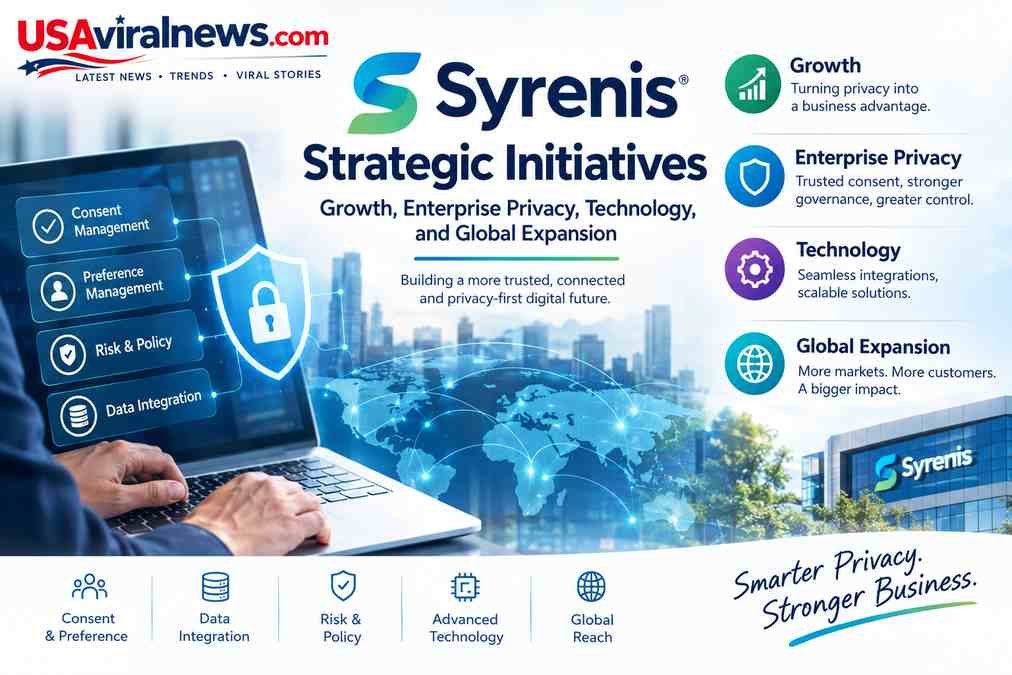
Syrenis strategic initiatives” is best understood as a description of the company’s current strategic direction, not the official name of a single product or program. Syrenis is positioning itself as an enterprise privacy technology platform focused on consent and preference management, with its broader strategy extending into privacy governance, data integration, international expansion, and the operational use of trusted customer permission data.
The clearest way to understand that strategy is to look at what Syrenis has changed, what it is building, where it is expanding, and how those pieces fit together.
What are Syrenis strategic initiatives?
Syrenis’s current strategic direction centers on a shift from being viewed primarily as a consent or compliance tool toward operating as a broader enterprise privacy platform.
The company describes its platform through four connected areas:
- Consent Management
- Preference Management
- Risk and Policy
- Data Management and Integration
Together, these areas are designed to help large organizations capture customer choices, connect those choices to the right identities, synchronize them across systems, manage privacy obligations, and apply the resulting permissions consistently throughout the enterprise.
That distinction matters. For a small website, consent management can look like a cookie banner. For a global enterprise, the harder problem is what happens after the customer makes a choice.
A customer may interact with a website, mobile application, CRM, marketing platform, customer service system, analytics platform, and other data environments. If those systems do not share an accurate view of the customer’s permissions, the organization can end up with inconsistent records and inconsistent behavior.
Syrenis is building its strategy around solving that larger operational problem.
1. Repositioning Syrenis as an enterprise privacy platform
One of the most visible strategic initiatives is the company’s repositioning.
In April 2026, Syrenis announced a major brand refresh and retired its legacy product names in favor of a unified Syrenis identity. The company said the change reflected its evolution from a compliance tool toward an enterprise platform designed for organizations dealing with jurisdictional complexity, multiple brands, and large scale data governance.
This is more than a branding exercise.
It changes the commercial story Syrenis is telling prospective customers. Instead of presenting consent as an isolated compliance function, the company is positioning privacy infrastructure as something that connects legal requirements, customer experience, data governance, and business growth.
Its current messaging emphasizes a simple model: capture customer choices, connect those choices across systems, and enable organizations to act on trusted preference data.
The strategic implication is that Syrenis wants to compete for a larger enterprise problem rather than only the narrow problem of website consent.
2. Expanding internationally, particularly in the United States
International growth is another major part of Syrenis’s current direction.
The company says that under CEO Adam Binks, who became CEO in February 2025, it has expanded its international footprint and launched US operations. Syrenis now lists an Atlanta office alongside its North American headquarters and European presence.
The US expansion fits naturally with the company’s enterprise strategy.
Privacy requirements in the United States are becoming increasingly complex because organizations may need to account for different state laws, consumer rights, data categories, and operational requirements. Syrenis’s own 2026 privacy material highlights the growing complexity of state privacy legislation and the importance of turning privacy requirements into operational processes rather than treating them as static policies.
For Syrenis, establishing a stronger US presence therefore serves two purposes:
- It expands access to a large enterprise technology market.
- It places the company closer to organizations facing increasingly complex privacy requirements.
The company’s brand relaunch specifically connected its unified positioning with its international growth strategy across the US, UK, and Europe.
3. Building consent and preference management into one connected model
Another important initiative is the convergence of consent and preference management.
Consent and preferences are related, but they are not identical.
Consent generally concerns permission for a particular type of data processing. Preferences can cover broader customer choices, such as communication channels, frequency, content, or other ways a customer wants an organization to interact with them.
Syrenis increasingly presents the two as part of one connected customer choice record. Its recent material describes a situation where a customer can make different choices across a website, application, email, and SMS channel, creating fragmented records if those systems operate independently.
The strategic opportunity is straightforward: customer choices become more useful when an enterprise can understand and honor them consistently.
That makes preference management less of a marketing convenience and more of a data governance capability.
4. Turning privacy data into connected enterprise infrastructure
Syrenis is also putting substantial emphasis on integrations and data movement.
Its current platform offers more than 350 integrations and supports APIs, connectors, data exports, and system mapping. The objective is to allow consent and preference information to move between the systems an enterprise already uses rather than keeping privacy information isolated inside one application.
This is one of the most consequential aspects of the company’s strategy.
Consider a simplified example. A customer changes a marketing preference. Recording that change is only the beginning. The organization may also need the change to reach its CRM, marketing technology, customer service environment, analytics systems, and other downstream applications.
Syrenis describes real time synchronization as a way of keeping connected systems aligned with current consent and preference information. Its APIs are intended to let organizations capture, update, and apply privacy information across websites, applications, and internal systems.
In other words, Syrenis is positioning privacy data as an operational layer that needs to travel through the enterprise.
5. Expanding beyond consent into risk and policy management
Syrenis’s strategic direction also extends beyond capturing customer permissions.
Its Risk and Policy offering is designed around privacy risk, processing activities, policy obligations, privacy notices, and data subject rights. The company describes capabilities including risk assessments, processing records, policy mapping, notice management, rights request workflows, and compliance monitoring.
This broadens the platform’s potential role within a privacy department.
A consent platform primarily answers questions such as:
- What did the customer agree to?
- When was that choice made?
- Where should the choice be applied?
A broader privacy governance platform also needs to address questions such as:
- What personal data is being processed?
- What privacy risks exist?
- Which policies apply?
- How are privacy rights requests handled?
- Can the organization demonstrate what happened?
Syrenis’s expansion into these areas suggests that the company wants its platform to support both the customer choice layer and the governance processes surrounding it.
6. Making enterprise integration a competitive differentiator
Integration is not simply a technical feature in Syrenis’s strategy. It appears to be one of the areas where the company wants to differentiate itself.
The company emphasizes more than 350 integrations, configurable data mapping, APIs, synchronization, connectors, and support for legacy environments.
That focus reflects a real enterprise constraint.
Large organizations rarely operate on one clean technology stack. They accumulate systems through acquisitions, regional deployments, technology changes, and years of operational decisions. A privacy platform that works well only when every surrounding system is modern and standardized has limited practical value.
Syrenis therefore emphasizes the ability to connect privacy data to existing architectures.
The strategic value is not simply “more integrations.” It is the possibility of reducing the gap between a privacy decision and the systems that must actually enforce it.
7. Positioning privacy as a driver of growth
Perhaps the most important change in Syrenis’s strategic narrative is its treatment of privacy as something more than a compliance cost.
The company repeatedly describes privacy, consent, and customer choice as foundations for trust, personalization, better customer experiences, and sustainable growth. Its current positioning explicitly frames compliance as something that can support business value rather than simply restrict activity.
The reasoning is straightforward.
If a business knows what customers have consented to and what they prefer, it can make more informed decisions about how customer data is used. If those choices are accurate and consistently enforced, the business can also reduce the operational risk associated with using data incorrectly.
This creates a three way relationship:
better customer control → more reliable permission data → more confident use of customer data
That is considerably broader than the traditional cookie management model.
8. Preparing for increasingly complex privacy and AI requirements
AI is another emerging factor in Syrenis’s strategic direction, although it is important not to confuse an emerging market theme with a formally announced standalone AI initiative.
Syrenis’s 2026 privacy material increasingly connects privacy operations with AI governance and responsible use of customer data. Its privacy playbook discusses the question of who owns privacy and AI governance and emphasizes the need for clear accountability across leadership, business, privacy, legal, security, and IT functions.
This is strategically significant because AI increases the importance of knowing what data an organization can legitimately use.
An organization may possess enormous quantities of customer information, but possession does not automatically answer whether that information can be used for a particular purpose.
Reliable consent, preference, identity, and governance records can therefore become part of the infrastructure supporting responsible data use.
Syrenis’s strategy appears increasingly aligned with that broader problem: making privacy decisions understandable, auditable, connected, and operational across enterprise systems.
9. Strengthening partnerships and enterprise delivery
Syrenis is also developing a partner oriented growth model.
Its partner proposition includes revenue sharing, sales enablement, technical training, certification, demo access, co branded marketing, and joint go to market planning. The company has also created dedicated material around its relationship with KPMG, positioning implementation partners as a route to additional customer value and revenue opportunities.
This matters because enterprise privacy technology often requires more than software.
Large deployments can involve legal teams, privacy specialists, marketing, engineering, IT, data teams, customer service, and regional stakeholders. Partners can provide implementation expertise, consulting, integration support, and organizational change capabilities.
A stronger partner ecosystem can therefore help Syrenis scale without relying entirely on direct delivery.
10. Focusing on complex enterprise use cases
Syrenis’s strategic direction is particularly visible in the types of organizations and problems it highlights.
Its platform is positioned for sectors including automotive, energy and utilities, financial services, healthcare and pharmaceuticals, life sciences, legal services, media, retail, and ecommerce.
These sectors share an important characteristic: customer or user data often moves through complicated environments.
For example, Syrenis describes an automotive deployment involving consent for connected vehicle data across a very large global customer base, including situations where one person may be associated with multiple vehicles. It also describes a life sciences deployment involving more than 100 countries, multiple languages, and different regulatory requirements.
These examples illustrate where the company’s enterprise strategy has practical relevance.
The problem is not simply collecting consent. It is maintaining accurate relationships between people, systems, purposes, jurisdictions, and changing customer choices.
What Syrenis is ultimately trying to build
Taken together, the initiatives point toward a broader strategic model.
Syrenis wants privacy information to behave less like an isolated compliance record and more like connected enterprise infrastructure.
The basic architecture can be understood as:
Capture → identify → govern → synchronize → enforce → audit
A customer makes a choice. Syrenis captures it. The choice is connected to the appropriate identity or relationship. Governance rules determine how it should be treated. The information is synchronized with connected systems. Those systems act on the current choice. The organization retains an auditable record of what happened.
That model explains why the company is investing simultaneously in consent, preferences, identity, integrations, APIs, risk, policy, privacy rights, and international expansion. These are not entirely separate initiatives. They reinforce the same underlying objective: making customer choice reliable across a complicated enterprise environment.
Syrenis strategic initiatives at a glance
| Strategic area | What Syrenis is doing | Why it matters |
| Enterprise repositioning | Consolidating its identity around the Syrenis platform | Moves the company beyond a narrow compliance tool narrative |
| US expansion | Building a stronger North American operation, including Atlanta | Supports international enterprise growth |
| Consent management | Centralizing and enforcing consent across systems and jurisdictions | Creates a more reliable foundation for compliant data use |
| Preference management | Connecting customer communication and data use choices | Gives organizations a broader view of customer preferences |
| Data integration | Providing APIs, connectors, exports, mapping, and 350+ integrations | Helps privacy decisions reach operational systems |
| Risk and policy | Expanding into risk, notices, rights requests, and governance | Extends the platform’s role within privacy operations |
| Partner ecosystem | Supporting implementation and go to market partners | Creates additional routes to enterprise customers |
| Privacy and growth | Positioning trusted customer choice as a business asset | Connects compliance with customer experience and data value |
| AI readiness | Addressing privacy and governance questions surrounding AI data use | Helps organizations establish clearer boundaries for responsible data use |
What these initiatives mean for Syrenis’s future
The strategic direction suggests that Syrenis is trying to win on depth in enterprise consent and connected privacy operations, rather than simply competing on the visibility of a cookie banner.
That distinction could become increasingly important as enterprises deal with more jurisdictions, more customer touchpoints, more technology systems, and greater pressure to demonstrate exactly how customer data is being used.
The company’s own product architecture supports that interpretation. Consent management remains central, but it is increasingly surrounded by preference management, risk and policy controls, data integration, identity capabilities, and operational workflows.
The biggest strategic challenge will be execution.
Expanding internationally, broadening the product platform, supporting complex integrations, maintaining regulatory adaptability, and building a larger partner ecosystem all increase operational complexity. Syrenis will need to demonstrate that its broader platform strategy delivers measurable value without making implementation and governance harder for the very enterprises it is targeting.
For customers, the practical question is therefore not simply whether Syrenis offers consent management. It is whether the platform can become a dependable operating layer for customer permissions across a complicated technology environment.
That is the central idea behind Syrenis’s current strategic initiatives: turning consent and preference data from an isolated compliance record into connected, governed enterprise infrastructure that supports trust, responsible data use, and growth.
You may also read:adstotally