
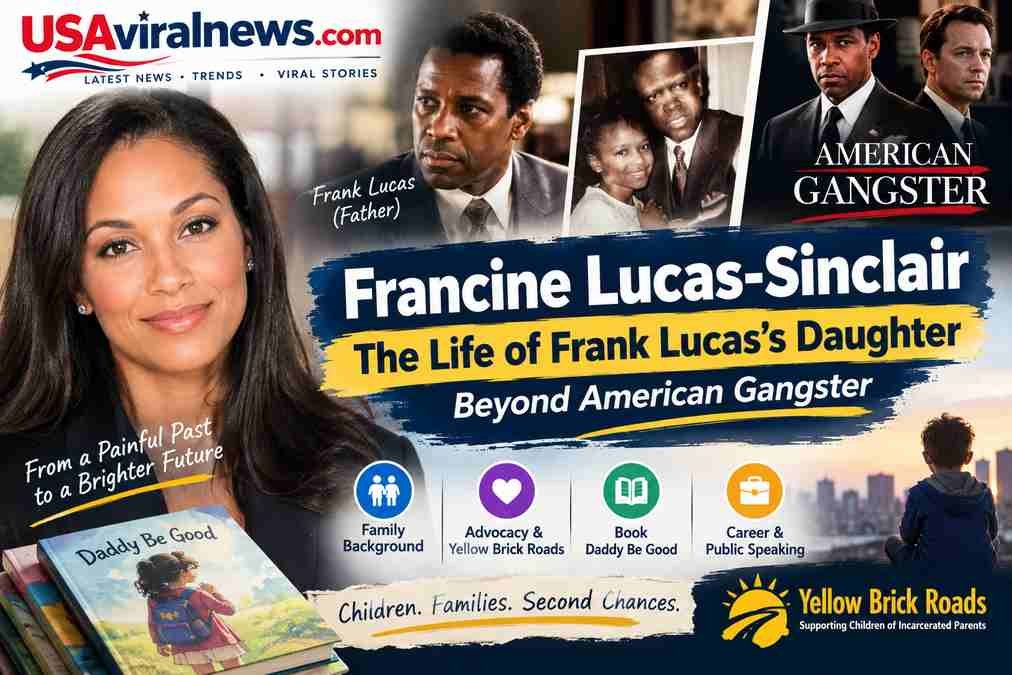
Francine Lucas-Sinclair is best known as the daughter of Frank Lucas, the Harlem heroin trafficker whose life became the basis for the 2007 film American Gangster. But reducing her story to her father’s criminal reputation misses the part of her life that became most meaningful: her work to support children whose parents are incarcerated.
Lucas-Sinclair grew up surrounded by extraordinary wealth, criminal activity, parental incarceration, and eventually intense public attention. She later used those experiences to establish Yellow Brick Roads, an organization focused on children affected by parental imprisonment. She has also spoken publicly about her childhood and authored the children’s book Daddy Be Good.
Who is Francine Lucas-Sinclair?
Francine Lucas-Sinclair is an American advocate and public speaker who became known publicly because of her connection to Frank Lucas. She is the daughter of Frank Lucas and Julianna Farrait, and her childhood was profoundly affected by her parents’ involvement in the drug trade and subsequent imprisonment.
Unlike her father, whose public identity is tied primarily to organized crime, Lucas-Sinclair has spent much of her public life addressing the consequences that incarceration can have on children and families.
Her story became particularly visible around the release of American Gangster in 2007. Rather than simply embracing the notoriety surrounding her father’s name, she used the renewed attention to discuss an issue that was personal to her: what happens to children when a parent disappears into the criminal justice system.
Francine Lucas-Sinclair at a glance
| Detail | What is reliably reported |
| Full name | Francine Lucas-Sinclair |
| Known for | Advocacy concerning children of incarcerated parents |
| Father | Frank Lucas |
| Mother | Julianna Farrait |
| Organization | Yellow Brick Roads |
| Book | Daddy Be Good |
| Public work | Speaking about her childhood and incarceration’s effect on families |
| Profession reported in earlier profiles | Mortgage broker |
| Husband | Mark Sinclair, according to contemporary profiles |
| Public birth date | Not reliably established by strong sources |
A number of websites publish an exact birth year, age, net worth, height, and other personal details about Lucas-Sinclair. Those figures are frequently repeated online, but they are not supported by sufficiently reliable primary or major biographical sources. They should therefore not be treated as established facts.
Her childhood with Frank Lucas
Lucas-Sinclair’s childhood was dramatically different from an ordinary family upbringing.
A 2007 Glamour profile described her as a young child living in a wealthy New Jersey household while her father operated his drug business. She remembered expensive toys, designer clothing, and large amounts of cash around the family home, while she had little understanding of where the money came from.
That life changed when law enforcement raided the family home in 1975.
Lucas-Sinclair was only a young child when her father’s criminal operation collapsed. Her mother, Julianna Farrait, also became involved in the resulting legal proceedings and served time in prison. Lucas-Sinclair consequently spent part of her childhood being raised by her grandparents.
The important point is that incarceration did not affect only Frank Lucas and his wife. It reshaped the childhood of their daughter.
That distinction later became central to Lucas-Sinclair’s work.
What happened to Francine Lucas-Sinclair’s parents?
Her father, Frank Lucas, was a major heroin trafficker who operated in Harlem during the 1960s and 1970s. He was arrested in 1975 and ultimately received a lengthy prison sentence. After cooperating with authorities, his sentence was reduced, and he was released in 1981. He later returned to prison after another drug-related conviction and was eventually released in 1991.
His wife, Julianna Farrait, also faced imprisonment connected to drug activity. Contemporary accounts describe the effect of both parents’ incarceration on Francine’s childhood.
Frank Lucas died on May 30, 2019, at the age of 88, in Cedar Grove, New Jersey.
The family’s history later received another layer of public attention through American Gangster, which dramatized Frank Lucas’s life.
Francine Lucas-Sinclair and American Gangster
Ridley Scott’s American Gangster, released in 2007, stars Denzel Washington as Frank Lucas and Russell Crowe as Richie Roberts.
The film brought considerable renewed attention to the Lucas family. For Francine, however, the publicity was complicated.
She had spent decades keeping her family’s history private. In her 2007 interview with Glamour, she described the emotional difficulty of having her father’s criminal past suddenly become public entertainment and conversation.
That publicity eventually gave her an opportunity to discuss something broader than her father’s biography.
She began speaking about children who, like her, had to cope with an incarcerated parent.
This is an important distinction when understanding her public identity. She is not primarily known because she participated in her father’s criminal enterprise. She became publicly visible because she experienced its consequences as a child and subsequently chose to talk about them.
Why did Francine Lucas-Sinclair create Yellow Brick Roads?
Lucas-Sinclair founded Yellow Brick Roads to support children with incarcerated parents.
The organization was described as a nonprofit initiative intended to give affected children a safe environment in which they could express their feelings, receive guidance and develop practical and academic skills.
Her motivation was personal.
Lucas-Sinclair had experienced the sudden absence of her parents herself. Contemporary reporting from Temple University described how she spent part of her childhood with her grandparents while her parents were serving prison sentences. Her experience eventually influenced her decision to create a program for children facing similar circumstances.
The significance of Yellow Brick Roads is therefore less about its connection to a famous criminal and more about the perspective behind it.
Lucas-Sinclair understood that when a parent is incarcerated, the child has not committed the offense. Yet the child can still experience separation, confusion, stigma, financial disruption, instability and emotional distress.
Her organization attempted to address that often overlooked part of incarceration.
What is Daddy Be Good?
Lucas-Sinclair also wrote Daddy Be Good, a children’s book designed to help young children understand the absence of an incarcerated parent.
The book was aimed at children roughly four to seven years old and used a fictional family of bees to discuss consequences, parental absence and difficult choices in language intended to be accessible to young readers. It was co-written with British author Alison Henderson.
The idea behind the book reflects the same problem Lucas-Sinclair addressed through Yellow Brick Roads: children need an explanation they can understand when a parent suddenly disappears from their everyday life.
Instead of presenting incarceration purely as a legal issue, the book approaches it as a family and childhood issue.
That perspective is one of the most distinctive parts of Lucas-Sinclair’s public work.
What is known about Francine Lucas-Sinclair’s career?
Older profiles identify Lucas-Sinclair as a mortgage broker while also describing her work as the founder of Yellow Brick Roads and a public speaker. A 2008 account, for example, described her as living in the Atlanta area and working as a mortgage broker while developing her nonprofit work.
Her public career should therefore be understood as having more than one dimension.
| Area | Role associated with Lucas-Sinclair |
| Financial services | Mortgage broker in earlier profiles |
| Advocacy | Support for children of incarcerated parents |
| Public speaking | Personal presentations about her childhood and family history |
| Writing | Co-author of Daddy Be Good |
| Nonprofit work | Founder of Yellow Brick Roads |
Because much of the available reporting about her dates from the late 2000s, it is difficult to establish her present-day professional activities with confidence. Recent biography websites often fill this gap with unsupported claims, so those claims should be treated cautiously.
What happened to Francine Lucas-Sinclair after her father’s death?
Frank Lucas died in 2019, but Francine Lucas-Sinclair’s public identity had already developed independently of him.
Her connection to Frank Lucas remains the reason many people first encounter her name, particularly because of American Gangster. However, her own documented public work centers on the experience of growing up with incarcerated parents and helping other children dealing with similar circumstances.
There is comparatively little reliable recent reporting about her private life.
That matters because many online biographies present highly specific claims about her current age, income, net worth, family circumstances and location without demonstrating where those details came from. A responsible biography should distinguish between information documented in contemporary reporting and details repeated by low-quality biography sites.
Is Francine Lucas-Sinclair still alive?
There is no reliable evidence in the sources reviewed that Francine Lucas-Sinclair has died.
She has maintained a considerably lower public profile than her father, and current, authoritative information about her personal life is limited. She should not be confused with Frank Lucas or with characters based on the Lucas family in American Gangster.
Did Francine Lucas-Sinclair appear in documentaries?
Yes. Lucas-Sinclair has appeared as herself in documentary and television productions concerning her father and his criminal history.
IMDb credits her as a participant in Mobsters and in the documentary series Narco Wars. In these appearances, she is identified as Frank Lucas’s daughter rather than as an actor portraying a fictional character.
Her appearances are significant because they allow her perspective to sit alongside accounts from law-enforcement officials, journalists and other people connected with Frank Lucas’s story.
Francine Lucas-Sinclair’s relationship to Frank Lucas’s legacy
The most interesting part of Lucas-Sinclair’s story is the contrast between inheritance and choice.
She inherited a famous surname and a deeply troubled family history. She also inherited the consequences of decisions she did not make herself.
Instead of building her public identity around the criminal mythology surrounding Frank Lucas, she used that history to discuss children who can become invisible victims of incarceration.
That does not erase the harm associated with her father’s activities. Nor does it require romanticizing his story.
It does, however, show why a person’s identity cannot always be reduced to the most notorious member of their family.
Francine Lucas-Sinclair and the real story behind American Gangster
It is also important to separate the movie from the historical record.
American Gangster is a dramatized film, not a documentary. Contemporary reporting about Frank Lucas has pointed out that the movie took substantial liberties with real events and relationships.
Consequently, details involving Francine, her parents and their family life should not automatically be assumed to have happened exactly as shown or implied by the film.
Lucas-Sinclair’s own interviews are more useful for understanding her childhood than fictional scenes created for a Hollywood production.
What can actually be verified about Francine Lucas-Sinclair?
The strongest documented picture is relatively straightforward:
- She is Frank Lucas’s daughter. Multiple biographical and contemporary sources identify her as his daughter.
- Her childhood was affected by her parents’ incarceration. She spent part of her childhood with her grandparents while her parents served prison sentences.
- She founded Yellow Brick Roads. The organization focused on children with incarcerated parents.
- She wrote Daddy Be Good. The book was designed to help young children understand parental incarceration.
- She has spoken publicly about her experiences. Her presentations and media appearances have addressed her childhood and the effects of parental incarceration.
- She has appeared in documentary programming. She has been credited as herself in productions covering Frank Lucas and his criminal history.
By contrast, claims about a precise birth year, current net worth, physical measurements and other highly specific personal details are not sufficiently established by the strongest available evidence.
Frequently asked questions about Francine Lucas-Sinclair
Who is Francine Lucas-Sinclair?
Francine Lucas-Sinclair is the daughter of former Harlem drug trafficker Frank Lucas and Julianna Farrait. She became publicly known through her family’s history and later through her advocacy for children affected by parental incarceration.
Is Francine Lucas-Sinclair Frank Lucas’s daughter?
Yes. She is identified in multiple sources as one of Frank Lucas’s daughters.
What does Francine Lucas-Sinclair do?
Earlier public profiles identify her as a mortgage broker, nonprofit founder and speaker. Her best documented advocacy work concerns children whose parents are incarcerated.
What is Yellow Brick Roads?
Yellow Brick Roads was an organization founded by Lucas-Sinclair to provide support and resources for children with incarcerated parents. Its stated aims included emotional support, guidance, educational assistance and opportunities for children to express their experiences.
Did Francine Lucas-Sinclair write a book?
Yes. She co-wrote Daddy Be Good, a children’s book intended to help young children understand the absence of an incarcerated parent.
How old is Francine Lucas-Sinclair?
A precise current age cannot be established confidently from strong, reliable public sources. Several websites publish a birth year, but those claims are not adequately documented and should not be treated as verified.
What is Francine Lucas-Sinclair’s net worth?
There is no reliable public figure establishing her net worth. Online estimates are speculative and should not be presented as fact.
Is Francine Lucas-Sinclair in American Gangster?
The 2007 film dramatizes her father’s life, but Francine Lucas-Sinclair is not the principal character portrayed in the movie. She has instead discussed her real-life experiences in interviews and documentary appearances connected with her father’s story.
The larger meaning of Francine Lucas-Sinclair’s story
Francine Lucas-Sinclair’s story is ultimately about what happens to a family after the headlines fade.
Frank Lucas became famous because of his criminal empire and the Hollywood film inspired by his life. Francine experienced that history from a completely different position. She was the child who had to live with the consequences.
Her later advocacy gave that experience a different purpose. Through Yellow Brick Roads, public speaking and Daddy Be Good, she directed attention toward children who can suffer the effects of incarceration without having any responsibility for the crime that caused it.
That is why Francine Lucas-Sinclair is worth understanding as more than simply Frank Lucas’s daughter. Her public story is not only about a notorious father. It is about a child growing up inside the consequences of his choices, and eventually choosing to make those experiences useful to other families.
You may also read:Harry Joseph Letterman