
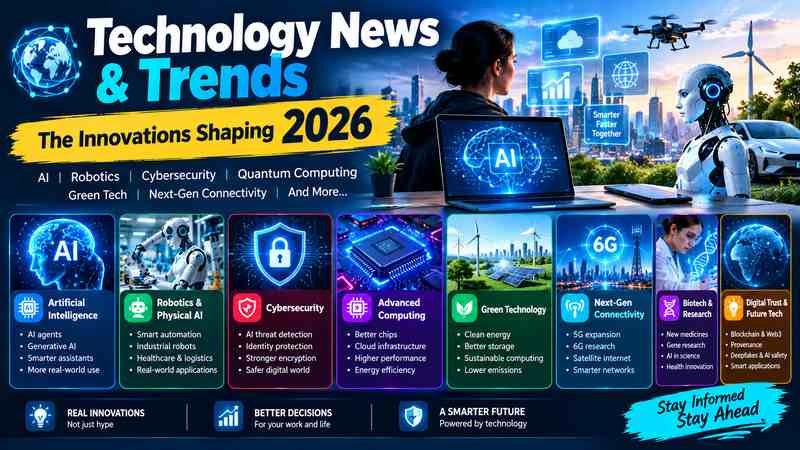
Technology news and trends reveal how new inventions, software, digital services, and scientific breakthroughs are changing the way people work, communicate, learn, and do business. In 2026, artificial intelligence, autonomous systems, cybersecurity, advanced computing, robotics, and next-generation connectivity are among the major developments shaping the technology landscape.
But following technology news is about more than knowing which company launched a new product or which device has the fastest processor. The bigger question is how these developments affect everyday life, business decisions, privacy, employment, and the future of the digital economy.
The most useful way to follow technology is to separate genuine progress from marketing claims, understand which innovations are ready for practical use, and recognize which remain experimental. That distinction helps readers make better decisions about the devices they buy, the skills they learn, and the technologies they trust.
What Are Technology News and Trends?
Technology news covers recent developments involving digital products, computing, telecommunications, scientific research, software, electronics, and related industries. Technology trends describe broader patterns of change that develop over time, often across multiple companies, industries, and countries.
These terms are connected, but they serve different purposes.
- Technology news reports individual developments, such as a new smartphone release, a software update, a cybersecurity incident, or an artificial intelligence announcement.
- Technology trends identify recurring developments, such as the growing use of AI assistants, the shift toward on-device processing, or increasing investment in digital security.
- Emerging technologies are innovations that are still developing or moving toward wider adoption, including advanced robotics, quantum computing, and new energy systems.
A single announcement does not necessarily establish a lasting trend. A more convincing signal appears when independent organizations invest in the same technology, practical applications expand, and evidence of real-world benefits begins to accumulate.
For readers, this distinction makes technology coverage more useful. Instead of reacting to every headline, they can identify developments that are likely to have a lasting impact.
The Biggest Technology News and Trends to Watch in 2026
The most consequential technology developments are not happening in isolation. AI depends on computing infrastructure, connected devices generate data, cybersecurity protects digital systems, and advances in energy influence how efficiently all of this technology can operate.
The following areas offer a useful picture of where technology is heading in 2026. They draw on industry outlooks from Gartner, Deloitte, McKinsey, and the World Economic Forum, which identify overlapping developments while emphasizing different aspects of technological change.
Gartner
+3
1. Artificial Intelligence Is Moving Beyond Chatbots
Artificial intelligence remains one of the defining forces in technology news. The focus is expanding from tools that answer questions or generate text to systems that can assist with complex workflows, analyze different types of information, and interact with software.
Generative AI can create text, images, audio, video, and computer code. Newer approaches combine these capabilities with planning, information retrieval, and the ability to use approved digital tools.
What is changing in AI?
- AI agents: Systems designed to carry out sequences of tasks, such as gathering information, preparing reports, or coordinating steps in a business workflow.
- Multimodal AI: Models that can work with combinations of text, images, audio, and video.
- Specialized AI models: Systems tailored to particular fields, such as software development, scientific research, customer service, or industrial operations.
- AI-assisted development: Tools that help developers write, test, explain, and maintain software.
- AI-powered search: Search experiences that synthesize information and provide direct answers alongside, or instead of, traditional lists of links.
Gartner’s 2026 technology outlook identifies AI-native development platforms, domain-specific language models, and multiagent systems among its strategic trends.
Gartner
+1
Why this trend matters
AI can reduce repetitive work and help people process information more quickly. A small business might use it to draft customer responses, summarize documents, or organize product information. A software team might use AI to generate a first draft of code and identify possible errors.
However, automation does not guarantee accuracy. AI systems can produce incorrect answers, misunderstand instructions, expose sensitive information, or take inappropriate actions if given excessive permissions.
The practical opportunity is to use AI for tasks where its output can be checked and its benefits measured. For consequential decisions, human review remains important.
2. AI Agents and Autonomous Workflows
AI agents are a more action-oriented development within artificial intelligence. Rather than responding to each instruction independently, an agent may break a goal into steps, use tools, inspect results, and continue working within defined limits.
For example, a research workflow might collect information from approved sources, organize findings, and prepare a draft summary for a person to review. Each step may require separate permissions and checks.
The distinction between a chatbot and an agent is useful:
| Capability | Conventional chatbot | AI agent |
| Main purpose | Responds to prompts | Works toward a defined goal |
| Task execution | Usually conversational | Can perform sequences of actions |
| Tool use | May have limited integrations | May coordinate multiple approved tools |
| Oversight | User evaluates responses | User may need to monitor actions and outcomes |
| Main concern | Incorrect or misleading answers | Incorrect answers plus unintended actions |
Agent capabilities vary considerably by product. The term agentic AI does not mean that a system can operate independently, reliably, or safely in every environment.
For organizations, the next challenge is not simply deploying more agents. It is deciding which tasks can be automated, which actions require approval, how access should be restricted, and how to recover when a workflow fails.
3. Cybersecurity Is Becoming More Important
As more business operations and personal activities move online, cybersecurity remains a fundamental technology concern. Artificial intelligence is affecting both sides of the security equation: defenders can use it to analyze threats, while attackers can use automated tools to support scams and other malicious activity.
The World Economic Forum’s 2026 cybersecurity outlook highlights AI-related risks, geopolitical uncertainty, and vulnerabilities in digital supply chains.
World Economic Forum
+1
Important cybersecurity developments include:
- AI-assisted threat detection: Identifying suspicious activity and prioritizing security alerts.
- Identity and access management: Controlling who or what can access systems and sensitive data.
- Phishing and impersonation defenses: Detecting deceptive messages, fraudulent websites, and manipulated audio or video.
- Software supply chain security: Checking the integrity and security of software components and external dependencies.
- Proactive security testing: Identifying weaknesses before attackers exploit them.
- AI security controls: Monitoring how AI applications use data, tools, and permissions.
What individuals and businesses should do
Use multifactor authentication wherever available, keep software updated, maintain backups, and verify unexpected requests for money, credentials, or confidential information through a separate trusted channel.
Businesses should also review third-party access, establish incident response procedures, and restrict automated systems to the permissions they genuinely need.
A convincing message, voice recording, or video is no longer sufficient proof of identity. Verification procedures matter more than the apparent realism of the content.
4. Robotics and Physical AI
Artificial intelligence is increasingly being applied to machines that interact with the physical world. This field, often called physical AI, includes robotics, autonomous equipment, intelligent industrial systems, and machines that use sensors and AI models to respond to their surroundings.
Unlike a purely digital assistant, a robot must deal with physical constraints. It needs to perceive its environment, estimate distances, control movement, and respond safely when conditions change.
Potential applications include:
- Manufacturing, inspection, and warehouse operations.
- Agricultural monitoring and precision farming.
- Logistics and material handling.
- Healthcare support and laboratory automation.
- Inspection of infrastructure and hazardous environments.
- Autonomous navigation in carefully controlled settings.
Gartner includes physical AI among its strategic technology trends for 2026, while Deloitte highlights the convergence of AI and robotics.
Gartner
+1
The opportunity is substantial, but so are the engineering challenges. Hardware costs, maintenance, unpredictable environments, safety requirements, and integration with existing operations can limit adoption.
A robot that performs reliably in a structured factory may struggle in a crowded home or an unfamiliar outdoor environment. Progress should therefore be judged by demonstrated performance in the intended setting, not by impressive demonstrations alone.
5. Smartphones, Computers, and On-Device AI
Consumer technology is also changing as manufacturers add AI features to smartphones, laptops, tablets, and other connected devices.
Some AI processing takes place in remote data centers. Other tasks can run locally on a device, using specialized processors designed for AI workloads.
This creates two different approaches to delivering AI services.
| Consideration | Cloud-based AI | On-device AI |
| Processing | Remote servers | Local device hardware |
| Internet connection | Usually required for the AI request | May work offline for supported tasks |
| Privacy | Data may be sent to a service provider | Some data can remain on the device |
| Performance | Depends on connectivity and server capacity | Depends on local hardware and workload |
| Model capability | Can use powerful remote models | Limited by available memory and computing resources |
| Operating cost | May involve subscriptions or usage fees | Uses device resources and may increase battery consumption |
Neither approach is automatically superior. Cloud processing can support more demanding models, while local processing can reduce latency and limit the need to transmit certain information.
The important detail for consumers is that a device advertised as AI-capable does not necessarily run every AI feature locally. Some functions may still require an internet connection, a subscription, or a compatible service.
Before upgrading, consider whether the features solve a real problem. Battery life, software support, repairability, memory, storage, and total cost may matter more than an AI label.
6. Cloud Computing and AI Infrastructure
Cloud computing allows individuals and organizations to use remote computing resources, storage, databases, and software without owning all the underlying infrastructure. It has become a foundation for online services, enterprise applications, and many AI systems.
The expansion of AI is changing what cloud infrastructure needs to deliver. Training large models and serving millions of AI requests require substantial computing capacity, fast data movement, memory, cooling, and dependable electricity.
Current technology discussions increasingly focus on three related issues:
- AI computing capacity: Providing enough processing power for training and running AI models.
- Inference efficiency: Reducing the cost and delay involved in generating responses from trained models.
- Energy and cooling: Managing the electricity and heat associated with increasingly demanding computing workloads.
McKinsey’s 2026 technology outlook highlights the growing importance of AI infrastructure and the economics of running AI systems.
McKinsey & Company
+1
Why infrastructure matters to ordinary users
Computing infrastructure influences the speed, availability, and cost of digital services. It also affects how much companies need to charge for AI features and how quickly new capabilities become widely accessible.
Organizations choosing cloud services should evaluate total operating costs, performance, data protection, service reliability, and the difficulty of moving to another provider. A low introductory price does not necessarily mean a lower long-term cost.
7. Quantum Computing and Post-Quantum Security
Quantum computing uses principles of quantum physics to process information in ways that differ from conventional computers. Researchers are investigating applications in chemistry, materials science, optimization, and other specialized fields.
The technology is promising, but practical quantum computers still face major engineering challenges. They should not be confused with ordinary computers that are simply faster at every task.
A related development is post-quantum cryptography, which focuses on encryption methods designed to resist attacks from future quantum computers.
The National Institute of Standards and Technology finalized its first principal post-quantum cryptography standards in 2024. These standards provide a foundation for organizations to begin planning and implementing stronger protection against potential future quantum threats.
World Economic Forum
+1
What does this mean for digital security?
Some sensitive information must remain confidential for many years. An attacker could collect encrypted data today and attempt to decrypt it in the future if sufficiently capable quantum computers become available. This possibility is often called a harvest-now, decrypt-later risk.
Organizations responsible for long-lived sensitive data should inventory their cryptographic systems, identify vulnerable dependencies, and plan migrations to appropriate post-quantum standards.
For most consumers, there is no need to replace everyday devices simply because quantum computing is advancing. The more immediate responsibility lies with software providers, governments, financial institutions, and other organizations that maintain critical security infrastructure.
8. Semiconductors and Advanced Computer Chips
Semiconductors are essential components in smartphones, computers, cars, communication equipment, industrial machines, and data centers. Their importance is increasing as AI workloads create demand for specialized processors and high-bandwidth memory.
Traditional central processing units, graphics processing units, and dedicated AI accelerators perform different roles. CPUs handle a broad range of general computing tasks, GPUs excel at many parallel workloads, and specialized accelerators can improve efficiency for particular operations.
Several developments are worth following:
- AI chips designed for model training and inference.
- Improvements in memory capacity and bandwidth.
- Advanced chip packaging that connects components more efficiently.
- Manufacturing techniques that improve performance, power consumption, and transistor density.
- Efforts to strengthen semiconductor supply chains.
The effects reach beyond the technology industry. Chip availability and production costs can influence computer prices, smartphone launches, vehicle manufacturing, and the expansion of data centers.
The important story is not simply which company has the fastest chip. Efficiency, manufacturing capacity, software compatibility, reliability, and cost per useful task also determine a chip’s value.
9. 5G, 6G Research, and Next-Generation Connectivity
Connectivity continues to develop through improvements in mobile networks, fiber broadband, satellite communications, and network management software.
5G supports a range of applications that benefit from high data rates, lower latency in suitable conditions, and the ability to connect many devices. Its actual performance depends on network deployment, spectrum, congestion, signal strength, and the user’s equipment.
Research into 6G is exploring possible future improvements in communication capacity, sensing, network intelligence, and connectivity. However, 6G should be treated as a developing research and standardization area rather than a mature service that is universally available.
The technology news to watch includes:
- Expansion and modernization of 5G networks.
- Satellite services that connect compatible phones or specialized devices in areas with limited terrestrial coverage.
- AI-assisted network management.
- Private wireless networks for factories, campuses, and industrial sites.
- Research into future 6G standards and applications.
For consumers, a newer network generation is not automatically better in every location. Coverage, network reliability, device compatibility, and data costs often matter more than the label on a phone’s specifications.
10. Green Technology, Energy Storage, and Sustainable Computing
Energy is becoming a central part of technology strategy. AI data centers, electric vehicles, connected infrastructure, and modern industrial systems all depend on reliable power. At the same time, countries and businesses are exploring ways to reduce emissions and improve energy efficiency.
The World Economic Forum’s 2026 emerging technologies report highlights innovations such as everything-to-grid energy systems, direct lithium extraction, and passive radiative cooling materials.
World Economic Forum
+1
These technologies address different problems:
- Grid-connected batteries and vehicles: Stored energy can potentially be returned to the electricity grid when demand rises, provided the equipment, software, and grid arrangements support it.
- Direct lithium extraction: Methods designed to recover lithium from brines through processes that differ from conventional evaporation ponds.
- Passive radiative cooling: Materials designed to release heat and reduce the need for active cooling in suitable environments.
- More efficient data centers: Improvements in computing hardware, cooling systems, and workload management that can reduce energy consumed per unit of useful computing.
The benefits depend on real-world conditions. Battery production has material and environmental costs, extraction techniques require appropriate water and chemical management, and cooling materials perform differently according to climate and installation.
Sustainable technology should therefore be assessed across its lifecycle, including manufacturing, operation, maintenance, and disposal. A product that consumes less electricity during use may still have other environmental costs that deserve consideration.
11. Biotechnology and AI-Powered Scientific Research
Technology innovation is not limited to computers and consumer electronics. Digital tools are increasingly intersecting with biology, chemistry, medicine, and materials science.
AI-assisted research can help scientists analyze large datasets, identify patterns, generate hypotheses, and investigate potential molecules or materials. These tools may shorten parts of the research process, but laboratory testing and independent validation remain necessary.
The World Economic Forum’s 2026 emerging technologies report includes personalized mRNA cancer vaccines, exosome drug delivery, precision fermentation, and quantum simulation for drug discovery among the fields attracting attention.
World Economic Forum
+1
Their potential applications vary considerably:
- Personalized mRNA cancer vaccines: Designed around characteristics of an individual patient’s tumor to help the immune system recognize it.
- Exosome-based drug delivery: Research into using biological vesicles to transport therapeutic materials.
- Precision fermentation: Using programmed microorganisms to produce particular proteins and other useful compounds.
- AI-assisted drug discovery: Applying computational methods to help identify and evaluate candidate treatments.
These are not interchangeable technologies, and promising research does not automatically translate into approved, widely available treatments. Clinical evidence, manufacturing quality, regulatory review, cost, and access determine how much benefit reaches patients.
The broader trend is the combination of computational research with experimental science. AI may help researchers explore possibilities faster, while physical experiments determine which ideas work.
12. Digital Provenance, Deepfakes, and Online Trust
As AI-generated content becomes more convincing, verifying the origin and authenticity of digital information is becoming an important technology challenge.
Images, audio recordings, videos, and written documents can be manipulated or generated with increasingly accessible tools. This creates opportunities for creative work, but it also makes impersonation, misinformation, and fraud easier to attempt.
One response is digital provenance, which involves recording and verifying information about where digital content originated, how it was produced, and whether it has changed.
Technologies and methods in this area include:
- Cryptographic signatures that help verify whether content or software came from a particular source.
- Content credentials that record supported information about the origin or editing history of media.
- Software supply chain verification to help identify trusted software components.
- Detection tools that look for signs of manipulated or synthetic content.
- Identity verification processes for sensitive transactions.
Gartner identifies digital provenance and AI security platforms among its strategic technology trends for 2026.
Gartner
+1
No single method can establish that every digital claim is true. A valid signature can help establish where a file came from, but it does not guarantee that the information in the file is accurate. Likewise, deepfake detectors can produce false positives and false negatives.
For readers, the most reliable approach is to verify important claims against credible independent sources, especially when content requests money, personal information, or urgent action.
13. Gaming Technology, Virtual Reality, and Immersive Experiences
Gaming technology continues to advance through improvements in graphics processing, game engines, cloud infrastructure, virtual reality, and AI-assisted development.
These developments influence more than visual quality. They can change how games are designed, how players interact with virtual environments, and how developers distribute their products.
Major areas to watch include:
- Real-time rendering: Techniques that create detailed environments, realistic lighting, and more responsive visual effects.
- AI-assisted game development: Tools that help create assets, test gameplay, or support development workflows.
- Cloud gaming: Services that stream games from remote hardware to compatible devices.
- Virtual and augmented reality: Technologies that place digital content within immersive or real-world environments.
- Cross-platform gaming: Systems that allow players on supported devices to share multiplayer experiences.
- Performance optimization: Improvements in frame rates, loading times, and hardware efficiency.
Each approach has tradeoffs. Cloud gaming depends on network quality and service availability, while virtual reality requires suitable hardware and comfortable experiences. AI-generated assets may speed up parts of development, but they do not eliminate the need for design, testing, and creative judgment.
For consumers, the best gaming technology depends on the games they play, the hardware they already own, their budget, and the importance they place on portability, performance, and immersion.
14. Blockchain and Web3 Applications
Blockchain remains part of technology news, particularly in discussions about digital ownership, financial infrastructure, and decentralized applications.
A blockchain is a type of shared digital ledger that records transactions according to a defined protocol. Different blockchains vary in their security models, governance, transaction costs, performance, and degree of decentralization.
Potential applications include:
- Recording transactions between participants.
- Tracking certain assets through supply chains.
- Supporting programmable transactions through smart contracts.
- Enabling digital tokens and some forms of digital ownership.
- Providing infrastructure for selected decentralized applications.
However, a blockchain does not automatically make a system secure, transparent, or useful. Smart contracts can contain vulnerabilities, transaction records may be difficult to reverse, and the legal meaning of digital ownership depends on the relevant agreement and jurisdiction.
The practical question is whether a blockchain solves a problem better than a conventional database or other established technology. If a trusted organization can operate the system more simply and cheaply, decentralization may provide little additional value.
Blockchain should therefore be evaluated through a specific use case rather than treated as a universal solution.
How to Identify the Most Important Technology Trends
Technology headlines can make every new product or research announcement seem revolutionary. A more reliable method is to assess each development using a few consistent criteria.
A practical technology evaluation framework
- Evidence of real-world use
Is the technology operating in real conditions, or has it only appeared in a demonstration, prototype, or laboratory experiment?
- Cost and measurable benefit
Does it save time, reduce expenses, improve quality, or solve a problem well enough to justify its cost?
- Reliability and risk
What happens when it fails? Consider security, privacy, maintenance, safety, and the need for human supervision.
- Adoption beyond early users
Are independent organizations adopting it? Are supporting infrastructure, skills, standards, and supply chains developing?
- Time to practical impact
Can people benefit from it today, or does it depend on future technical breakthroughs, regulation, or lower costs?
This framework helps distinguish technologies that are already useful from those that remain speculative. It also prevents a common mistake: confusing a technology’s potential with proof that it is commercially successful.
How to Stay Updated With Technology News and Trends
Keeping up with technology does not require reading every headline. A small set of reliable sources, combined with a consistent checking routine, can provide a more useful understanding of the industry.
Follow authoritative technology publications
Choose sources according to the type of information you need.
Reuters
Useful for company announcements, technology business developments, market changes, and independent reporting.
MIT Technology Review
Covers emerging technologies, scientific developments, AI, and the social implications of innovation.
Ars Technica
Provides technical reporting on computing, software, consumer devices, science, and digital policy.
The Verge
Covers consumer electronics, online platforms, digital culture, and technology product launches.
Explore consumer technology news
For scientific or industry-specific claims, supplement journalism with original research, official technical documentation, regulatory announcements, or institutional reports. Vendor announcements can explain a product’s specifications, but independent testing is often more useful for evaluating actual performance.
Use a simple weekly routine
A manageable routine can keep you informed without turning news consumption into a full-time task.
- Check major headlines. Identify significant product releases, security incidents, research developments, and company announcements.
- Investigate one or two important stories. Read beyond the headline and look for original documentation or independent reporting.
- Separate facts from predictions. A confirmed product release is different from a company’s roadmap or an analyst’s forecast.
- Consider the practical effect. Ask what the development changes for consumers, workers, businesses, or society.
- Review developments over time. Repeated evidence is generally more informative than a single viral announcement.
This approach favors understanding over volume. It also makes it easier to recognize when a widely discussed trend is losing momentum or when a previously experimental technology is becoming practical.
The Benefits and Risks of Rapid Technological Change
Technology can improve productivity, expand access to information, support scientific discovery, and make services more convenient. The benefits, however, are not distributed equally, and the risks differ by technology and context.
| Potential benefit | Possible limitation or risk |
| Automation of repetitive tasks | Job disruption and changing skill requirements |
| Faster access to information | Misinformation and inaccurate AI responses |
| Connected digital services | Privacy risks and dependence on reliable networks |
| Advanced medical research | High development costs and unequal access |
| Smarter energy management | Infrastructure costs and material demands |
| More capable cybersecurity tools | Automated attacks and new vulnerabilities |
| Improved computing performance | Energy consumption and supply chain concentration |
The goal is not to accept or reject technology as a whole. It is to understand which applications create meaningful value, which risks require safeguards, and who is responsible when systems fail.
For individuals, that may mean learning digital skills and protecting personal information. For businesses, it may mean testing new systems carefully, training employees, and measuring outcomes before expanding adoption. For policymakers, it involves balancing innovation with privacy, competition, safety, and public accountability.
Frequently Asked Questions About Technology News and Trends
What are the latest technology trends in 2026?
Major technology trends in 2026 include AI agents, AI-assisted software development, robotics, AI computing infrastructure, cybersecurity, semiconductor innovation, post-quantum cryptography, energy storage, and emerging biotechnology. The speed and maturity of adoption vary across these fields.
Which technology will have the biggest impact in the future?
Artificial intelligence is a strong candidate because it can influence many industries, including software, education, healthcare, manufacturing, and scientific research. However, its long-term impact will depend on reliability, cost, regulation, adoption, and how organizations use it. Computing infrastructure, energy, and cybersecurity will also shape what AI can accomplish.
Where can I read reliable technology news?
Reuters, MIT Technology Review, Ars Technica, and The Verge are useful starting points for different kinds of technology coverage. For important technical claims, consult primary sources such as research papers, official product documentation, standards organizations, and government publications.
How can I distinguish real technology breakthroughs from hype?
Look for independent validation, demonstrated performance, practical use cases, transparent limitations, and evidence of adoption. Be cautious when an announcement relies mainly on extraordinary promises, selective demonstrations, or predictions without supporting evidence.
What technology skills should I learn in 2026?
Useful skills depend on your career goals, but digital literacy, AI-assisted problem-solving, cybersecurity awareness, data analysis, and clear communication are broadly applicable. Developers may benefit from learning software engineering fundamentals and AI-assisted coding, while business professionals may focus on workflow automation and data interpretation.
Prioritize skills that help you solve real problems rather than chasing every newly popular tool.
Are emerging technologies always better than older ones?
No. Established technologies often have advantages in reliability, affordability, compatibility, and maintenance. A newer product is worth adopting when its measurable benefits outweigh its costs and limitations, not simply because it is more recent.
How does technology news affect everyday life?
Technology news can help people understand changes in device capabilities, online security, workplace tools, digital services, and the skills employers may need. Its value comes from explaining practical consequences, not simply announcing that a new product or system exists.
Conclusion
Technology news and trends in 2026 point toward a connected future in which AI, computing hardware, robotics, digital security, energy systems, and scientific research increasingly influence one another.
For readers, the most valuable habit is to look beyond announcements and ask three questions: What has actually changed? What evidence supports the claim? How might the development affect real decisions?
Following reliable sources and evaluating new technologies through evidence, practical benefits, and limitations makes it easier to identify genuine progress without getting distracted by hype. The technologies worth watching are not necessarily those attracting the most attention, but those that demonstrate lasting value in the real world.
You may also read:Clever AI Humanizer