
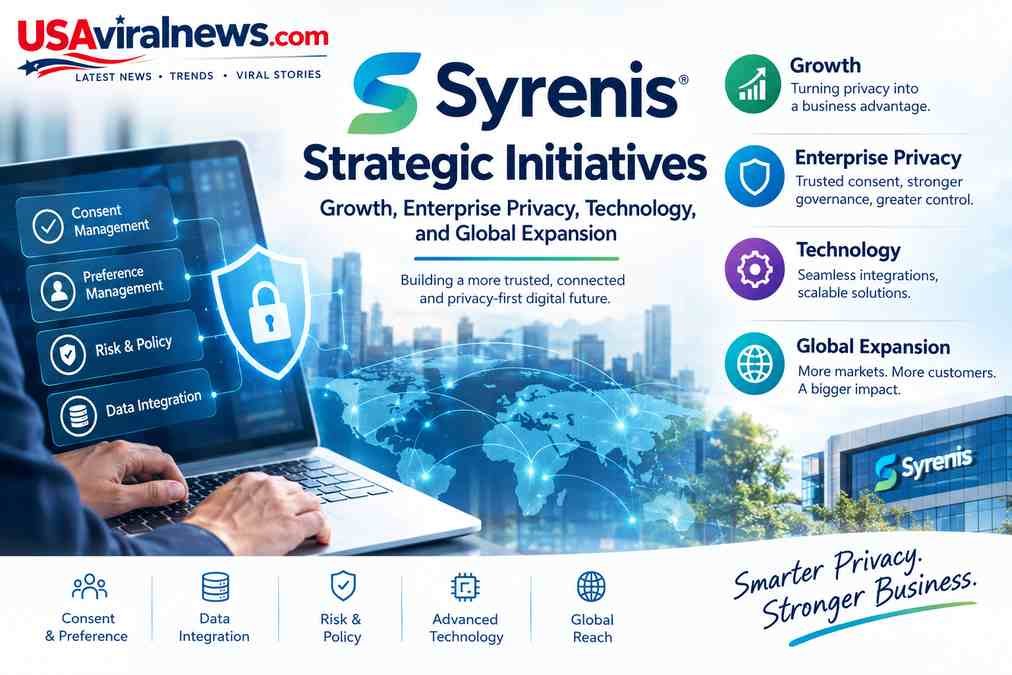
Syrenis Strategic Initiatives: Growth, Enterprise Privacy, Technology, and Global Expansion

syrenis-strategic

Syrenis strategic initiatives” is best understood as a description of the company’s current strategic direction, not the official name of a single product or program. Syrenis is positioning itself as an enterprise privacy technology platform focused on consent and preference management, with its broader strategy extending into privacy governance, data integration, international expansion, and the operational use of trusted customer permission data.

The clearest way to understand that strategy is to look at what Syrenis has changed, what it is building, where it is expanding, and how those pieces fit together.

What are Syrenis strategic initiatives?

Syrenis’s current strategic direction centers on a shift from being viewed primarily as a consent or compliance tool toward operating as a broader enterprise privacy platform.

The company describes its platform through four connected areas:

  1. Consent Management
  2. Preference Management
  3. Risk and Policy
  4. Data Management and Integration

Together, these areas are designed to help large organizations capture customer choices, connect those choices to the right identities, synchronize them across systems, manage privacy obligations, and apply the resulting permissions consistently throughout the enterprise.

That distinction matters. For a small website, consent management can look like a cookie banner. For a global enterprise, the harder problem is what happens after the customer makes a choice.

A customer may interact with a website, mobile application, CRM, marketing platform, customer service system, analytics platform, and other data environments. If those systems do not share an accurate view of the customer’s permissions, the organization can end up with inconsistent records and inconsistent behavior.

Syrenis is building its strategy around solving that larger operational problem.

1. Repositioning Syrenis as an enterprise privacy platform

One of the most visible strategic initiatives is the company’s repositioning.

In April 2026, Syrenis announced a major brand refresh and retired its legacy product names in favor of a unified Syrenis identity. The company said the change reflected its evolution from a compliance tool toward an enterprise platform designed for organizations dealing with jurisdictional complexity, multiple brands, and large scale data governance.

This is more than a branding exercise.

It changes the commercial story Syrenis is telling prospective customers. Instead of presenting consent as an isolated compliance function, the company is positioning privacy infrastructure as something that connects legal requirements, customer experience, data governance, and business growth.

Its current messaging emphasizes a simple model: capture customer choices, connect those choices across systems, and enable organizations to act on trusted preference data.

The strategic implication is that Syrenis wants to compete for a larger enterprise problem rather than only the narrow problem of website consent.

2. Expanding internationally, particularly in the United States

International growth is another major part of Syrenis’s current direction.

The company says that under CEO Adam Binks, who became CEO in February 2025, it has expanded its international footprint and launched US operations. Syrenis now lists an Atlanta office alongside its North American headquarters and European presence.

The US expansion fits naturally with the company’s enterprise strategy.

Privacy requirements in the United States are becoming increasingly complex because organizations may need to account for different state laws, consumer rights, data categories, and operational requirements. Syrenis’s own 2026 privacy material highlights the growing complexity of state privacy legislation and the importance of turning privacy requirements into operational processes rather than treating them as static policies.

For Syrenis, establishing a stronger US presence therefore serves two purposes:

  • It expands access to a large enterprise technology market.
  • It places the company closer to organizations facing increasingly complex privacy requirements.

The company’s brand relaunch specifically connected its unified positioning with its international growth strategy across the US, UK, and Europe.

3. Building consent and preference management into one connected model

Another important initiative is the convergence of consent and preference management.

Consent and preferences are related, but they are not identical.

Consent generally concerns permission for a particular type of data processing. Preferences can cover broader customer choices, such as communication channels, frequency, content, or other ways a customer wants an organization to interact with them.

Syrenis increasingly presents the two as part of one connected customer choice record. Its recent material describes a situation where a customer can make different choices across a website, application, email, and SMS channel, creating fragmented records if those systems operate independently.

The strategic opportunity is straightforward: customer choices become more useful when an enterprise can understand and honor them consistently.

That makes preference management less of a marketing convenience and more of a data governance capability.

4. Turning privacy data into connected enterprise infrastructure

Syrenis is also putting substantial emphasis on integrations and data movement.

Its current platform offers more than 350 integrations and supports APIs, connectors, data exports, and system mapping. The objective is to allow consent and preference information to move between the systems an enterprise already uses rather than keeping privacy information isolated inside one application.

This is one of the most consequential aspects of the company’s strategy.

Consider a simplified example. A customer changes a marketing preference. Recording that change is only the beginning. The organization may also need the change to reach its CRM, marketing technology, customer service environment, analytics systems, and other downstream applications.

Syrenis describes real time synchronization as a way of keeping connected systems aligned with current consent and preference information. Its APIs are intended to let organizations capture, update, and apply privacy information across websites, applications, and internal systems.

In other words, Syrenis is positioning privacy data as an operational layer that needs to travel through the enterprise.

5. Expanding beyond consent into risk and policy management

Syrenis’s strategic direction also extends beyond capturing customer permissions.

Its Risk and Policy offering is designed around privacy risk, processing activities, policy obligations, privacy notices, and data subject rights. The company describes capabilities including risk assessments, processing records, policy mapping, notice management, rights request workflows, and compliance monitoring.

This broadens the platform’s potential role within a privacy department.

A consent platform primarily answers questions such as:

  • What did the customer agree to?
  • When was that choice made?
  • Where should the choice be applied?

A broader privacy governance platform also needs to address questions such as:

  • What personal data is being processed?
  • What privacy risks exist?
  • Which policies apply?
  • How are privacy rights requests handled?
  • Can the organization demonstrate what happened?

Syrenis’s expansion into these areas suggests that the company wants its platform to support both the customer choice layer and the governance processes surrounding it.

6. Making enterprise integration a competitive differentiator

Integration is not simply a technical feature in Syrenis’s strategy. It appears to be one of the areas where the company wants to differentiate itself.

The company emphasizes more than 350 integrations, configurable data mapping, APIs, synchronization, connectors, and support for legacy environments.

That focus reflects a real enterprise constraint.

Large organizations rarely operate on one clean technology stack. They accumulate systems through acquisitions, regional deployments, technology changes, and years of operational decisions. A privacy platform that works well only when every surrounding system is modern and standardized has limited practical value.

Syrenis therefore emphasizes the ability to connect privacy data to existing architectures.

The strategic value is not simply “more integrations.” It is the possibility of reducing the gap between a privacy decision and the systems that must actually enforce it.

7. Positioning privacy as a driver of growth

Perhaps the most important change in Syrenis’s strategic narrative is its treatment of privacy as something more than a compliance cost.

The company repeatedly describes privacy, consent, and customer choice as foundations for trust, personalization, better customer experiences, and sustainable growth. Its current positioning explicitly frames compliance as something that can support business value rather than simply restrict activity.

The reasoning is straightforward.

If a business knows what customers have consented to and what they prefer, it can make more informed decisions about how customer data is used. If those choices are accurate and consistently enforced, the business can also reduce the operational risk associated with using data incorrectly.

This creates a three way relationship:

better customer control → more reliable permission data → more confident use of customer data

That is considerably broader than the traditional cookie management model.

8. Preparing for increasingly complex privacy and AI requirements

AI is another emerging factor in Syrenis’s strategic direction, although it is important not to confuse an emerging market theme with a formally announced standalone AI initiative.

Syrenis’s 2026 privacy material increasingly connects privacy operations with AI governance and responsible use of customer data. Its privacy playbook discusses the question of who owns privacy and AI governance and emphasizes the need for clear accountability across leadership, business, privacy, legal, security, and IT functions.

This is strategically significant because AI increases the importance of knowing what data an organization can legitimately use.

An organization may possess enormous quantities of customer information, but possession does not automatically answer whether that information can be used for a particular purpose.

Reliable consent, preference, identity, and governance records can therefore become part of the infrastructure supporting responsible data use.

Syrenis’s strategy appears increasingly aligned with that broader problem: making privacy decisions understandable, auditable, connected, and operational across enterprise systems.

9. Strengthening partnerships and enterprise delivery

Syrenis is also developing a partner oriented growth model.

Its partner proposition includes revenue sharing, sales enablement, technical training, certification, demo access, co branded marketing, and joint go to market planning. The company has also created dedicated material around its relationship with KPMG, positioning implementation partners as a route to additional customer value and revenue opportunities.

This matters because enterprise privacy technology often requires more than software.

Large deployments can involve legal teams, privacy specialists, marketing, engineering, IT, data teams, customer service, and regional stakeholders. Partners can provide implementation expertise, consulting, integration support, and organizational change capabilities.

A stronger partner ecosystem can therefore help Syrenis scale without relying entirely on direct delivery.

10. Focusing on complex enterprise use cases

Syrenis’s strategic direction is particularly visible in the types of organizations and problems it highlights.

Its platform is positioned for sectors including automotive, energy and utilities, financial services, healthcare and pharmaceuticals, life sciences, legal services, media, retail, and ecommerce.

These sectors share an important characteristic: customer or user data often moves through complicated environments.

For example, Syrenis describes an automotive deployment involving consent for connected vehicle data across a very large global customer base, including situations where one person may be associated with multiple vehicles. It also describes a life sciences deployment involving more than 100 countries, multiple languages, and different regulatory requirements.

These examples illustrate where the company’s enterprise strategy has practical relevance.

The problem is not simply collecting consent. It is maintaining accurate relationships between people, systems, purposes, jurisdictions, and changing customer choices.

What Syrenis is ultimately trying to build

Taken together, the initiatives point toward a broader strategic model.

Syrenis wants privacy information to behave less like an isolated compliance record and more like connected enterprise infrastructure.

The basic architecture can be understood as:

Capture → identify → govern → synchronize → enforce → audit

A customer makes a choice. Syrenis captures it. The choice is connected to the appropriate identity or relationship. Governance rules determine how it should be treated. The information is synchronized with connected systems. Those systems act on the current choice. The organization retains an auditable record of what happened.

That model explains why the company is investing simultaneously in consent, preferences, identity, integrations, APIs, risk, policy, privacy rights, and international expansion. These are not entirely separate initiatives. They reinforce the same underlying objective: making customer choice reliable across a complicated enterprise environment.

Syrenis strategic initiatives at a glance

Strategic area What Syrenis is doing Why it matters
Enterprise repositioning Consolidating its identity around the Syrenis platform Moves the company beyond a narrow compliance tool narrative
US expansion Building a stronger North American operation, including Atlanta Supports international enterprise growth
Consent management Centralizing and enforcing consent across systems and jurisdictions Creates a more reliable foundation for compliant data use
Preference management Connecting customer communication and data use choices Gives organizations a broader view of customer preferences
Data integration Providing APIs, connectors, exports, mapping, and 350+ integrations Helps privacy decisions reach operational systems
Risk and policy Expanding into risk, notices, rights requests, and governance Extends the platform’s role within privacy operations
Partner ecosystem Supporting implementation and go to market partners Creates additional routes to enterprise customers
Privacy and growth Positioning trusted customer choice as a business asset Connects compliance with customer experience and data value
AI readiness Addressing privacy and governance questions surrounding AI data use Helps organizations establish clearer boundaries for responsible data use

What these initiatives mean for Syrenis’s future

The strategic direction suggests that Syrenis is trying to win on depth in enterprise consent and connected privacy operations, rather than simply competing on the visibility of a cookie banner.

That distinction could become increasingly important as enterprises deal with more jurisdictions, more customer touchpoints, more technology systems, and greater pressure to demonstrate exactly how customer data is being used.

The company’s own product architecture supports that interpretation. Consent management remains central, but it is increasingly surrounded by preference management, risk and policy controls, data integration, identity capabilities, and operational workflows.

The biggest strategic challenge will be execution.

Expanding internationally, broadening the product platform, supporting complex integrations, maintaining regulatory adaptability, and building a larger partner ecosystem all increase operational complexity. Syrenis will need to demonstrate that its broader platform strategy delivers measurable value without making implementation and governance harder for the very enterprises it is targeting.

For customers, the practical question is therefore not simply whether Syrenis offers consent management. It is whether the platform can become a dependable operating layer for customer permissions across a complicated technology environment.

That is the central idea behind Syrenis’s current strategic initiatives: turning consent and preference data from an isolated compliance record into connected, governed enterprise infrastructure that supports trust, responsible data use, and growth.
You may also read:adstotally

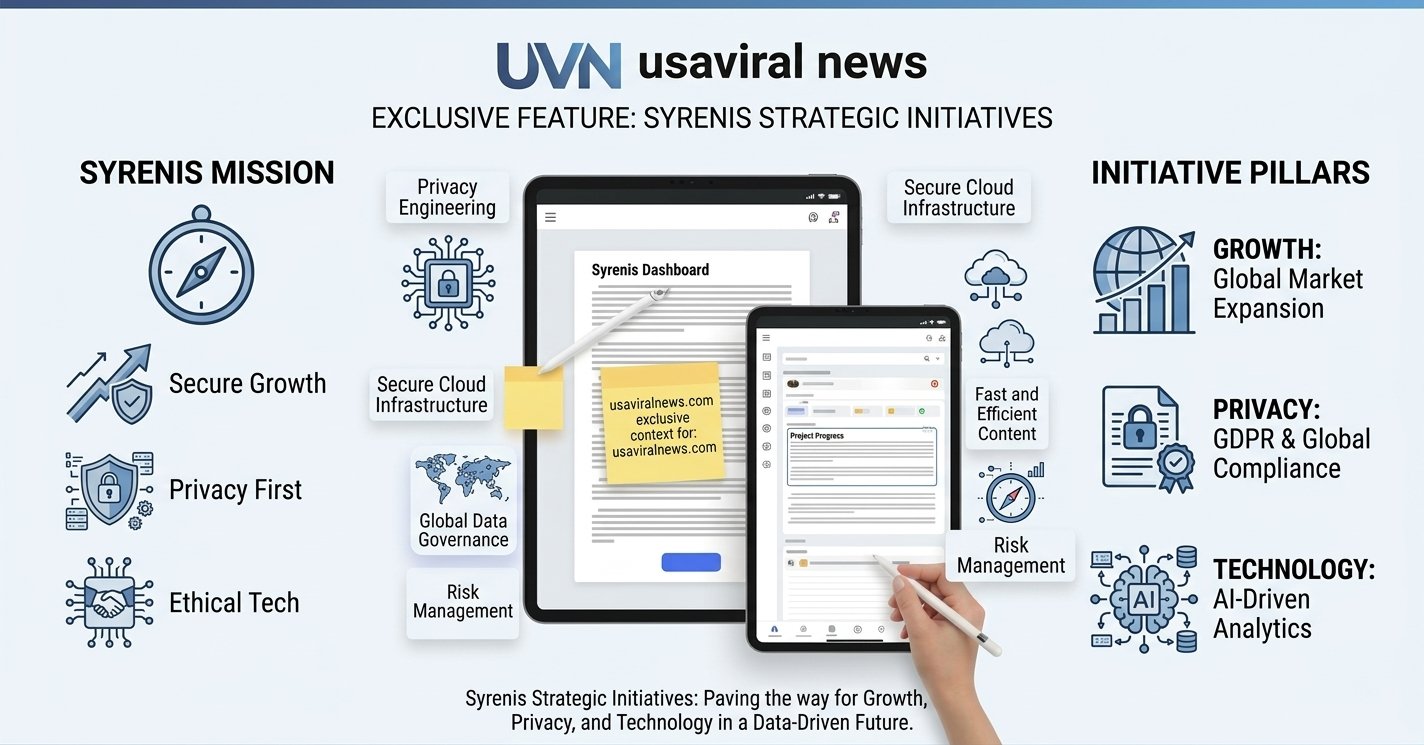


Syrenis Strategic Initiatives: Growth, Enterprise Privacy, and Global Expansion

syrenis-strategic-initiatives

Syrenis strategic initiatives are best understood as the company’s broader direction across enterprise consent and preference management, international expansion, platform development, data integration, and the repositioning of privacy as a business capability.

The phrase “Syrenis strategic initiatives” does not describe a single product or formally named program. Instead, it captures several connected priorities visible in Syrenis’s current platform, leadership, product positioning, and recent corporate activity.

The most significant development is the company’s shift toward a unified enterprise privacy platform. In April 2026, Syrenis announced a major brand refresh, retired its legacy product names, and consolidated its offering under the Syrenis name. At the same time, it highlighted its expansion into North America and its ambition to serve large enterprises across the United States, United Kingdom, and Europe.

What are Syrenis strategic initiatives?

Syrenis’s current direction can be grouped into five closely related areas:

  1. Expanding globally, particularly in North America
  2. Building enterprise scale into consent and preference management
  3. Connecting privacy data across business systems
  4. Combining consent, preferences, risk, policy, and data management
  5. Positioning privacy as an enabler of customer trust and business growth

These initiatives address a common enterprise problem. A large organization may collect customer choices through websites, applications, customer service, marketing systems, CRM platforms, and other channels. If those choices remain fragmented, the company can struggle to apply them consistently.

Syrenis is positioning its platform as infrastructure for coordinating those decisions across the enterprise rather than as a tool limited to website cookie consent. Its current platform is organized around Consent Management, Preference Management, Risk & Policy, and Data Management & Integrations.

1. Global expansion is a major strategic priority

One of the clearest current initiatives is international expansion.

Syrenis says that it expanded into North America in 2026 with a dedicated US go to market operation based in Atlanta. Its April 2026 brand relaunch positioned the unified Syrenis brand as part of an international growth strategy targeting enterprise buyers in the US, UK, and Europe.

The company currently lists North American offices in Austin and Atlanta, alongside its European operation in the UK.

This matters because enterprise privacy requirements are increasingly difficult to manage across jurisdictions. A multinational organization may need different rules, consent experiences, data handling practices, and evidence requirements depending on where customers are located.

Syrenis therefore appears to be pursuing a strategy in which its technology can operate across those differences without forcing enterprises to manage completely separate privacy systems.

Its own platform messaging emphasizes jurisdictional complexity, multi brand environments, global systems, and regional requirements as core enterprise challenges.

Why North America matters

The US privacy environment is particularly fragmented compared with a single national framework. Organizations can encounter different requirements across states, alongside federal requirements and sector specific obligations.

For a consent platform, that creates a technical problem as well as a legal one. The system must be capable of changing how consent is collected, interpreted, stored, and enforced according to relevant circumstances.

Syrenis is building its positioning around that type of complexity rather than treating privacy as a single website configuration.

2. Syrenis is moving beyond the traditional cookie banner

Another important initiative is the expansion of consent management beyond basic cookie controls.

A conventional consent management platform can focus heavily on the visitor experience: displaying a notice, allowing a person to accept or reject categories of tracking, and recording the resulting choice.

Enterprise consent management is broader.

A customer’s decision may need to reach a CRM system, marketing platform, analytics environment, customer service application, data warehouse, or other connected system. If the choice exists only in the original website, the organization may have recorded consent without actually operationalizing it throughout the business.

Syrenis describes its platform as a single source of truth for consent across systems, jurisdictions, and customer touchpoints. Its current architecture is also described as API first, allowing privacy information to be exchanged with applications, platforms, and legacy systems.

That distinction is central to understanding the company’s strategic direction.

The objective is not simply to ask customers what they permit. It is to make the resulting information usable throughout the organization.

3. Consent and preference management are becoming one connected data problem

A particularly important aspect of Syrenis’s positioning is the relationship between consent and preference management.

They are related but not identical.

Consent generally concerns what an organization has permission to do with someone’s data.

Preferences concern what the customer wants, such as communication channels, frequency, content categories, or other choices.

A customer could, for example, permit marketing communication while preferring email rather than SMS. Another customer might permit service notifications but reject promotional messages.

If these decisions live in different systems, the business can end up with an incomplete picture of the customer’s choices.

Syrenis’s September 2026 discussion of consent and preference management describes a model in which tracker consent, preference management, and privacy rights activity can be associated with the same identity, with changes propagated to connected business systems.

This represents a meaningful strategic shift because it turns consent and preferences into enterprise data infrastructure rather than treating them as isolated compliance functions.

4. Integration is becoming a core part of the strategy

The value of an enterprise privacy platform depends heavily on what happens outside the platform itself.

Syrenis currently advertises more than 350 integrations and describes connections with CRM, marketing, analytics, enterprise applications, cloud infrastructure, and other systems.

Its integration strategy includes:

  • Pre built connectors
  • Configurable data mapping
  • System synchronization
  • APIs
  • Data exports
  • Connector services
  • Support for different enterprise architectures

The underlying objective is consistency. If a customer changes a privacy choice, the relevant systems need access to an accurate and current version of that choice.

Syrenis describes its APIs as supporting real time calls and data updates, while its connector service is intended to synchronize privacy data across systems.

This is strategically important because integration can determine whether a consent program works operationally.

A sophisticated privacy interface is of limited value if downstream systems continue acting on stale or incomplete information.

5. The company is broadening its platform beyond consent

Syrenis’s current platform architecture extends beyond consent management.

Its four principal areas are:

Platform area Strategic role
Consent Management Capture and manage customer permissions
Preference Management Manage customer choices across communication and interaction preferences
Risk & Policy Manage privacy policies, notices, rights, and related governance
Data Management & Integrations Connect privacy information with enterprise systems

Syrenis presents these areas as interconnected parts of an enterprise privacy platform.

That broader architecture helps explain the company’s 2026 brand consolidation.

Rather than maintaining separate product identities, Syrenis retired its legacy product names and moved toward one unified enterprise platform brand. The company said the change was intended to reflect the scale and complexity of the platform and the organizations it serves.

6. Product development is increasingly focused on enterprise complexity

Enterprise customers create a different set of requirements from smaller organizations.

A global company may have:

  • Multiple brands
  • Hundreds of websites
  • Mobile applications
  • Different CRM systems
  • Multiple marketing platforms
  • Regional privacy requirements
  • Legacy applications
  • Different customer identifiers
  • Large volumes of consent records

Syrenis’s platform architecture is explicitly designed around this type of environment. The company describes its infrastructure as cloud native and highly resilient, with support for distributed workloads, global operations, API based integration, and regional data requirements.

Its historical product material also demonstrates an emphasis on high volume. Syrenis previously reported deployments involving customers with up to 350 million data subjects and stated that its system could handle up to 50,000 record requests per second. Those figures come from Syrenis itself and should therefore be understood as company reported performance information rather than independent benchmarks.

The strategic implication is straightforward: scalability is being treated as part of the product’s identity, not merely a technical feature.

7. Syrenis is targeting highly regulated industries

The company is also developing its strategy around industries where privacy, identity, and customer data have unusually high operational importance.

Syrenis identifies sectors including healthcare and life sciences, financial services, automotive, retail, travel, telecommunications, and technology.

Recent customer examples illustrate why this matters.

In July 2026, Syrenis described a life sciences deployment covering more than 100 countries. The project involved geo aware consent, cross domain consent, and an identity service across a complex regulatory environment that included GDPR, US state privacy laws, and HIPAA.

Another July 2026 case study described a global automotive manufacturer managing vehicle data consent across hundreds of millions of users and requiring granular controls for situations in which one user could own multiple vehicles.

These examples show the type of enterprise complexity Syrenis is attempting to address.

They should not, however, be interpreted as independent evidence that every organization would achieve the same results. They are company published case studies describing specific implementations.

8. Partnerships support the enterprise growth strategy

Partnerships are another component of Syrenis’s broader commercial direction.

The company describes a partner model that includes revenue sharing, sales enablement, co branded marketing, technical training, certification, demo access, and joint go to market planning.

Syrenis also maintains dedicated material relating to its work with KPMG, describing implementation partners as a route to expanding service offerings and creating additional customer value.

This type of partner strategy can be important for enterprise software because large privacy programs often require more than software.

They can involve consulting, architecture, implementation, data mapping, legal interpretation, change management, and integration work.

A partner ecosystem can therefore extend the reach of a platform without requiring the software company to perform every part of an implementation itself.

9. Privacy is being positioned as a growth capability

Perhaps the most significant strategic idea behind Syrenis’s current positioning is that privacy should not be treated solely as a compliance expense.

The company explicitly describes its mission around giving privacy leaders greater control and visibility in complex regulated environments. It also argues that structured consent and preference management can support better customer experiences, stronger first party data, and long term business value.

Logic is important.

A customer who understands how their data will be used is in a better position to make an informed choice. A company that accurately records and honors that choice has a stronger foundation for using customer data responsibly.

That can influence more than regulatory compliance. It can affect personalization, marketing operations, customer experience, data quality, and trust.

Syrenis therefore frames privacy infrastructure as something that can support commercial activity rather than simply restrict it.

Whether that translates into measurable commercial gains will depend on the individual organization, implementation, customer experience, and use of the resulting data. The strategic proposition is nevertheless clear in the company’s current positioning.

10. What changed with the 2026 brand relaunch?

The April 2026 rebrand provides an important marker for understanding Syrenis’s current strategy.

The company retired its legacy product names and consolidated its offering under the Syrenis brand. It described the move as a response to the evolution of the business from a compliance focused tool toward an enterprise platform serving complex organizations.

The relaunch also coincided with North American expansion.

That combination is significant because it suggests the company is trying to establish a clearer global enterprise identity at the same time that it expands its commercial footprint.

In practical terms, Syrenis is presenting one platform rather than a collection of narrowly defined privacy products.

The strategic model in simple terms

The different initiatives become easier to understand when viewed as a single chain:

More jurisdictions and digital touchpoints

↓

More customer choices and privacy obligations

↓

Greater need for centralized consent and preference records

↓

Greater need for real time integration with enterprise systems

↓

Greater need for governance, evidence, and policy management

↓

A broader enterprise privacy platform

↓

Global expansion into organizations facing these problems at scale

This is the central logic behind Syrenis’s current direction.

The company is not simply expanding the number of features around cookie consent. It is attempting to make consent and preference information part of the wider enterprise data architecture.

What makes Syrenis’s strategy different from a basic CMP approach?

The distinction is primarily one of scope.

Traditional narrow CMP focus Syrenis’s current enterprise positioning
Website consent Enterprise wide consent
Cookie choices Consent plus preferences
Front end experience Front end plus connected systems
Single site Multiple brands and domains
Local configuration Multi jurisdiction management
Consent record Connected privacy data
Limited integrations 350+ advertised integrations
Compliance activity Compliance plus customer experience and data operations

This does not mean every enterprise needs the broader model. The appropriate architecture depends on the organization’s size, regulatory footprint, technology stack, data practices, and operational requirements.

For a small organization with one website and relatively simple data flows, an extensive enterprise platform may solve problems the organization does not have.

For a multinational business with numerous brands, systems, jurisdictions, and customer touchpoints, the architectural problem is considerably different.

What Syrenis appears to be building toward

Based on the company’s current positioning and 2026 activity, several priorities stand out.

First, global scale. The North American operation and unified international brand indicate a stronger focus on enterprise growth outside the company’s historical UK base.

Second, platform consolidation. The retirement of legacy product names and expansion into a unified platform suggest a strategy centered on one broader enterprise privacy proposition.

Third, connected privacy data. The emphasis on APIs, integrations, synchronization, and a single source of truth indicates that privacy information is being treated as operational data that must move through the enterprise.

Fourth, consent plus preferences. Syrenis is increasingly connecting legal permission with customer choice, rather than treating the two as separate systems.

Fifth, privacy as a business capability. The company is explicitly linking privacy infrastructure with trust, customer experience, first party data, and growth.

Frequently asked questions

Is Syrenis Strategic Initiatives an official Syrenis product?

No specific Syrenis product appears to be formally named “Strategic Initiatives.” The phrase is better understood as shorthand for the company’s broader strategic direction, including enterprise privacy technology, global expansion, platform development, integrations, and partnerships.

What does Syrenis actually do?

Syrenis provides enterprise consent and preference management technology. Its current platform also includes risk and policy capabilities plus data management and integration functionality.

What is the main focus of Syrenis’s current growth strategy?

Global enterprise expansion is a major focus. In 2026, the company expanded its North American presence and launched a unified Syrenis brand aimed at enterprise customers across the US, UK, and Europe.

How many integrations does Syrenis offer?

Syrenis currently advertises more than 350 integrations covering areas such as CRM, marketing, analytics, enterprise applications, and cloud infrastructure.

Why are integrations so important to consent management?

Consent is useful only if systems that collect or use customer data can act on the customer’s current choices. Integrations allow consent and preference information to move between the privacy platform and other enterprise systems.

Is Syrenis only about cookie consent?

No. Cookie management is one part of its broader platform. Syrenis also positions the platform around preference management, risk and policy, privacy rights, identity, APIs, data exports, and system integrations.

Who is Syrenis designed for?

Its positioning is primarily aimed at large, complex organizations operating across multiple systems, brands, channels, and jurisdictions. The company highlights sectors including healthcare and life sciences, financial services, automotive, retail, travel, telecommunications, and technology.

The bottom line

Syrenis’s strategic direction is centered on a straightforward idea: enterprise privacy becomes much harder when consent and customer preferences are scattered across systems, brands, channels, and jurisdictions.

The company’s response is to build a broader privacy platform around centralized consent and preferences, integration, governance, and enterprise scale.

Its 2026 priorities make that direction particularly visible. The company has expanded into North America, unified its product identity, promoted a broader enterprise platform, expanded its integration strategy, and increasingly connected privacy management with customer experience and business growth.

The most useful way to understand Syrenis strategic initiatives, therefore, is not as one isolated project. It is the company’s transition toward a globally positioned enterprise privacy technology platform in which consent and customer preferences become connected, operational data that organizations can manage across their entire digital ecosystem.
You may also read:
Jeannine Belleguic


Syrenis Strategic Initiatives: Growth, Privacy, Technology, and Future Direction

Syrenis Strategic Initiatives

Data privacy has become a major business issue for modern companies. Businesses collect customer information across websites, apps, stores, and digital services. They also need to respect the choices people make about that information. This is where Syrenis strategic initiatives become interesting for enterprise businesses managing complex privacy needs.

Syrenis focuses on enterprise consent and preference management technology. Its platform helps organizations capture, manage, and apply customer choices across different systems. The company has also been developing its wider enterprise position during 2026. Its recent brand relaunch reflects that broader direction and market focus.

But what do these strategic initiatives actually mean? The answer goes beyond cookie banners or simple consent forms. Syrenis is working around a wider privacy infrastructure model. This includes consent, customer preferences, data integration, governance, and enterprise-scale privacy management.

What Are Syrenis Strategic Initiatives?

The phrase Syrenis strategic initiatives is not the name of one standalone product. Instead, it describes several connected areas within the company’s business direction. These areas include enterprise privacy technology, consent management, preference management, integrations, governance, customer trust, and international growth.

The central idea is fairly simple. A customer makes a privacy choice, and that choice should remain accurate. It should also reach the systems that need to follow it. This becomes much harder when a company operates many websites, applications, brands, regions, and internal systems.

Syrenis positions its platform around this challenge. Its official website highlights consent management, preference management, risk and policy, and data management and integration. These areas work together rather than operating as completely separate tasks.

This approach gives the company a broader role in enterprise privacy. Instead of focusing only on collecting consent, the technology can help organizations manage what happens afterward.

Why Enterprise Consent Management Matters

Consent management can sound like a small website task. In reality, large organizations can face a much more complicated situation. A business may have thousands or millions of customers across different markets and digital channels.

Imagine that a customer visits a company’s website. They choose certain privacy settings and reject others. That decision should not disappear after leaving the website. Other systems may also need access to the same preference information.

Marketing platforms may need the choice. Customer service systems may need it too. Analytics tools and other business systems can also depend on accurate privacy information.

This creates a data coordination problem.

Syrenis focuses on helping enterprises manage these decisions from a central platform. Its website describes a real-time source of truth across domains, devices, and identities.

That approach can make privacy operations easier to manage. It can also give teams a clearer view of customer choices.

Syrenis and Preference Management

Consent and preferences are related, but they are not always identical. Consent can answer whether a company has permission for a particular activity. Preferences can provide more detailed choices about communication and customer experiences.

For example, a customer may want email updates but reject text messages. They may accept product information while rejecting certain promotional communications.

These choices can become difficult to manage when information sits in different databases. A customer might change a preference through one channel, while another system still has an older record.

Syrenis places preference management alongside consent management. Its platform is designed to centralize customer preferences and support updates across different channels.

This is an important part of the company’s broader strategy. Modern privacy management is not only about asking for permission. It is also about respecting customer choices afterward.

A Stronger Focus on Enterprise Privacy

One of the clearest themes in Syrenis strategic initiatives is enterprise privacy. Large organizations often have more complicated privacy needs than smaller companies.

They may operate across several countries. They may also manage multiple brands and different digital properties. Each market can introduce different regulatory requirements and operational challenges.

Syrenis says its platform is designed for organizations dealing with complex regulation, fragmented systems, and global scale. This positioning places the company firmly within the enterprise technology market.

That focus also explains the company’s emphasis on centralized privacy information. A large organization needs consistency when handling customer choices.

Without consistency, privacy decisions can become difficult to track. Teams may also struggle to determine which customer preference is current.

Syrenis Strategic Initiatives and Global Growth

Global expansion is another important part of the company’s direction. Privacy requirements differ between countries and regions. Enterprises therefore need technology that can handle different rules without creating completely separate systems.

Syrenis has highlighted its ability to support different regulatory environments. Its platform includes controls for privacy policies, notices, and data subject rights. It also supports privacy management across jurisdictions.

The company’s recent brand relaunch provides another sign of its wider enterprise ambitions. Syrenis said the refreshed brand reflects the scale and complexity of the organizations it serves. It also described its evolution from a compliance tool toward a broader enterprise platform.

This shift is important because privacy technology has become a larger business category. Companies increasingly connect privacy with customer experience, data management, and responsible personalization.

The 2026 Syrenis Brand Relaunch

In April 2026, Syrenis announced a significant brand refresh. The company said it was retiring its legacy product names and bringing its identity together under the Syrenis brand.

This change is more than a visual update. It reflects how Syrenis wants the market to understand its technology.

The company described itself as an enterprise-grade platform for organizations facing complex privacy and data governance challenges. It also highlighted large regulated businesses among its target customers.

A unified brand can make a technology platform easier to understand. It can also help connect several related products and capabilities under one identity.

For Syrenis, this supports its wider enterprise strategy. The company wants privacy technology to be seen as part of broader business infrastructure.

Technology and System Integration

Enterprise privacy becomes difficult when systems cannot communicate properly. A consent choice stored in one location may have limited value if other systems cannot receive it.

This makes integration a major part of the Syrenis approach.

The company’s platform is designed to connect consent and preference information across an organization’s wider technology environment. Syrenis describes this as data management and integration. It also emphasizes real-time activation of privacy information.

This can be useful for companies with complicated technology stacks. Instead of forcing every department to work from separate privacy records, organizations can create a more consistent approach.

Integration also supports better operational control. When systems receive current preference information, teams can respond more consistently to customer choices.

Privacy, Governance, and Risk

Privacy technology is not only about customer-facing screens. Businesses also need governance behind those screens.

Organizations must know what information they collect. They also need to understand how that information is used and which rules apply.

Syrenis includes risk and policy capabilities within its current platform. Its official materials describe centralized control for policies, notices, and data subject rights.

This matters because privacy regulations continue to evolve. A business operating across several regions may need different rules for different audiences.

Centralized governance can make those differences easier to manage. It can also support stronger auditing and internal oversight.

Of course, technology alone does not guarantee compliance. Companies still need appropriate legal advice, internal policies, security controls, and responsible data practices.

Syrenis and the Future of Customer Data

Customer data has become increasingly valuable to modern businesses. Companies use information to understand customers, improve services, and create more relevant experiences.

At the same time, customers want greater control over their information.

This creates an important balance.

Businesses want useful data. Customers want transparency and meaningful choices. Regulators want organizations to follow privacy rules.

Syrenis sits within this changing environment by focusing on consent and preference data. Its platform aims to help businesses use customer information while respecting documented choices.

This could become increasingly important as businesses use more personalization and artificial intelligence. Better data governance can help organizations understand whether information is suitable for particular uses.

Syrenis itself has discussed the connection between consent, governance, and AI data strategies.

AI Makes Privacy Strategy More Important

Artificial intelligence has created another reason for companies to improve data governance. AI systems depend heavily on data, but not every data source is suitable for every purpose.

Organizations therefore need to understand where information comes from. They also need to consider whether the information was collected and processed appropriately.

Syrenis has connected this issue with consent and governance. The company argues that poor data governance can create problems throughout an AI lifecycle.

This does not mean every AI project needs the same privacy setup. Different use cases require different controls.

Still, the broader point is easy to understand. Better data decisions can support better technology decisions.

That makes privacy infrastructure increasingly relevant beyond traditional compliance departments.

Syrenis Strategic Initiatives and Customer Trust

Customer trust is another important part of this discussion. People are more aware of how companies collect and use personal information.

A confusing privacy experience can damage that trust. A clear experience can make customer choices easier to understand.

Syrenis describes its platform as a way to give customers greater control over their data preferences. It also connects privacy management with customer trust and experience.

This creates a useful shift in perspective.

Privacy does not always need to be treated as a barrier. When handled properly, it can become part of a better customer relationship.

However, trust depends on more than software. Businesses must actually respect the choices customers make.

Syrenis Strategic Initiatives Across Different Industries

Enterprise privacy problems appear across many industries. Healthcare companies manage sensitive information. Financial organizations handle regulated customer data. Retailers collect information through websites and stores.

Automotive companies now manage data from connected vehicles. Media businesses operate across many digital channels.

Syrenis lists several industries where its platform can support complex consent and preference needs. These include automotive, energy and utilities, healthcare, financial services, retail, and other enterprise sectors.

The exact privacy requirements differ by industry. A healthcare company may face different concerns than a retailer.

Still, the basic problem can remain similar. Customer choices need to be captured accurately and respected across connected systems.

What Makes the Syrenis Approach Different?

The main difference is the company’s enterprise focus. Syrenis is not presenting privacy as only a website banner problem.

Instead, the company connects consent with preferences, governance, integration, and customer data.

This wider approach makes sense for large organizations. Their privacy systems often need to work across many departments and technologies.

The company’s official platform now brings these capabilities together under the Syrenis brand. This follows the 2026 brand relaunch and its move toward a unified enterprise platform.

The real value will depend on how effectively organizations implement these capabilities. Technology is one part of a successful privacy program.

People, processes, policies, security, and governance remain equally important.

What Could Syrenis Focus on Next?

Looking ahead, several areas appear important for Syrenis. Enterprise privacy requirements will continue changing as companies expand across markets.

Integration will likely remain important because businesses continue adding new digital systems. Customer preference management may also become more detailed as personalization grows.

AI governance could become another major area. Companies need stronger controls when personal data enters automated systems and AI workflows.

International expansion also remains relevant. Global businesses need privacy technology that can operate across different regulations and regions.

These are areas connected to the company’s existing platform direction. They should not be treated as guaranteed future announcements unless Syrenis officially confirms them.

Why Syrenis Strategic Initiatives Matter

The bigger story behind Syrenis strategic initiatives is the changing role of privacy technology.

Privacy once looked like a narrow compliance task for many organizations. Today, it can affect marketing, customer experience, data management, technology, and artificial intelligence.

That creates a need for systems that can manage customer choices across an entire business.

Syrenis is positioning its platform around that need. Its current strategy combines consent management, preferences, governance, integration, and enterprise privacy.

The company’s 2026 brand relaunch also shows a clear effort to present these capabilities as one broader enterprise platform.

For businesses dealing with complex privacy requirements, this area deserves attention. The exact value will depend on each organization’s systems, goals, regulations, and implementation.

Frequently Asked Questions

What are Syrenis strategic initiatives?

Syrenis strategic initiatives describe the company’s broader business and technology direction. The main areas include consent management, preference management, privacy governance, data integration, enterprise growth, and global privacy support.

What does Syrenis do?

Syrenis provides enterprise consent and preference management technology. Its platform helps organizations capture, manage, synchronize, and apply customer privacy choices across different systems.

Is Syrenis a privacy technology company?

Yes. Syrenis positions itself as an enterprise privacy technology platform. Its current offering covers consent, preferences, risk and policy, and data management and integration.

Why is consent management important?

Consent management helps organizations record and respect customer choices. This becomes more complex when companies operate many websites, applications, brands, and customer systems.

Does Syrenis only manage cookie consent?

No. Its current platform goes beyond basic cookie consent. Syrenis also highlights preference management, governance, data integration, and enterprise privacy capabilities.

Did Syrenis change its brand in 2026?

Yes. Syrenis announced a brand relaunch in April 2026. The company said it was retiring legacy product names and consolidating under the Syrenis brand.

Can Syrenis support global organizations?

Syrenis positions its platform for organizations operating across complex regulatory environments. Its materials emphasize global scale, multiple jurisdictions, and enterprise technology environments.

How could AI affect privacy strategy?

AI can increase the need for strong data governance. Organizations need to understand where data comes from and whether it can be used appropriately. Syrenis has specifically discussed the relationship between AI, consent, and governance.

Final Thoughts

The story behind Syrenis strategic initiatives is larger than consent banners. The company is building its position around enterprise privacy, customer preferences, governance, integration, and responsible data use.

Its 2026 brand relaunch also shows how the company is presenting these capabilities under one unified identity.

For large organizations, privacy can become complicated very quickly. Different countries bring different rules. Different systems hold different information. Customers can also make changing choices across multiple channels.

Syrenis is addressing this challenge through a platform designed to connect those privacy decisions. Its approach combines consent management with preferences, governance, and data integration.

The future direction will depend on customer needs, privacy regulation, technology changes, and the company’s continued product development. For now, its strategy clearly reflects a wider shift in enterprise technology.

Privacy is no longer just something businesses need to manage quietly. It is becoming part of how companies build trust, use data, and design better digital experiences.
You may also read:Blessingtide.com USA