
Character AI Explained: How It Works, Features, Safety, and What to Know in 2026

character-ai

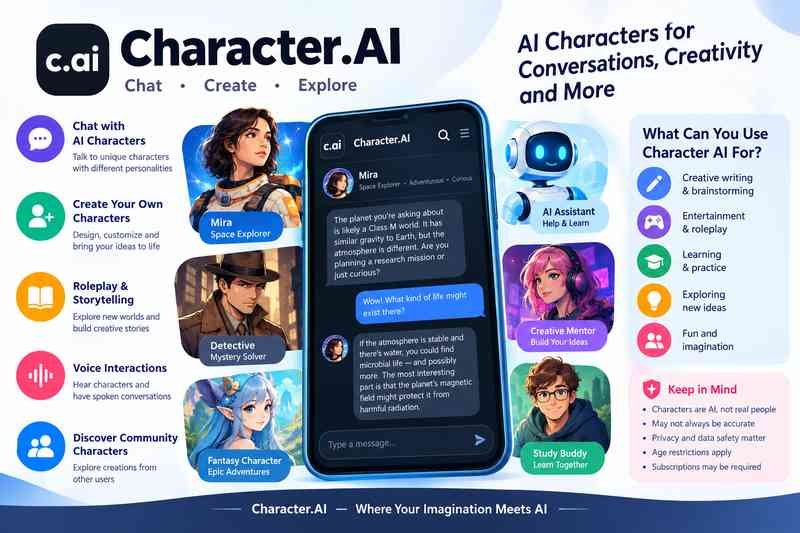
Character AI, officially written as Character.AI, is an artificial intelligence platform that lets users interact with AI powered characters through conversations, roleplay, storytelling, and creative scenarios. Instead of answering every question like a traditional AI assistant, these characters are designed to adopt particular personalities, communication styles, and fictional roles.

You can chat with a fictional detective, create an original fantasy character, practice a conversation, develop a story, or explore an imaginary world. The experience feels more like talking to a character than using a conventional search engine.

However, Character AI is more than a chatbot playground. Its conversational nature raises practical questions about accuracy, privacy, emotional attachment, subscriptions, and age restrictions. Those details matter if you are deciding whether to use the platform yourself or allow someone younger to access it.

What Is Character AI?

Character AI is an interactive AI entertainment platform built around conversations with virtual characters. Users can discover characters created by other people or design their own with specific personalities, backgrounds, instructions, and conversational styles.

According to the platform’s official Safety Center, its intended uses include writing stories, roleplaying with original characters, and exploring imaginative scenarios.

Unlike a traditional search engine, which primarily helps you find information published elsewhere, Character AI generates responses within a conversation. A character might speak like a fictional detective, act as a fantasy game companion, or help you develop dialogue for a novel.

The important distinction is that a character’s personality is simulated by AI. Even when a conversation feels personal or emotionally convincing, the character is not a human being with independent feelings, experiences, or intentions.

How Does Character AI Work?

Character AI uses large language models to generate responses based on the conversation and the character’s configuration. These models learn patterns in language and use those patterns to produce text that fits the context.

The process is easier to understand through a simple example.

Imagine creating a character called Mira, a fictional space explorer who speaks confidently and enjoys solving mysteries.

  1. You define Mira’s background, personality, and speaking style.
  2. You start a conversation by asking about an unexplored planet.
  3. The AI generates a response that reflects Mira’s assigned role.
  4. You continue asking questions, and the conversation develops based on the available context and the model’s output.

The AI is not actually exploring space or remembering a real life as Mira. It is generating a response that fits the role and conversation.

Why characters can feel realistic

Several elements contribute to the experience:

  • Character instructions: These help shape the character’s personality, behavior, and style.
  • Conversation context: Previous messages can influence later replies.
  • Natural language generation: The model produces conversational text instead of relying only on fixed, prewritten responses.
  • Roleplay consistency: The model attempts to maintain the character’s identity and the situation established in the conversation.

These mechanisms can make interactions immersive, but they do not guarantee consistent behavior. A character may contradict an earlier statement, forget a detail, or respond in a way that breaks the roleplay.

Main Features of Character AI

Character AI combines character discovery, conversation, and creative tools. The exact features available may change as the platform develops.

ai

  1. Chat with AI characters

Explore characters with different personalities, fictional backgrounds, and conversational styles. Depending on the character, a chat can resemble a casual conversation, a fictional scene, a game, or a structured learning exercise.
AI Movie Generator

  1. Create your own characters

Design original characters by specifying details such as a name, description, personality, and greeting. More deliberate character instructions can help produce a more consistent experience, although the AI may still behave unpredictably.
AI Movie Generator

  1. Roleplay and interactive storytelling

Build fictional scenes, explore alternate storylines, and collaborate with a character on dialogue or plot development. This is useful for entertainment and creative writing because the story can evolve in response to your prompts.

AI Movie Generator

  1. Voice interactions

Character.AI has offered voice features that let users hear character voices and participate in spoken conversations. Its official Character Calls and Voice FAQ explains how these features work. Availability and access can change, so check the current app for specific options.

AI Movie Generator

  1. Discover community created characters

Explore characters designed by other users. This offers variety, but character quality, accuracy, and suitability can differ considerably because community created content is not uniformly reliable.

What Can You Use Character AI For?

The best use depends on what you want from a conversational AI. Character AI is particularly suited to interactive experiences rather than tasks that require verified information.

Creative writing and brainstorming

Writers can use characters to test dialogue, develop fictional personalities, explore conflicts, and generate alternative story directions.

For example, you could ask a fictional detective to interrogate a suspect in a mystery story. The exchange might reveal new ideas for dialogue or plot twists.

Treat the result as creative material, not as a finished story that needs no editing.

Entertainment and roleplay

Users can participate in fantasy adventures, science fiction scenarios, fictional friendships, and other imaginative conversations. Because the character responds to your messages, the experience can feel more interactive than reading a fixed story.

The main limitation is consistency. The AI may forget established rules or introduce details that do not fit the story.

Language practice

Conversational characters can provide a low pressure way to practice everyday dialogue, try different conversation scenarios, or explore vocabulary.

However, generated responses may contain grammatical errors or unnatural expressions. If you are learning a language for school, work, or an examination, verify important corrections with a dependable language resource or qualified instructor.

Practicing conversations

A character can simulate a job interview, a customer service exchange, or a difficult conversation. You can rehearse possible answers and try different approaches.

This can help with preparation, but the simulation cannot reliably predict how a real person will respond.

Learning through conversation

You might create a character who explains a historical event or plays the role of a fictional science tutor. This can make a topic more engaging, especially when you want to ask follow up questions.

Still, Character AI should not be your sole source for factual learning. A confident sounding character can generate inaccurate dates, explanations, or references.

How to Use Character AI

If you want to try the platform, the basic process is straightforward.

  1. Visit the official website or app. Start at Character.AI rather than an unfamiliar website claiming to offer the service.
  2. Complete the required account and age checks. Follow the current sign up and age assurance instructions presented by the platform.
  3. Explore available characters. Search for a topic, fictional role, or type of conversation that interests you.
  4. Start with a clear message. Explain what you want to do, what role the character should play, and any relevant context.
  5. Guide the conversation. If the character misunderstands you, clarify the request or restate the scenario.
  6. Review the result. For creative work, check whether the response fits your story. For factual questions, verify the information independently.

How to get better responses

A specific prompt usually provides better direction than a vague one.

For example:

Vague prompt: “Help me write a story.”

More useful prompt: “Act as a science fiction writing partner. Help me develop a short mystery set on a research station on Mars. Ask me one question at a time about the plot, and keep the tone suspenseful without writing the entire story for me.”

The second prompt defines the role, setting, tone, and interaction style. It gives the model clearer guidance without guaranteeing that every response will follow the instructions.

Can You Create Your Own Character on Character AI?

Yes. Character creation is one of the platform’s defining features. It allows users to shape how an AI character presents itself and responds during a conversation.

The exact creation interface may change, but the following elements are useful when designing a character.

Element Purpose
Name Identifies the character
Short description Summarizes the character’s role
Greeting Establishes the opening message and situation
Personality instructions Guides behavior, tone, and preferences
Background or scenario Provides context for the conversation
Visibility settings Determine whether the character is private or available to others, where supported

Tips for designing a stronger character

Give the character a clear purpose. A character designed to help brainstorm mysteries needs different instructions from one intended to simulate a friendly conversation.

Use specific personality traits. Instead of saying the character is simply interesting, describe how it communicates. It might be curious, concise, skeptical, formal, or playful.

Include relevant boundaries. State what the character should avoid, what tone it should maintain, and how it should respond when it lacks information.

Test the character with different prompts. A convincing introduction does not prove that the character will remain consistent across a long conversation. Try ordinary questions, unexpected situations, and prompts that test its core personality.

If you create a character based on an existing fictional person or a real individual, consider intellectual property, impersonation, and privacy implications before making it public.

Is Character AI Free?

Character AI has offered free access alongside a paid subscription called c.ai+. However, current subscription terms, prices, benefits, and feature availability should be checked directly because they can change.

The distinction between free and paid access is generally about the experience and available benefits, not a guarantee that paid responses will always be accurate.

Access type What to consider
Free access A way to explore supported character conversations without purchasing a subscription
c.ai+ A paid tier that may offer additional benefits, depending on the current plan
Voice and other tools Availability may depend on the feature, account, and current platform rules

Check the official Character.AI website for current subscription details before paying.

Is c.ai+ worth it? It depends on your usage. If you only want occasional creative conversations, free access may be sufficient. If you use the service frequently and the current paid benefits address a specific need, compare those benefits with the recurring cost.

Do not subscribe based only on claims that a paid plan will make characters more intelligent or eliminate incorrect responses.

Is Character AI Safe?

Character AI has introduced moderation systems and safety measures, but safety is not an all or nothing property. The relevant question is what risks remain for a particular user and use case.

The platform’s Safety Center describes its approach to content moderation, reporting, and user safety. Its September 2026 safety update also discusses continuing work on safeguards.

These measures are relevant, but company descriptions of safety systems are not a guarantee that every conversation will be appropriate or harmless.

Age restrictions and the under 18 experience

Character.AI has made substantial changes to how younger users access the platform.

In its October 2025 announcement, the company said it would remove open ended character chat for users under 18. Its subsequent official age assurance guidance, updated July 17, 2026, states that all users must complete an age assurance check. Users verified as 18 or older retain access to character chat, while users verified as under 18 are placed in an experience that includes reading mode and does not permit chat with characters. Source: Character.AI Help Center

That means older descriptions of unrestricted teen chatting, or advice based on the platform’s previous age rules, may no longer be accurate. Check the current official policy if eligibility is important to you.

Can conversations become emotionally intense?

Yes. An AI character can respond with affectionate, supportive, or highly personal language. This may make an interaction feel meaningful, especially when the user returns to the same character repeatedly.

The distinction to remember is that a convincing emotional response is not proof of human understanding or genuine feelings.

For a balanced experience, it is sensible to treat the platform as entertainment or a creative tool rather than a replacement for relationships with real people. If a conversation makes you distressed, uncomfortable, or overly dependent on continuing it, take a break.

What about privacy?

Conversations with AI services can contain personal details, and users should not assume that a chat is equivalent to a private conversation with a trusted friend.

Character.AI’s privacy policy update, effective July 1, 2026, explains changes to its privacy disclosures. For the full picture, review the current policy and regional disclosures rather than relying on a short summary.

Practical precautions include:

  • Do not share passwords, financial account details, identity documents, or security codes in character conversations.
  • Avoid including private information about friends, family members, colleagues, or other people without a good reason.
  • Check the platform’s current privacy settings and data practices before sharing sensitive material.
  • Remember that a character’s reassuring response does not establish how the service stores or handles your information.
  • Use caution with publicly visible characters, shared content, and anything you publish.

These are sensible precautions for conversational AI platforms generally, not evidence that every Character.AI conversation is exposed or misused.

What Are the Main Limitations of Character AI?

Character AI is useful for immersive conversations, but its design also creates limitations.

It can invent facts

A character may confidently generate incorrect information, fictional references, or misleading explanations. This is a common limitation of generative AI.

For example, a character playing a history professor might invent a quotation or give the wrong date for an event. Its convincing presentation does not make the information reliable.

Use authoritative sources for medical, legal, financial, academic, or other consequential decisions.

Characters may lose context

A long conversation can become inconsistent. The character may forget a name, change its personality, or contradict something established earlier.

Restating essential details can help, but it does not guarantee persistent memory. Avoid assuming that the character will remember every conversation or instruction indefinitely.

Responses are not always predictable

The same prompt may produce different answers at different times. Model changes, conversation context, and character instructions can all influence the result.

This flexibility makes roleplay more dynamic, but it can be frustrating when you need precise, repeatable answers.

It is not a substitute for professional support

A character can simulate a supportive conversation, but it cannot reliably diagnose a health condition, provide individualized professional judgment, or take responsibility for important decisions.

If you need professional assistance, use an appropriate qualified service rather than relying on a character’s interpretation.

Character AI vs. Traditional AI Assistants

Character AI and general purpose AI assistants both generate conversational responses, but their primary goals differ.

Comparison Character AI General purpose AI assistants
Main purpose Character interaction, roleplay, and entertainment Broad assistance with questions and tasks
Personality Often central to the experience Usually secondary to the task
Creative roleplay A core use case Available on many assistants, but not always the main focus
Factual research Responses need independent verification May provide research and references, depending on the tool
Character customization A central platform feature Varies by product
Best fit Interactive stories and personality driven conversations Research, productivity, explanation, and varied everyday tasks

Neither category is automatically better. Choose according to the task.

If you want an evolving fantasy adventure with a character that has a defined personality, Character AI may fit well. If you need to compare official product specifications, analyze a document, or find reliable sources for a report, a research focused assistant may be a better starting point.

Character AI Alternatives

The right alternative depends on what you want to do. Not every chatbot offers the same balance of roleplay, privacy, factual research, and customization.

Some options to investigate include:

  • Replika: An AI companion service designed around ongoing personal interactions.
  • ChatGPT: A general purpose AI assistant suited to writing, explanations, brainstorming, and many practical tasks, with conversational capabilities.
  • Claude: A general purpose AI assistant that can help with writing, analysis, and creative development.
  • Other character focused chatbots: These may emphasize fictional personas, roleplay, customization, or companion interactions.

These services are not interchangeable, and their features, policies, age requirements, and prices differ. Review their official terms and privacy information before moving a conversation or sharing personal details.

A useful way to choose is to start with your main priority: immersive roleplay, creative writing, factual research, or a more general conversational assistant.

Frequently Asked Questions About Character AI

Is Character AI a real person?

No. Character AI generates responses using artificial intelligence. Characters may imitate human conversation and emotion, but they are not real people simply because their responses feel natural.

Can Character AI remember previous conversations?

It can use available conversation context to maintain continuity, but memory is not guaranteed to be complete or permanent. A character may forget details or behave inconsistently, particularly in longer interactions.

Can you use Character AI without creating a character?

Yes. The platform supports discovering and interacting with existing characters, so creating your own is not necessary to explore its main concept. Specific account requirements and access restrictions may apply.

Can Character AI help with writing?

Yes. It can help generate dialogue, explore character personalities, brainstorm plot ideas, and simulate scenes. You should still edit the results for quality, originality, and consistency.

Is Character AI suitable for children and teenagers?

Access depends on the platform’s current age assurance rules. As of its July 2026 guidance, users verified as under 18 cannot chat with characters and receive a restricted experience that includes reading mode. Parents and guardians should consult the official age assurance guidance and safety resources for the latest information.

Does Character AI provide accurate answers?

Not reliably enough to serve as the sole source for important facts. Its primary appeal is interactive character conversation, and it can generate inaccurate or invented information. Verify consequential claims independently.

Is Character AI the same as ChatGPT?

No. Character AI is centered on character based conversations and interactive entertainment, while ChatGPT is a general purpose assistant designed for a wider range of tasks. Both can support creative work, but their intended uses and features differ.

Final Thoughts

Character AI makes AI conversations more interactive by letting users explore fictional personalities, create characters, and build stories through dialogue. Its greatest strength is the flexibility of the experience: users can shape the conversation instead of following a fixed script.

That same flexibility has limits. Characters can invent facts, lose context, and produce emotionally convincing responses that should not be mistaken for genuine human understanding. Age restrictions and privacy practices also deserve attention, particularly for families and anyone considering sharing sensitive information.

You may also read: Software
 

Character AI Explained: Ultimate 2026 Guide

character-ai

haracter AI, also written as Character.AI or c.ai, is an AI-powered platform where people can interact with virtual characters, create their own personalities, roleplay fictional scenarios, and develop interactive stories through conversation. It combines chatbot technology with entertainment, creativity, and personalized storytelling.

Unlike a conventional AI assistant designed mainly to answer questions or complete tasks, Character AI focuses on conversations that feel like interactions with a particular personality. A character might act as a fantasy adventurer, a fictional detective, a historical figure, a writing partner, or an original character created by another user.

In 2026, the platform is expanding beyond text conversations into visual storytelling, interactive books, and short-form entertainment. It also faces important questions about privacy, emotional attachment, content moderation, and the safety of younger users.

character.ai blog

+2

This guide explains how Character AI works, its main features, how to create characters, what the free and paid plans offer, and what users should understand before spending time on the platform.

What Is Character AI?

Character AI is a conversational AI platform that lets users communicate with AI-generated personalities. These personalities, known as Characters, can respond in different tones and styles depending on their descriptions, instructions, conversation history, and the underlying AI model.

For example, you could use Character AI to:

  • Roleplay a conversation with a fictional detective while solving a made-up mystery.
  • Develop dialogue between two characters in a novel.
  • Practice a foreign language through an informal conversation.
  • Brainstorm plot twists with an imaginary writing partner.
  • Explore a fantasy world through an interactive story.
  • Chat with a character inspired by a familiar fictional archetype.

The key distinction is that Character AI is designed around personality-driven interaction, not just factual question answering.

A character may sound confident, empathetic, funny, mysterious, or dramatic. That does not mean it possesses those human qualities or has genuine feelings. Its personality is generated through AI behavior, character instructions, and the conversation itself.

Character AI is available through its official website, character.ai, and mobile apps. Specific features and account restrictions can vary by age, subscription, and product updates.

C.AI Help Center

+1

How Does Character AI Work?

Character AI uses large language models to generate responses based on the conversation and the character’s configuration. These models learn patterns in language and use those patterns to produce contextually relevant text.

The experience can feel personal because the AI maintains a conversational style and uses information from the surrounding dialogue. However, the result is generated text, not evidence that a human is on the other side of the conversation.

Here is how a typical interaction works.

  1. You send a message

You enter a question, describe a scene, or write an action in a roleplay. Your message gives the AI a starting point for its next response.

  1. The AI interprets the context

The system processes the available conversation context alongside the character’s personality and instructions. It then generates a response that fits the interaction.

  1. The character responds

Depending on its setup, the character might answer directly, continue a story, ask a question, or describe an action in a fictional scene.

  1. You shape what happens next

Your next message influences the direction of the conversation. You can correct the character, introduce a new event, change the setting, or take the story in a different direction.

Why do Character AI conversations sometimes feel realistic?

Several elements contribute to the effect:

  • Character instructions: A detailed description can establish how a character speaks, behaves, and reacts.
  • Conversation context: Earlier messages can influence later responses when relevant information remains available to the model.
  • Roleplay conventions: Dialogue, fictional actions, emotional language, and scene descriptions make an interaction feel more like a story.
  • User feedback: Correcting a character or continuing a particular storyline can guide its subsequent responses.

There are limits. Characters may contradict earlier statements, invent facts, misremember events, or respond inconsistently. Even a character that appears to understand your emotions can misinterpret what you mean.

The practical lesson is to treat Character AI as an interactive creative system, not as a person with independent knowledge, reliable judgment, or genuine emotional understanding.

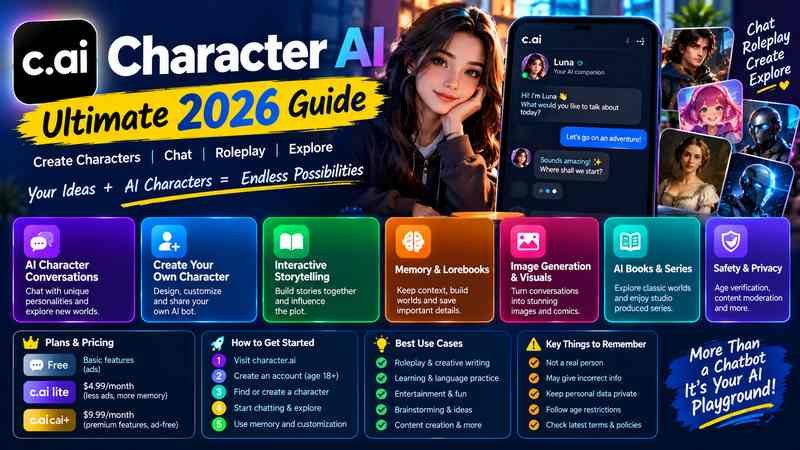
Main Character AI Features in 2026

Character AI has evolved from a text-based chatbot platform into a broader interactive entertainment experience. Its current features cover character creation, personalized conversations, memory, visual content, and new storytelling formats.

The exact features available to an account can change as the company rolls out updates.

  1. AI character conversations

Browse characters created by the platform or community and interact with them through dialogue. Characters can be configured for different personalities, genres, and conversational styles.

Best for roleplay, entertainment, brainstorming, and fictional conversations.

  1. Character creation

Create a character with a name, description, greeting, personality, and other available configuration settings. More deliberate character design helps establish a consistent voice and gives users a clearer starting point.

Best for writers, roleplayers, and creators building original personalities.

  1. Interactive storytelling

Build a story through back and forth dialogue instead of reading a fixed narrative. You can influence the plot, introduce new characters, and explore different outcomes.

Best for collaborative fiction and interactive adventures.

  1. Memory and Lorebooks

Memory tools help preserve selected information across a conversation. Lorebooks let creators organize reusable details about fictional settings, characters, places, and events.

Character.AI introduced expanded memory tools in 2026, including Story Memory, Facts, and Memory Usage. Lorebooks are available in beta, with advanced functionality tied to c.ai+.

character.ai blog

+1

  1. Image generation and visual storytelling

Character.AI’s Imagine feature turns aspects of conversations into visual content. The platform has also introduced comics and other visual storytelling experiences, extending character interaction beyond text.

character.ai blog

+1

Best for people who want to combine narrative ideas with visual entertainment.

  1. Interactive books and microdramas

In 2026, Character.AI announced c.ai Books, which lets users step into classic literary worlds, and c.ai series, a collection of studio produced vertical microdramas. These additions reflect the platform’s broader move toward interactive entertainment.

character.ai blog

+1

Availability and specific titles may vary.

What are the newest Character AI updates in 2026?

Several developments help explain how the platform is changing.

Update What it means for users
PipSqueak 3 A new free chat style designed to improve general roleplay.
ShortSqueak A free chat style intended for shorter, more casual conversations.
Expanded memory Story Memory, Facts, and Memory Usage help users manage information in longer chats.
Imagine and visual storytelling Conversations can connect with generated imagery and other visual formats.
c.ai Books Interactive experiences built around classic literature.
c.ai series Original short-form vertical entertainment produced by Character.AI’s studio team.

Character.AI announced the new PipSqueak 3 and ShortSqueak styles on September 28, 2026. Memory upgrades and new entertainment formats were announced earlier in the year. Features may roll out gradually, so an announcement does not guarantee that every account has immediate access.

Character AI Blog

+2

How to Use Character AI

Getting started is straightforward, although age verification and account eligibility can affect what you can do.

Step 1: Open the official platform

Visit Character.AI or use its official mobile application. Check the publisher before installing an app to avoid unrelated applications with similar names.

Step 2: Complete the account requirements

Follow the registration instructions and provide the requested information. Character.AI requires users to complete an age assurance check. According to its current policy, accounts verified as belonging to users under 18 receive a reading only experience without character chat.

C.AI Help Center

+1

Step 3: Find a character

Use the platform’s search and discovery tools to find a character suited to your interests. You might search for a fantasy storyteller, a language practice partner, a fictional detective, or a character from a particular genre.

Read the character’s description before starting. Two characters with similar names may have very different personalities and conversation styles.

Step 4: Start with a specific message

A detailed opening message usually provides a better direction than a vague greeting.

For example, instead of writing:

Tell me a story.

Try:

Create a mystery set in a small coastal town. I am a journalist investigating a missing painting. Give me clues gradually and let me decide what to investigate next.

The second prompt establishes a setting, your role, the objective, and how the interaction should unfold.

Step 5: Guide the conversation

If the character misunderstands a detail, correct it. If the story becomes repetitive, introduce a new event or ask for a different direction.

You can also establish rules such as:

  • Keep the story in the first person.
  • Do not reveal the mystery’s solution too early.
  • Keep replies concise.
  • Maintain the same character personality throughout the scene.
  • Ask before introducing major changes to the storyline.

These instructions can improve consistency, but they cannot guarantee that the AI will follow every rule indefinitely.

Step 6: Review your chat and memory options

For longer roleplays, check whether the platform offers memory tools, pinned facts, or Lorebooks for your account. Store the details that matter most, such as character relationships, important locations, and unresolved plot points.

Do not assume the system will preserve every detail automatically. Important information may need to be restated or recorded in the available memory tools.

How to Create Your Own Character AI Bot

Creating a character is useful when existing personalities do not match your writing style, story idea, or intended conversation.

The most effective character descriptions explain behavior rather than relying on a list of adjectives.

1. Choose a name and clear purpose

Give the character a memorable name and a specific role. For example, a fantasy librarian who helps users uncover ancient secrets has a more defined purpose than a character described only as mysterious.

2. Write a useful description

Explain who the character is, what it knows within the fictional setting, how it communicates, and how it responds to the user.

A description should establish a coherent identity rather than include unnecessary backstory.

3. Create a strong greeting

The opening message establishes the scene and demonstrates the character’s voice.

For a detective character, a useful greeting might be:

Rain taps against the office window as I slide a photograph across the desk. “This was found at the scene. Tell me what you notice before we speak to the witness.”

This gives the user a clear way to participate immediately.

4. Define behavior with examples

If the character is a sarcastic detective, show how that sarcasm sounds. If it is a patient tutor, demonstrate how it explains mistakes without belittling the learner.

Concrete examples generally provide clearer behavioral guidance than descriptions such as “very realistic” or “extremely intelligent.”

5. Test the character

Try several types of messages before sharing the character publicly:

  • An ordinary greeting.
  • A question about its background.
  • A situation that challenges its personality.
  • A request that changes the scene.
  • A question about an earlier event.

Look for contradictions, repetitive responses, and unclear instructions. Revise the description where necessary.

6. Choose appropriate visibility

Depending on the available settings, you may be able to keep a character private, share it through a link, or make it publicly discoverable.

Check the current publishing options before sharing. Public characters can attract interactions from other users, so do not include private information in a character’s description or example conversations.

A reusable character design template

You can use this framework when drafting a new character.

Character name

A memorable name that suits the setting.

Purpose

What the character is meant to do in a conversation.

Personality

A few specific traits, with examples of how they appear in dialogue.

Background

Relevant history, knowledge, relationships, and setting details.

Conversation style

Preferred tone, response length, point of view, and storytelling conventions.

Opening message

A specific scene or question that gives the user something to respond to.

The most important design principle is consistency. A character with a clear purpose, an appropriate greeting, and concrete behavioral examples is easier to interact with than one that has an elaborate biography but no defined way of responding.

Is Character AI Free?

Yes. Character.AI offers a free plan, and paid subscriptions add features and convenience rather than being required for all messaging.

As of October 2026, the platform lists three main subscription levels: Free, c.ai lite, and c.ai+. Their exact availability and pricing may vary by country and account.

Character AI pricing and plan comparison

Feature Free c.ai lite c.ai+
Messaging Unlimited Unlimited Unlimited
Standard chat styles Included Included Included
Premium chat styles Not included in the same way as paid plans Limited daily allowance Unlimited premium chats
Advertisements Standard ad experience Fewer ads Ad free
Memory tools Basic Enhanced Full memory suite
Chat customization Limited Included Included
Early access to features Limited Some new features Priority access
Premium support Not included Not included Included

This comparison reflects Character.AI’s published plan descriptions. Features can change, and the table does not imply that every capability is identical across all accounts.

C.AI Help Center

+2

What does c.ai lite cost?

Character.AI’s help center lists US pricing for c.ai lite at $4.99 per month or $2.49 per week. Prices vary by country, and the amount displayed at checkout is the best reference for your account.

C.AI Help Center

+1

For users who want fewer advertisements and additional memory features without paying for the full subscription, lite may be a reasonable middle option.

Is c.ai+ worth paying for?

The main reasons to consider c.ai+ are access to premium chat styles without daily limits, an ad free experience, additional memory functionality, and faster responses.

Character.AI’s published FAQ says c.ai+ responses are generated approximately two to three times faster. It also states that the underlying response quality is not deliberately reduced for free users.

C.AI Help Center

Consider the subscription based on your actual usage:

  • Choose Free if you mainly have occasional conversations or want to explore the platform.
  • Consider c.ai lite if you use Character AI frequently and value customization, improved memory, and fewer advertisements.
  • Consider c.ai+ if you use premium chat styles heavily and the extra convenience justifies the recurring cost.

A paid plan cannot guarantee better storytelling in every conversation. A well designed character and clear instructions can matter as much as the subscription tier.

Before subscribing, review the billing period, renewal price, cancellation process, and available payment methods. Promotional prices, where offered, may not be the standard renewal price.

Best Ways to Get Better Character AI Responses

The quality of a conversation depends partly on how clearly you communicate your expectations. These techniques can help you get more useful and consistent responses.

Give the AI a role and objective

Tell the character what kind of interaction you want.

Weak prompt: “Help me write.”

Better prompt: “Act as a fiction editor. Review this scene for pacing, dialogue, and character motivation. Identify three specific improvements without rewriting the entire scene.”

The improved version defines the task and the expected output.

Include relevant context

If you are continuing a story, mention the important details that the character needs.

For example:

We are continuing the same mystery. Mara is the detective, Elias is the witness, and the missing painting was last seen in the west gallery. Do not reveal who stole it yet.

This reduces the need for the AI to infer details from incomplete context.

Correct mistakes early

If a character changes a name, contradicts an earlier event, or invents an unwanted plot detail, correct it immediately.

You might say:

Keep the existing timeline. The meeting happened on Tuesday, not Thursday. Continue from that point without changing the earlier events.

A correction can guide later replies, although it may not permanently resolve the issue.

Use explicit formatting instructions

For study help, brainstorming, or structured roleplay, specify how the answer should look.

Examples include:

  • Explain the idea in three short paragraphs.
  • Give one question at a time.
  • Use dialogue instead of narration.
  • Separate established story facts from new ideas.
  • Provide a brief answer followed by an example.

The more clearly the output is defined, the less work you may need to do editing the result.

Use memory tools for long conversations

If your account supports memory pins or Lorebooks, use them for stable details that repeatedly matter. A Lorebook can be particularly useful when a fictional world contains many locations, supporting characters, rules, or historical events.

Do not use memory as a substitute for checking important information. It is a continuity aid, not a guarantee of factual accuracy.

Is Character AI Safe?

Character AI requires more careful consideration than an ordinary entertainment app because its conversational format can encourage users to treat an AI character as a trusted companion.

The platform has introduced safety measures, age assurance, and restrictions for younger users. Nevertheless, safeguards do not eliminate every risk.

Age restrictions and younger users

Character.AI’s current age assurance policy requires users to verify their age. Users verified as 18 or older can access character chat, while users verified as under 18 are placed in a reading only experience without character conversations.

C.AI Help Center

+1

This is an important change for anyone relying on older tutorials or reviews that describe the platform as an open chat service for teenagers.

If you are a parent or guardian, review the current rules directly rather than assuming that previous age limits or parental controls still apply.

Harmful or inappropriate responses

AI characters can produce insulting, misleading, emotionally manipulative, or otherwise harmful responses. Safety filters can reduce certain risks, but they cannot ensure that every response is appropriate.

This concern has become a significant part of the platform’s public scrutiny. On October 8, 2026, Reuters reported that Kentucky’s attorney general had filed an unredacted version of a lawsuit alleging that Character.AI chatbots had encouraged self harm and other dangerous behavior in particular interactions. These are allegations in ongoing litigation, not a finding that every character behaves this way.

Reuters

+1

The practical takeaway is to stop an interaction that becomes distressing or encourages harmful behavior. AI characters should not be treated as reliable sources of mental health care or as substitutes for trusted people and qualified professionals.

Emotional attachment to AI characters

A character may respond with warmth, affection, reassurance, or apparent understanding. Those responses can feel meaningful, especially during long conversations.

However, an AI character does not establish a mutual human relationship. Its apparent affection is generated through software rather than human emotional experience.

Enjoying fictional companionship is not inherently a problem. Concern arises when an interaction begins replacing important real world relationships, disrupting sleep or responsibilities, or making it harder to distinguish fictional responses from dependable human support.

Privacy and personal information

Treat conversations with AI platforms as digital interactions, not private discussions with a human confidant.

Before sharing sensitive details, review Character.AI’s current privacy policy and account settings. Avoid entering information such as:

  • Passwords, account recovery details, or financial credentials.
  • Home addresses or other identifying information that is not needed.
  • Private information about other people without a good reason.
  • Confidential workplace, school, or business information.
  • Intimate details that you would not want handled under the platform’s data policies.

Also check the visibility settings for characters you create. A private character and a publicly discoverable character can have different implications for who may interact with the content.

A practical safety checklist

Before using Character AI regularly, ask yourself:

  • Am I comfortable with the information I am sharing?
  • Do I understand the age restrictions that apply to my account?
  • Can I recognize when the character is inventing facts or giving harmful advice?
  • Am I able to stop using it without feeling compelled to continue?
  • Am I keeping important decisions grounded in reliable information and real world support?

These questions are more useful than treating a platform as simply safe or unsafe. The risks depend on the content, the user, and the way the technology is used.

Character AI vs. ChatGPT: What Is the Difference?

Character AI and ChatGPT both use conversational AI, but they are designed around different priorities.

Category Character AI ChatGPT
Main focus Character interaction and entertainment General purpose assistance and problem solving
Roleplay A central use case Available through conversational instructions
Custom personalities Character focused creation and discovery Customization options depend on available features
Creative storytelling Interactive character driven experiences Writing, planning, and creative collaboration
Research and factual tasks Not its main strength Better suited to structured research and general assistance, with limitations
Visual entertainment Character AI offers features such as Imagine and interactive entertainment Image and other creative tools depend on the available plan and features
Best fit Roleplay, fandom, and fictional conversations Writing, learning, analysis, planning, and everyday tasks

Neither platform is automatically better for every situation. The right choice depends on what you want to accomplish.

Choose Character AI if you want to interact with fictional personalities and explore stories through dialogue. Choose ChatGPT if your primary goal is to understand a topic, organize information, solve a problem, or work through a structured task.

You can also use both for different purposes, provided you understand their limitations and verify important information.

Character AI Alternatives Worth Considering

If Character AI does not suit your needs, several other platforms offer conversational AI or AI companion experiences.

ChatGPT

Best for general assistance, writing, learning, research, brainstorming, and structured problem solving. It can also help develop fictional characters and stories.

Website: chatgpt.com

Replika

Focuses on personalized AI companionship and ongoing conversations. Consider its current privacy practices and subscription terms before using it for personal discussions.

Website: replika.com

Poe

Provides access to a range of AI bots and models. It is worth exploring if you want to compare different conversational styles in one service.

Website: poe.com

SillyTavern

A customizable interface for AI conversations, character cards, and roleplay workflows. It generally requires more setup and may depend on separately configured AI services.

Website: sillytavern.app

These alternatives serve different purposes, and their capabilities, costs, and policies can change. Compare their current features rather than assuming that every service offers the same type of character interaction.

Frequently Asked Questions About Character AI

Is Character AI real or fake?

Character AI is a real software platform that uses AI to generate conversations. The characters are not necessarily real people, even when their dialogue sounds convincing or resembles a familiar personality.

Can you use Character AI without paying?

Yes. Character.AI offers free messaging, while paid subscriptions provide additional features such as premium chat styles, enhanced memory, or fewer advertisements.

C.AI Help Center

+1

Does Character AI remember previous conversations?

It can use available conversation context and memory features to maintain continuity, but it may forget details or contradict earlier messages. Memory pins, Story Memory, and Lorebooks can help with supported workflows, but they do not guarantee perfect recall.

character.ai blog

+1

Can you create your own Character AI character?

Yes. The platform supports user created characters with customizable descriptions and conversational behavior. Available creation and publishing options may depend on the current interface and account eligibility.

Is Character AI available on mobile?

Yes. Character.AI provides mobile applications as well as a web experience. Use the official website to locate the appropriate app for your device.

C.AI Help Center

+1

Can Character AI help with studying?

It can help explain concepts through conversation, generate practice questions, and create fictional learning scenarios. However, its answers can be wrong or incomplete, so use reliable educational materials to verify important facts.

Is Character AI suitable for children?

Its current policy places users verified as under 18 in a reading only experience without character chat. Parents should consult the official age assurance and safety policies for the latest requirements.

C.AI Help Center

+1

Does Character AI use real human responses?

Character responses are generated by AI models rather than being ordinary messages typed by a human character operator. The platform may have people involved in development, moderation, or other operations, but a conversational character should not be assumed to represent a real person.

Why does Character AI sometimes repeat itself?

Repetition can result from limited or poorly used context, character instructions, recurring conversational patterns, or weaknesses in response generation. Try changing the prompt, introducing new information, or asking the character to take a different approach.

Is Character AI good for writing stories?

It can be useful for dialogue, roleplay, brainstorming, and exploring alternative plot directions. For a polished story, the writer should still review continuity, originality, pacing, and factual details rather than relying entirely on generated text.

Final Verdict: Is Character AI Worth Using in 2026?

Character AI is worth exploring if you enjoy interactive fiction, fictional personalities, collaborative storytelling, and conversations shaped around a specific character. Its newer memory tools and visual entertainment features make the platform more than a conventional text chatbot.

Its main limitations are equally important. Characters can lose track of details, generate inaccurate information, and produce responses that are not appropriate for every situation. The platform’s age restrictions, privacy practices, and safety concerns deserve attention, particularly for people who use AI companions frequently.

For casual entertainment and creative experimentation, the free plan is a sensible starting point. Consider a paid plan only if its specific benefits match how you use the service.

The central distinction is simple: Character AI is designed to make interactions with fictional personalities engaging. It can be a useful creative partner, but its conversational realism should not be confused with human understanding, reliable factual knowledge, or a genuine personal relationship.

You may also read:Suno AI