
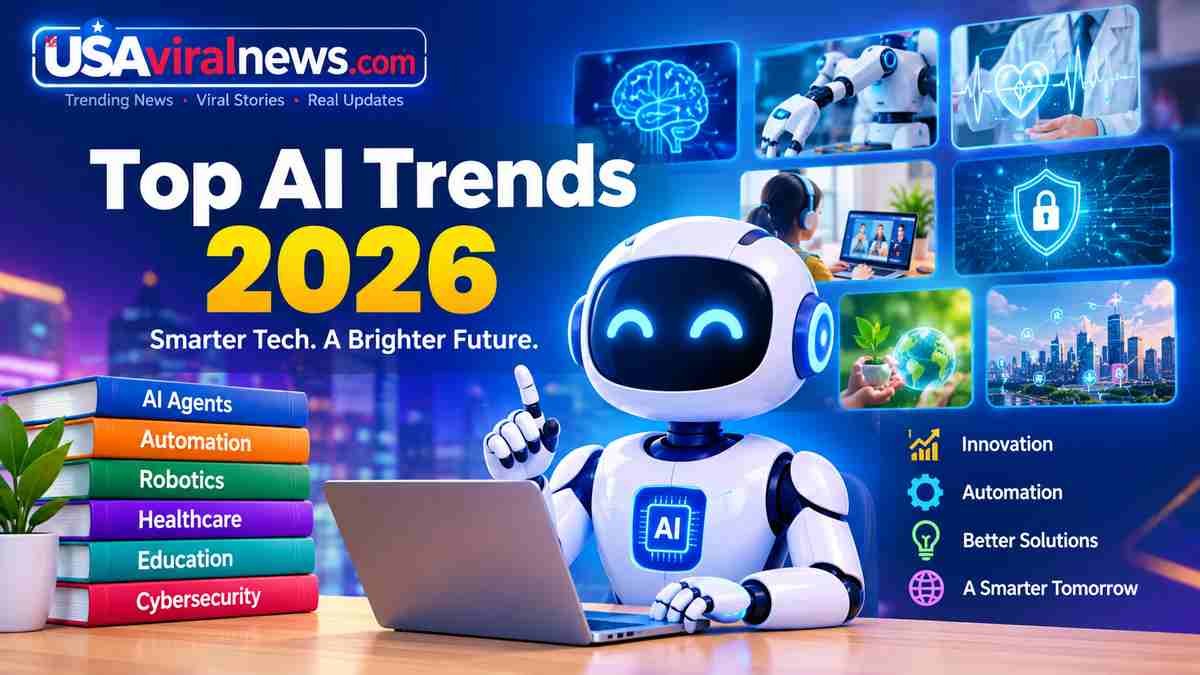
Artificial intelligence is changing how we work, learn, communicate, and solve everyday problems. From smart assistants to advanced robots, AI is becoming part of our daily lives. What once seemed like science fiction is now helping people complete real tasks. Businesses, students, developers, and content creators are discovering new ways to use this technology.
The Top AI Trends 2026 reveal an important shift toward smarter tools, automated workflows, and more practical applications. AI is no longer limited to answering questions or generating simple content. Modern systems can analyze information, understand different types of media, and support complex tasks. Some can even complete multiple steps with limited human guidance.
However, not every new technology will deliver the same value. Some innovations are already useful, while others still need testing and improvement. Understanding the latest AI trends helps you make better decisions about learning, business, and technology. In this guide, we explore 15 important developments shaping artificial intelligence in 2026.
What Are the Top AI Trends 2026?
The Top AI Trends 2026 describe important developments changing how artificial intelligence works and where people use it. These trends include AI agents, multimodal models, robotics, personalized assistants, and stronger security systems. They also highlight growing interest in smaller AI models and tools designed for specific industries.
The biggest change is the move from simple experimentation toward practical results. People increasingly want AI tools that save time, reduce repetitive work, and solve real problems. Businesses are also paying closer attention to reliability, privacy, operating costs, and measurable benefits. These priorities help explain why several artificial intelligence trends are receiving attention throughout 2026.
1. AI Agents Will Handle More Complex Tasks
AI agents are among the most important AI technology trends in 2026. Unlike traditional chatbots, these systems can work toward goals through several connected steps. Depending on their design, they can gather information, use software tools, and organize tasks. Some can also review results before continuing with the next step.
For example, an AI agent might research competitors, organize findings, and prepare a draft report. Another agent could help customer support teams classify requests and suggest suitable responses. These capabilities can reduce repetitive work and help employees focus on decisions requiring human judgment. However, agents still need clear instructions, appropriate permissions, and careful monitoring.
According to Google Cloud’s 2026 AI agent report, businesses are exploring agents for productivity, customer service, and security operations. The report also emphasizes workforce training as an important part of successful adoption.
2. Multimodal AI Will Understand Different Types of Content
Multimodal AI is another major development among the latest AI trends. These systems can work with different information types, including text, images, audio, video, and documents. Instead of treating every format separately, they can combine information to understand a broader context.
Imagine uploading a product photograph and asking an AI assistant to describe its features. You could then provide a video and request a comparison with another product. A multimodal system may analyze both inputs and explain their similarities. This makes AI more useful for education, research, marketing, and everyday communication.
Businesses can also use multimodal AI to review documents, summarize recorded meetings, and analyze visual information. These applications may save time when employees work with large amounts of mixed content. Still, users should verify important details because AI systems can misunderstand images, speech, or context.
3. AI-Powered Automation Will Transform Business Workflows
Business automation is moving beyond basic actions such as sending automatic emails. Modern AI systems can help connect different tasks into more organized workflows. For example, a system might summarize customer messages, identify urgent requests, and prepare suggested replies. Another workflow could organize sales information and generate regular performance reports.
These emerging AI technologies 2026 may help small businesses compete with larger organizations. Owners can use automation to manage repetitive administrative work without immediately hiring additional staff. Marketing teams can also organize research, content planning, and reporting more efficiently. However, automation works best when businesses define clear goals and review important outputs.
Companies should begin with simple processes that have predictable steps. They can measure time savings, error rates, and customer satisfaction before expanding automation. This approach helps businesses identify genuine benefits instead of adopting AI simply because it is popular.
4. Personalized AI Assistants Will Become More Useful
AI assistants are becoming more helpful as developers improve their ability to understand context. Some systems can remember relevant preferences or work with information users provide during conversations. Others can connect with approved applications to support everyday activities. These features may make digital assistants more useful for personal and professional tasks.
For instance, an assistant could help organize a weekly schedule, prepare meeting notes, or explain unfamiliar topics. A student might use one to understand difficult lessons through simpler examples. A business owner could ask for help planning campaigns or reviewing customer feedback. The quality of these results still depends on available information and the assistant’s capabilities.
Privacy remains important when assistants handle personal details or business documents. Users should review memory settings, permissions, and data policies before sharing sensitive information. Personalization can improve convenience, but it should never replace informed control over personal data.
5. Smaller AI Models Will Gain More Attention
Large AI models receive considerable attention because of their impressive capabilities. However, smaller models are becoming important for organizations seeking affordable and efficient solutions. These models can be designed for specific tasks, such as classification, summarization, or document analysis. They may also require fewer computing resources than larger alternatives.
Smaller models can be especially useful when businesses need predictable results for narrow applications. Some can run directly on local computers or compatible devices. This approach may reduce delays and limit the amount of information sent to external servers. Nevertheless, performance depends on the model, hardware, and complexity of the task.
Organizations should compare accuracy, speed, cost, and privacy requirements before choosing a model. A smaller system may outperform a larger one on a carefully defined task. The best choice depends on the problem rather than the model’s size alone.
6. AI Coding Tools Will Support Software Development
AI coding assistants are changing how developers write, test, and maintain software. These tools can suggest code, explain errors, generate tests, and help developers understand unfamiliar projects. More advanced systems can support several development steps within a connected workflow. This allows developers to spend less time on repetitive coding tasks.
However, generated code is not automatically correct or secure. Developers must check for errors, performance issues, and potential security weaknesses. They should also understand the code before using it in important applications. AI can speed up development, but professional judgment remains essential.
The future of software development will likely involve closer cooperation between humans and AI tools. Developers who understand programming fundamentals can evaluate suggestions more effectively. Learning how to test, debug, and review AI-generated code will therefore remain valuable.
7. AI Robotics Will Move Into More Real-World Environments
Robotics is becoming an important part of the future of artificial intelligence. Researchers are combining AI models with machines that interact with physical surroundings. These systems can help robots interpret instructions, recognize objects, and respond to changing conditions. Progress in this area could expand automation beyond traditional factory environments.
Manufacturing facilities already use robots for repetitive and controlled tasks. Newer systems aim to handle more flexible activities in warehouses, laboratories, and other workplaces. AI-powered robots may eventually support certain household and service tasks. However, reliable movement, safety, cost, and real-world training remain significant challenges.
Businesses should distinguish between impressive demonstrations and dependable commercial products. A robot that performs well in a controlled test may struggle in unfamiliar surroundings. Wider adoption will depend on consistent performance, practical costs, and effective safety measures.
8. AI in Healthcare Will Support Research and Patient Services
Healthcare is another important area among the top artificial intelligence trends. AI systems can help researchers examine medical information and identify patterns worth investigating. They may also support administrative work, medical image analysis, and clinical documentation. These applications can help professionals manage information more efficiently.
Researchers are also exploring AI-assisted drug discovery and other scientific applications. These tools may help identify promising research directions or prioritize experiments. However, discovering a potential treatment is different from proving that it works safely. Clinical testing and expert evaluation remain essential.
AI should support qualified healthcare professionals rather than replace appropriate medical care. Systems can make mistakes, and medical information requires careful interpretation. Patient privacy, reliable evidence, and human oversight must remain central to healthcare applications.
9. AI Education Tools Will Support Personalized Learning
Education technology is changing as AI tools become more accessible. Students can use AI assistants to explain difficult concepts, practice languages, and generate revision questions. Teachers may use these systems to prepare lesson materials or organize learning activities. These features can make educational support more flexible.
For example, a student struggling with mathematics could request several simpler explanations. The assistant could then provide practice questions with step-by-step guidance. A language learner might practice conversations and receive suggestions for improving grammar. These examples show how AI can support different learning needs.
However, students should not depend entirely on automatically generated answers. They need to check facts, practice independently, and develop their own understanding. Teachers also need clear policies for responsible AI use. The strongest educational results come when technology supports active learning rather than replacing it.
10. AI Cybersecurity Will Become More Important
As organizations adopt more AI tools, cybersecurity becomes increasingly important. AI can help security teams identify unusual activity and investigate potential threats. Some systems can organize alerts and highlight patterns that deserve attention. These capabilities may help analysts respond more efficiently.
Unfortunately, attackers can also use AI to improve phishing messages and automate certain malicious activities. This creates new challenges for businesses and individual users. Organizations must protect their systems, review access permissions, and train employees to recognize suspicious activity. Security teams should also test AI tools before allowing them to take sensitive actions.
Responsible AI security requires more than installing another software product. Businesses need monitoring, clear accountability, regular testing, and reliable backup procedures. Human review remains especially important when automated systems can affect important accounts or infrastructure.
11. On-Device AI Will Improve Speed and Privacy Options
On-device AI processes information directly on compatible phones, computers, or other devices. This differs from systems that depend entirely on remote cloud servers. Local processing can reduce network delays and may help keep certain information on the device. It can also allow some features to work without a constant internet connection.
For example, a smartphone might use local AI to summarize notes or organize photographs. A computer could support selected writing and productivity tasks without sending every request to a remote service. These benefits depend on hardware capabilities, model size, and available memory.
On-device processing does not automatically guarantee complete privacy. Apps may still collect information through other features or connected services. Users should check privacy settings and understand where their data goes. This trend offers useful options, but implementation details matter.
12. Open-Source AI Will Expand Opportunities for Developers
Open-source and open-weight AI projects are giving developers more ways to experiment. Depending on the license, users may inspect code, run available models, or adapt them for specific needs. This can help researchers and smaller businesses explore AI without relying entirely on one provider.
Developers may use these models to build specialized assistants or private document-search systems. Organizations can also evaluate whether local deployment suits their technical requirements. However, open-weight models do not always provide access to every part of the original training process. Their licenses and limitations also vary.
Before choosing a model, developers should review its documentation, permitted uses, and security requirements. They should also examine performance using their own examples. Open AI technologies can increase flexibility, but they still require responsible implementation.
13. Generative AI Will Improve Content Creation
Generative AI remains a significant force in writing, design, video, and audio production. These tools can help creators brainstorm ideas, prepare outlines, generate drafts, and explore different visual styles. Some systems can also transform existing content into alternative formats. This makes creative experimentation faster and more accessible.
For example, a content creator could develop several article outlines before selecting the strongest approach. A designer might explore different concepts before producing a polished final image. Video creators could use AI to prepare captions, organize footage, or draft scripts. Human creativity remains important for originality, accuracy, and audience understanding.
Businesses should avoid publishing unchecked AI-generated material. Incorrect facts, repetitive writing, and misleading images can damage trust. The strongest results usually combine AI assistance with original experience, careful editing, and a clear understanding of audience needs.
14. Responsible AI and Governance Will Receive Greater Attention
Responsible AI is becoming a practical business requirement rather than an optional discussion. Organizations need to understand how their systems use data and make decisions. They must also consider privacy, fairness, security, and the consequences of errors. These concerns become more important as AI handles complex tasks.
Businesses should establish clear rules for approving tools and reviewing their outputs. They can document important decisions, limit access, and test systems for known weaknesses. Employees also need guidance about which information they can share with AI services. These steps help organizations use technology more responsibly.
Governance does not have to prevent innovation. Clear policies can help teams experiment while reducing avoidable risks. Companies that combine useful AI applications with proper oversight may be better prepared for changing expectations and regulations.
15. AI Skills Will Become More Valuable Across Industries
Learning how to use AI effectively is becoming useful across many professions. Workers do not always need advanced programming skills to benefit from these tools. However, they should understand how to write clear instructions, evaluate results, and recognize common limitations. These practical abilities can improve everyday productivity.
Students can learn AI fundamentals alongside writing, research, and problem-solving. Business owners can explore automation and data analysis using tools suited to their needs. Marketers can practice content research, campaign planning, and performance reporting. Developers can build deeper skills in model integration, evaluation, and security.
The goal should not be to learn every new tool immediately. Instead, choose tools that solve real problems and practice using them consistently. Strong communication, critical thinking, subject knowledge, and adaptability will remain valuable alongside technical skills.
How AI Trends 2026 May Affect Different Industries
The impact of artificial intelligence will vary according to each industry’s needs. Some sectors will focus on automation, while others will prioritize research, customer service, or better access to information. Understanding these differences helps businesses choose suitable applications instead of following every new development.
| Industry | Potential AI application | Main benefit |
|---|---|---|
| Healthcare | Medical image support and research | Better information analysis |
| Education | Personalized explanations and practice | Flexible learning support |
| Marketing | Research, drafting, and campaign analysis | More efficient workflows |
| Software development | Code assistance and testing | Faster development tasks |
| Manufacturing | Robotics and predictive maintenance | Improved operational efficiency |
| Customer service | AI assistants and request classification | Faster initial responses |
| Cybersecurity | Alert analysis and threat detection | Better security monitoring |
| Retail | Product recommendations and demand analysis | More relevant customer experiences |
These examples represent potential uses rather than guaranteed results. Actual benefits depend on implementation, data quality, costs, and human supervision. Businesses should measure outcomes before expanding their AI investments.
Benefits and Challenges of the Latest AI Trends
The latest AI trends offer opportunities to improve productivity and make complex information easier to understand. They can help people explore ideas, automate routine tasks, and support decisions. Smaller organizations may also gain access to capabilities that previously required larger technical teams.
However, AI adoption comes with important challenges. Systems can generate incorrect information, expose sensitive data, or produce inconsistent results. Advanced applications may also require expensive hardware, technical expertise, and ongoing maintenance. Organizations must consider these limitations before relying on AI for important work.
A balanced approach focuses on clear goals, careful testing, and human accountability. Start with manageable tasks and evaluate the results honestly. Expand only when the benefits justify the costs and risks. This approach helps individuals and businesses gain value without treating AI as a perfect solution.
How to Prepare for Emerging AI Technologies in 2026
You do not need to become an AI researcher to prepare for these changes. Start by identifying tasks that consume too much time or involve repetitive work. Then explore tools designed for those specific needs. Test their outputs carefully and compare their results with your existing process.
Businesses should establish clear rules for data access, human review, and tool selection. Employees need practical training that matches their daily responsibilities. Small experiments can reveal whether AI improves speed, accuracy, or customer experience. Regular reviews also help teams identify problems before expanding their use.
Individuals can focus on digital skills, critical thinking, and responsible AI use. Learn how different tools work and understand their limitations. Keep improving your existing professional skills instead of relying entirely on automation. The best preparation combines technical awareness with sound judgment and real-world experience.
AI Predictions 2026: What Could Happen Next?
Several developments may shape the next stage of artificial intelligence. AI agents could handle more connected tasks as reliability and permission controls improve. Multimodal systems may become more useful across everyday applications. Smaller models could also expand access to AI on local devices.
Robotics may progress as researchers improve how machines understand and interact with physical environments. AI-assisted scientific research could support new discoveries in medicine and materials science. Businesses may increasingly demand evidence of measurable benefits before expanding their investments.
These AI predictions 2026 should be treated as informed expectations, not guaranteed outcomes. Technical limitations, costs, regulations, and public trust will influence adoption. Some technologies will advance quickly, while others may take longer than expected. Following credible research and real-world results provides a stronger picture than relying on hype.
Frequently Asked Questions
What are the top AI trends in 2026?
The leading trends include AI agents, multimodal models, business automation, AI coding assistants, and robotics. Other important developments include healthcare AI, personalized learning, cybersecurity, and on-device processing. Responsible AI governance and practical AI skills are also receiving greater attention.
Which AI technology will be most useful in 2026?
The most useful technology depends on your goals and daily tasks. AI assistants can help individuals with research, writing, and organization. Businesses may benefit from workflow automation and specialized AI agents. Developers may find coding assistants and smaller models particularly useful.
How will AI affect jobs in 2026?
AI will change how many people perform their jobs by automating selected tasks and supporting decision-making. Some roles may require fewer repetitive activities, while others may develop new responsibilities. The impact will differ across industries, and workers will benefit from learning relevant skills.
Is AI worth learning in 2026?
Yes, learning practical AI skills can be valuable across many industries. Start with basic AI concepts, clear prompting, fact-checking, and data privacy. Then explore tools related to your profession. Strong subject knowledge remains essential for evaluating AI-generated results.
Will AI replace human workers?
AI may automate certain tasks, but that does not mean every affected job will disappear. Many roles combine technical tasks with communication, judgment, and personal responsibility. Workers who learn to use AI effectively may adapt more easily as their industries change.
What are the biggest risks of artificial intelligence?
Important risks include inaccurate information, privacy violations, biased results, cybersecurity threats, and excessive dependence on automation. AI systems can also create challenges involving copyright and accountability. Careful testing, appropriate safeguards, and human oversight can help reduce these risks.
How can small businesses use AI trends in 2026?
Small businesses can begin with customer support, content planning, document summaries, and repetitive administrative tasks. They should select affordable tools that address clear business needs. Testing results and protecting customer information should remain priorities throughout adoption.
Final Thoughts on the Top AI Trends 2026
The Top AI Trends 2026 show how artificial intelligence is moving toward more practical, connected, and specialized applications. AI agents, multimodal tools, robotics, and smaller models offer new ways to solve everyday problems. Meanwhile, privacy, security, and responsible use remain essential parts of successful adoption.
You do not need to follow every new development to benefit from artificial intelligence. Focus on technologies that support your goals and produce measurable improvements. Learn how to check results, protect sensitive information, and make informed decisions. By combining useful AI tools with human judgment, you can prepare for the opportunities and challenges ahead.
You may also read:Top AI Trends 2026