
Introduction
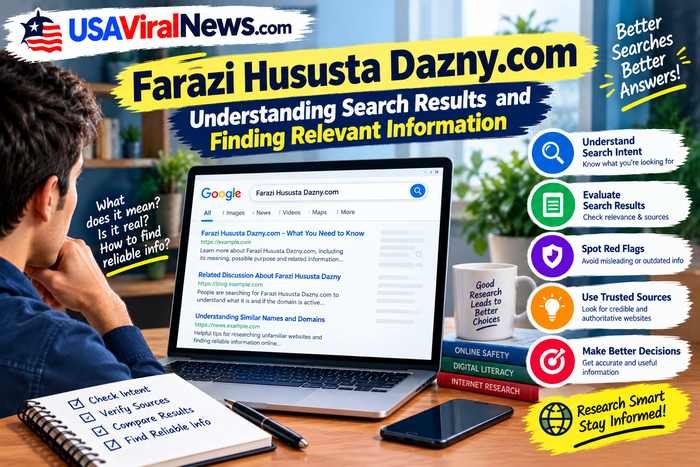
Searching for an unfamiliar name or website can sometimes create more questions than answers. When users search for Farazi Hususta Dazny.com, they may want to understand the phrase, find a relevant webpage, or discover information connected to the domain. The challenge is knowing which search results are genuinely useful and which ones provide little or no reliable context.
Search engines organize information from many sources. A result may contain the exact phrase, a similar name, a related discussion, or a page that mentions only one part of the search query. Therefore, seeing a matching result does not automatically mean that the page explains the subject accurately.
This article explores how search intent works, how to interpret search results, and how to organize information about Farazi Hususta Dazny.com without making unsupported assumptions. It also provides practical tips for finding relevant pages and recognizing misleading information.
What Is Search Intent?
Search intent is the reason someone enters a query into a search engine. Understanding this reason helps users decide what type of information they need.
For example, a person searching for a website address may want to open the site directly. Another person may be trying to understand an unfamiliar name or find an explanation of a topic.
The phrase Farazi Hususta Dazny.com does not reveal one definite purpose by itself. Different users may have different questions about it.
Common search intents include:
- Informational intent: The user wants to understand a name, phrase, or subject.
- Navigational intent: The user wants to find a particular website.
- Investigational intent: The user wants to compare sources or learn more before making a decision.
- Practical intent: The user wants to know how to access or use a website, if it offers a relevant service or resource.
Identifying the likely intent makes research more focused. Instead of reading every result, users can prioritize pages that answer their actual questions.
Why Search Results Can Be Confusing
Search engines do not always display results in a way that makes their relevance immediately clear. A page may rank for a phrase because it contains similar wording, even when it does not explain the topic in detail.
Several factors can create confusion.
Similar Names and Different Meanings
Two names may look similar but refer to unrelated subjects. A small spelling difference can lead to an entirely different person, organization, or website.
When researching Farazi Hususta Dazny.com, compare the exact spelling of the query with the wording on each page. Do not assume that a similar phrase refers to the same subject.
Short Search Snippets
A search snippet is the brief description displayed below a search result. It may show text from the page that appears relevant to the query.
However, a snippet is not the full article. It may leave out important context or show a sentence that does not fully explain the subject. Open the original page and read the surrounding content before drawing conclusions.
Outdated Information
Search engines may display pages that were published a long time ago. A result can remain accessible even when the information has changed.
Check dates when available. If a page makes claims about a website’s current status, services, or ownership, look for recent and reliable confirmation.
How to Search for Farazi Hususta Dazny.com More Effectively
A focused search process can reduce irrelevant results and make research easier.
1. Start With the Exact Phrase
Enter “Farazi Hususta Dazny.com” into your preferred search engine. Quotation marks can help find pages containing the phrase in that exact form.
Review the titles and descriptions of the results. Identify which pages appear to address the complete phrase rather than only one part of it.
2. Search for the Domain Separately
Try searching for “Dazny.com” without the additional words. This may help you find pages that discuss the domain independently.
If the domain is accessible, compare the information shown on the website with the descriptions appearing in search results. If it is unavailable, do not assume that the website is permanently offline or that it has a particular purpose.
3. Search for the Name Separately
Search for “Farazi Hususta” as a separate phrase. This can help identify whether the wording appears in another context.
Be careful when evaluating results involving similar spellings. A search engine may suggest related queries, but suggestions are not proof that the suggested terms refer to the same subject.
4. Compare the Most Relevant Sources
Choose pages that provide actual explanations, evidence, or useful context. Read them carefully and note whether they identify their sources.
A page that repeats the search phrase several times without answering a meaningful question is less useful than one that clearly explains its claims and supports them with evidence.
A Search Results Evaluation Table
The following table provides a simple way to evaluate pages found during research.
| Search result feature | What to examine | Recommended approach |
| Page title | Does it match the subject you are researching? | Open the page if the title is relevant |
| Search snippet | Does the description answer your question? | Read the complete page |
| Exact wording | Does the page use the same name or domain? | Check spelling and context |
| Publication date | Is the information recent enough for your purpose? | Seek updated confirmation when needed |
| Sources | Are important claims supported? | Check the original references |
| Author or publisher | Is responsibility for the content clear? | Consider the source’s credibility |
| Page purpose | Does the page inform, promote, or speculate? | Interpret claims accordingly |
This table is a research aid, not a guarantee that a page is accurate. Important information should still be verified.
How to Recognize Low-Quality Search Results
Not every page that appears in search results provides meaningful information. Some pages are written mainly to attract clicks or repeat popular search terms.
Watch for these warning signs:
Repeated Keywords Without Useful Answers
A page may mention Farazi Hususta Dazny.com many times but provide little explanation. Repeating a keyword does not make information accurate or helpful.
Useful content answers readers’ questions, provides context, and avoids unnecessary repetition.
Unsupported Statements
Be cautious when a page makes strong claims without showing where the information came from. Statements about a person’s identity, website ownership, business activity, or reputation need appropriate evidence.
If reliable confirmation is unavailable, treat the claim as unverified.
Misleading Headlines
Some headlines promise details that the article does not actually provide. Compare the headline with the body of the page and check whether the main question receives a direct answer.
Unnecessary Requests for Personal Information
An unfamiliar website may request information that is not necessary for its stated purpose. Before sharing personal details, verify who operates the website and understand why the information is needed.
Avoid entering passwords, payment details, or sensitive personal information on a site you have not adequately checked.
What Makes a Search-Friendly Article Useful?
If the goal is to publish an article about Farazi Hususta Dazny.com, the content should serve readers rather than simply repeat the keyword.
A helpful article should have a clear title, an informative introduction, organized headings, and a logical structure. Each section should answer a specific question or explain a useful idea.
The keyword should appear naturally in relevant places, including the title and introduction where appropriate. Related wording can help explain the topic, but unrelated phrases should not be added simply to increase keyword frequency.
Writers should also avoid inventing details to make an article appear comprehensive. If the available evidence does not establish what a name or domain represents, the article should state that limitation clearly.
For search-focused content, accuracy and usefulness are more important than unnecessary length. No particular keyword strategy can guarantee a specific Google ranking.
Organizing Your Research Findings
Keeping research notes makes it easier to separate confirmed information from assumptions.
Use a simple record for each relevant source:
| Research field | Information to record |
| Search phrase | The exact query used |
| Source title | The title of the page |
| Source address | The webpage URL, if available |
| Main claim | What the source actually states |
| Supporting evidence | References or details provided |
| Verification status | Confirmed, unverified, or unclear |
| Date checked | When you reviewed the information |
For example, if a page mentions Dazny.com but does not explain its relationship to Farazi Hususta, record that limitation. Do not turn the mention into a claim of ownership or affiliation.
This simple habit can improve research quality and reduce accidental misinformation.
Frequently Asked Questions
1. What is Farazi Hususta Dazny.com?
It is the phrase examined in this article. Its exact meaning and the relationship between the name and the domain have not been established here through verified evidence.
2. How should I search for Farazi Hususta Dazny.com?
Start with the exact phrase, then search for the domain and the name separately. Compare relevant pages and check the evidence behind their claims.
3. Why do search results show different information?
Results may come from different publishers, use similar wording, contain outdated material, or discuss separate subjects. Read the original pages to understand their context.
4. Can I trust a page that uses the exact keyword?
Not automatically. Exact keyword usage shows only that the phrase appears on the page. It does not prove that the page is accurate or authoritative.
5. How can I avoid misleading information?
Check the original source, compare independent references, review dates, and distinguish verified facts from speculation.
6. Can an article about this topic rank on Google?
It may be eligible to appear in search results, but rankings depend on many factors, including relevance, content quality, competition, and search engine systems. No ranking outcome can be guaranteed.
Conclusion
Understanding search results for Farazi Hususta Dazny.com begins with asking the right questions. Search intent, exact spelling, page context, source quality, and supporting evidence all help determine whether a result is relevant.
The best approach is to search carefully, read beyond the snippets, compare trustworthy sources, and record what can actually be established. If important details remain unknown, acknowledge those gaps instead of filling them with assumptions.
By following these principles, readers and content creators can produce more accurate, useful, and responsible information about unfamiliar names and domains.
You may also read: Farazi Hususta