
Search engine optimization can feel confusing when Google keeps changing how people discover information. You may publish helpful articles, build backlinks, and improve your website, yet rankings can still move up and down. The good news is that understanding the main Google ranking factors can help you make better decisions. You do not need to chase every new SEO trend or follow every ranking trick you find online.
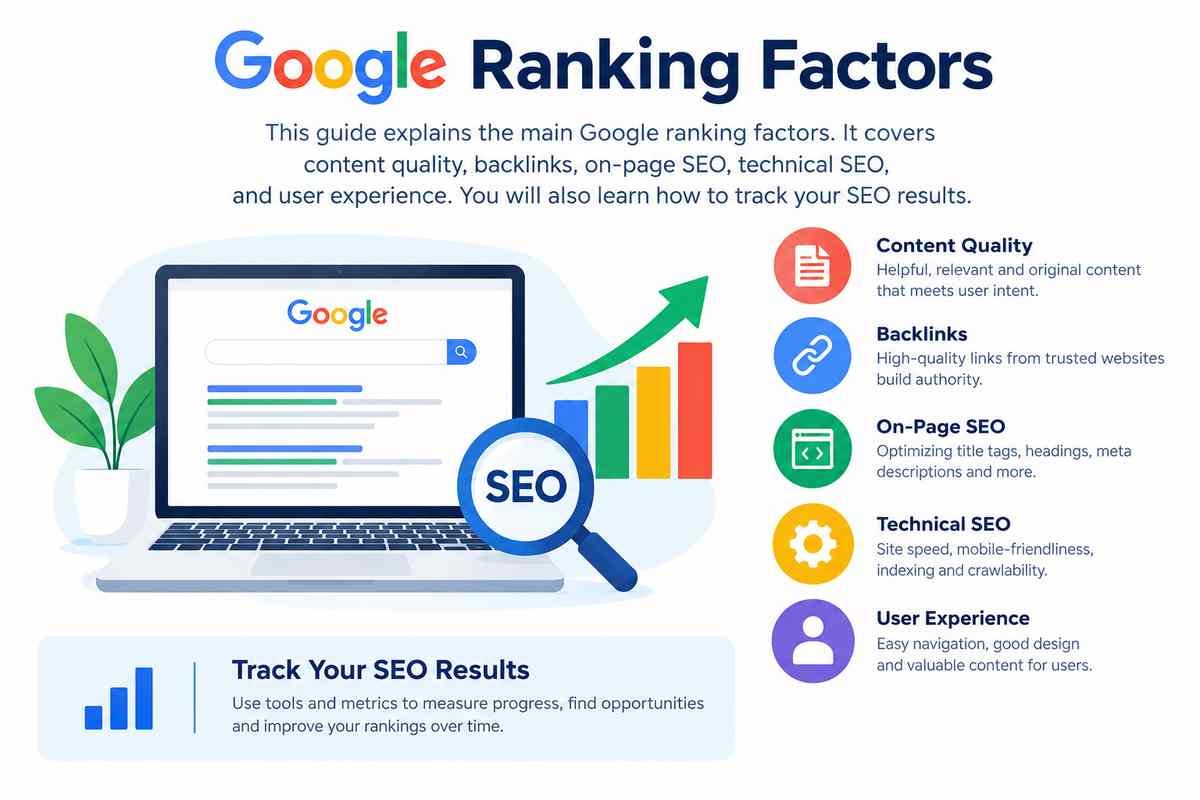
This guide explains the main Google ranking factors, including content quality, backlinks, on-page SEO, technical SEO, and user experience. You will also learn how Google AI Overviews SEO works, how to improve your website’s visibility, and how to track your SEO results. Whether you manage a blog, business website, or online publication, these practical steps can help you build a stronger search presence.
What Are Google Ranking Factors?
Google ranking factors are signals and systems that help Google decide which pages best answer a search query. These systems consider relevance, content quality, context, usability, and other signals. Different searches can require different ranking considerations. For example, someone searching for breaking news needs recent information, while someone learning a basic concept may need a clear, detailed explanation.
Google does not publish one complete checklist of every factor or its exact weight. Therefore, nobody can honestly promise first-page rankings by following a fixed formula. A better SEO strategy focuses on making pages useful, trustworthy, accessible, and relevant to real users. When your website consistently meets these goals, you give search engines stronger reasons to discover and recommend your content.
Why Google Ranking Factors Matter for SEO
Understanding Google ranking factors helps you spend time on improvements that matter. Instead of publishing dozens of similar articles, you can focus on answering important questions properly. You can also find technical problems that stop search engines from accessing your pages. These improvements may support better visibility and help visitors find information without unnecessary effort.
SEO is not only about getting more clicks from Google. It also helps the right people discover your services, products, expertise, or helpful resources. A visitor who finds a useful answer may explore related pages or return later. However, higher rankings and more traffic are never guaranteed. Your results depend on competition, search intent, website quality, and many other factors.
1. High-Quality Content
Content quality is one of the most important areas to focus on when improving SEO. Google aims to show helpful, reliable information that satisfies the user’s needs. Your article should answer the main question clearly and cover the supporting details readers need. Avoid adding paragraphs simply to increase word count because longer content does not automatically rank better.
Write with your readers in mind rather than trying to impress search engines. Explain difficult ideas using simple words, useful examples, and clear headings. If a topic involves changing facts, check reliable sources before publishing. Add original observations, practical steps, or examples that make your article more useful than similar pages. These efforts help readers understand why your content deserves their attention.
Match Content With Search Intent
Search intent means understanding what someone wants when they enter a query into Google. A person searching for “Google ranking factors” probably wants an explanation and practical SEO advice. Someone searching for “best SEO tools” may want comparisons, features, and pricing information. If your page does not match that purpose, even well-written content may struggle to perform.
Before writing, review the pages that currently appear for your target keyword. Notice whether Google shows guides, product pages, videos, or official documentation. Use these results to understand the likely intent, but do not simply copy competing articles. Create a more helpful resource by answering missing questions, explaining confusing details, and offering clear examples.
Demonstrate Experience, Expertise, Authoritativeness, and Trust
Google uses the concept of E-E-A-T to describe experience, expertise, authoritativeness, and trustworthiness. E-E-A-T is not a single ranking factor or a score you can directly optimize. However, its principles can help you create content that readers can trust. Your website should make it clear who created the content and why readers should consider it reliable.
Add accurate author information, relevant experience, and links to trustworthy sources when appropriate. If you review a product, explain how you tested it and what you actually observed. If you publish research, describe your sources and methods. Never invent personal experience, qualifications, reviews, or expert endorsements. Honest information builds trust more effectively than impressive claims without evidence.
Keep Content Accurate and Useful
Old content can lose value when facts, products, policies, or industry practices change. Review important pages regularly and correct outdated information. Add new details when they genuinely improve the reader’s understanding. You do not need to change a publication date merely to make an article appear fresh.
You should also check for repeated ideas, unclear explanations, and unsupported statements. Remove sections that do not help readers complete their goals. Include relevant examples, useful comparisons, and answers to common questions. The purpose is not to make every article longer. It is to make each page as useful and accurate as the topic requires.
2. Backlinks and Website Authority
Backlinks are links from other websites that point to your pages. They can help Google discover content and understand relationships between websites. Links from relevant, trustworthy sources can also send visitors who are genuinely interested in your topic. However, not every backlink provides the same value, and a large link count does not guarantee strong rankings.
Focus on earning links through useful resources, original research, expert contributions, and relevant digital outreach. For example, an original industry study may attract links from publishers discussing the same subject. A detailed tutorial may become a useful reference for other website owners. These links are more meaningful when they arise naturally from the value your content provides.
Build Relevant and Natural Backlinks
Relevance matters because a link should make sense within its surrounding content. A link from a respected website in your industry may be more useful than an unrelated link from a random site. Still, Google evaluates many signals, so you should not judge a backlink using domain metrics alone. Third-party authority scores are estimates, not Google’s own ranking scores.
Avoid buying links designed to manipulate rankings, automated link schemes, and excessive link exchanges. These methods can create risks under Google’s spam policies. Guest posting can be useful when it provides genuine value to the publication’s audience. Keep the article relevant, follow the publisher’s rules, and disclose paid placements where required. Never treat backlinks as a shortcut around content quality.
Use Internal Links to Connect Related Pages
Internal links connect pages within your own website. They help readers discover related information and give search engines paths to find other content. For example, an article about Google ranking factors can link to detailed guides about keyword research, technical SEO, and backlink strategies. These links should help readers understand the topic more fully.
Use clear anchor text that describes the destination page. Avoid adding dozens of links simply to make a page look optimized. Review important pages to ensure they have useful links from relevant sections of your website. A clear internal linking structure can support crawling, navigation, and the discovery of related content.
3. On-Page SEO
On-page SEO involves improving the content and HTML elements of individual pages. It helps search engines understand what a page covers and helps users decide whether it answers their questions. Important areas include page titles, headings, meta descriptions, URLs, image descriptions, and internal links. Each element should support the page’s purpose instead of repeating keywords without a reason.
Start by choosing one clear primary topic for each page. Use related terms naturally where they improve clarity and coverage. Organize the article with descriptive headings and place important information where readers can find it easily. Good on-page SEO should make the page easier to understand, not make the writing sound unnatural.
Optimize Your SEO Title and Meta Description
Your SEO title should describe the page accurately and give readers a clear reason to visit. Include the primary keyword when it fits naturally. Avoid exaggerated promises or repetitive wording that makes the title difficult to read. Google may generate a different title link when it believes another page element better represents the result.
A meta description should summarize the page and explain what readers can expect. It can influence how appealing your search listing appears, but it is not a direct ranking factor. Google may also create a different snippet from your page content. Write a unique, useful description that matches the actual information on the page.
Use Headings and Keywords Naturally
A clear heading structure makes long articles easier to scan. Use an H1 for the main page title, H2 headings for major sections, and H3 headings for supporting topics. Include relevant keywords when they accurately describe the section. You do not need to insert the exact keyword into every heading.
Semantic keywords are related words and phrases that help explain the topic in context. For a page about Google ranking factors, these might include search intent, crawlability, content relevance, backlinks, and Core Web Vitals. Use these terms where they support a complete explanation. Keyword stuffing can make content harder to read and may violate Google’s spam policies.
Optimize Images and Image Alt Text
Images can make complex topics easier to understand and give readers helpful visual context. Use relevant screenshots, original diagrams, charts, or illustrations when they add value. Compress large image files and choose suitable dimensions to avoid unnecessary loading delays. Descriptive file names can also make your media library easier to manage.
Alt text explains the purpose or content of an image for people using screen readers. It can also help search engines understand the image. Describe what the image actually shows instead of filling the alt text with keywords. Decorative images may need empty alt attributes, depending on how they are implemented.
4. Technical SEO
Technical SEO helps search engines access, crawl, render, and index your website. Even excellent content may receive little search visibility if important pages cannot be found or processed. Technical problems can include broken links, incorrect indexing directives, server errors, duplicate URLs, and poor mobile usability. Regular checks help you identify problems before they affect important pages for long periods.
You do not need an advanced technical setup for every website. Start with the basics and prioritize issues that prevent important pages from appearing in search. Make sure your website is accessible to visitors and search engines. Use Google Search Console to review indexing reports, inspect URLs, and identify technical issues that need attention.
Improve Crawling and Indexing
Crawling is the process of discovering and fetching pages, while indexing involves processing and storing information about them. A page must be eligible for indexing before it can appear as a normal Google Search result. However, meeting technical requirements does not guarantee that Google will index or display it.
Check that important pages are not blocked by robots.txt or restricted by an unintended noindex directive. Use internal links to help Google discover your content. An XML sitemap can help search engines find important URLs, especially on larger websites. Submit your sitemap through Search Console and investigate persistent indexing problems instead of repeatedly resubmitting the same URL.
Make Your Website Mobile-Friendly
Many visitors browse websites using phones and tablets. Your pages should fit different screen sizes without forcing users to zoom or scroll sideways. Text should remain readable, navigation should work properly, and important content should not disappear on smaller screens. Test your key pages on real devices as well as browser testing tools.
Mobile usability is only one part of a successful website experience. Make sure buttons are easy to tap and forms are simple to complete. Avoid intrusive pop-ups that cover the main content. A mobile-friendly design helps visitors use your website comfortably and supports a more accessible experience.
Improve Core Web Vitals and Page Speed
Core Web Vitals measure aspects of loading performance, responsiveness, and visual stability. Their main metrics are Largest Contentful Paint, Interaction to Next Paint, and Cumulative Layout Shift. These metrics help you understand whether a page loads its main content quickly, responds well to interactions, and avoids unexpected layout changes.
You can check Core Web Vitals through Google Search Console and use PageSpeed Insights to investigate individual URLs. Common improvements include compressing images, reducing unnecessary JavaScript, improving server response times, and reserving space for images or advertisements. Do not chase perfect scores at the expense of useful features. Focus on improvements that make the experience better for real visitors.
Use HTTPS and Maintain a Clean Website Structure
HTTPS protects information exchanged between a website and its visitors. Make sure your site uses a valid security certificate and redirects HTTP pages to their correct HTTPS versions. Also check for redirect loops, broken URLs, and unnecessary duplicate pages. A consistent URL structure makes navigation and website management easier.
Use canonical tags when appropriate to identify the preferred version of similar or duplicate pages. Keep important content accessible through useful navigation and internal links. Structured data can help Google understand eligible page information, but it does not guarantee special search appearances. Always ensure your structured data matches the visible content on the page.
5. User Experience and Page Experience
A good user experience helps visitors find answers without unnecessary effort. Readers should be able to understand the page, navigate related sections, and use the website without constant interruptions. Clear layouts, readable text, helpful navigation, and accessible design all contribute to a more useful experience. These improvements can also encourage visitors to explore other relevant resources.
Google considers page experience among several aspects of search quality, but there is no single page experience score that guarantees higher rankings. Relevant content can still rank when some experience elements are imperfect. Your goal should be to create an overall experience that supports the user’s needs. Do not focus on one metric while ignoring content quality or search intent.
Reduce Intrusive Ads and Pop-Ups
Advertisements can support a website, but they should not prevent visitors from reading the main content. Large pop-ups, aggressive interstitials, and excessive ad placements can frustrate users. They may also make your pages harder to navigate on mobile devices. Place advertising carefully and keep important information easy to access.
Review your pages from a visitor’s perspective. Check whether the main heading and opening paragraphs remain visible without closing multiple pop-ups. Ensure that buttons, links, and forms work correctly. A cleaner design can make your website more comfortable to use and help visitors focus on the information they came to find.
6. Google AI Overviews SEO
Google AI Overviews provide AI-generated summaries for certain searches. These summaries may combine information from multiple sources and show links that help users explore a topic further. This changes how some people discover websites, but it does not make traditional SEO unnecessary. Google’s guidance says the same foundational SEO practices remain important for AI Overviews and AI Mode.
Google AI Overviews SEO is therefore not about finding a secret ranking trick. It is about creating useful, accurate, accessible content that Google can discover and understand. Your pages must meet the relevant technical requirements and be eligible to appear in Google Search with a snippet. Even then, inclusion in AI Overviews is not guaranteed.
How to Optimize Content for Google AI Overviews
Start by answering the main question clearly near the beginning of your article. Then provide deeper explanations, examples, evidence, and helpful context. Use descriptive headings that reflect real questions readers ask. Make important information available as readable text rather than placing every answer inside images or inaccessible elements.
Support factual claims with reliable sources and explain information in your own words. Include original insights that go beyond a basic summary of other websites. Use relevant images or videos when they help explain the topic. Keep your pages crawlable, maintain strong internal links, and ensure your structured data matches the visible page content.
There is no special AI Overview schema or required word count for inclusion. You also do not need to create special AI text files to qualify. Google may choose different sources for different queries, and its AI-generated responses can change. Focus on the same fundamentals that make a page useful in traditional search.
Build Content That Answers Follow-Up Questions
People often ask several related questions while researching a topic. A useful article anticipates these questions and provides clear answers without forcing readers to visit many unrelated pages. For example, a guide to Google ranking factors can explain backlinks, crawlability, page speed, content quality, and performance measurement. Each section should provide enough detail to help readers understand the issue.
Question-based headings can make the article easier to navigate. Short definitions may help readers understand a new concept quickly, while deeper sections provide supporting details. Do not split content into unnecessary sections just to target more queries. Every section should have a clear purpose and contribute meaningful information.
Measure Visibility Beyond Traditional Rankings
AI-powered search can change how people discover and visit websites. Your page might receive impressions without gaining the same number of clicks as before. It is therefore useful to review traffic, conversions, engagement, and the queries that bring people to your site. Do not judge success using a single ranking position alone.
Use the performance tools available in Google Search Console to monitor search impressions, clicks, and other reported data. Google has also introduced reporting resources for generative AI search features, although availability and reporting details can change. Review the current Search Console documentation to understand which reports are available to your property. Compare trends over time instead of reacting to every short-term change.
7. Content Freshness and Topical Coverage
Freshness matters when a search needs current information, such as recent product changes, new policies, or breaking news. However, not every topic requires frequent updates. A basic educational guide may remain useful for years if its information is still correct. Update pages when you have meaningful improvements to make, not simply to change the date.
Topical coverage means publishing related content that serves a clear audience and website purpose. For example, an SEO website might cover keyword research, technical audits, content optimization, link building, and Search Console. These pages can support each other through relevant internal links. However, publishing many shallow articles about similar keywords can create repetition instead of useful depth.
Create a Helpful Content Plan
Begin by identifying the questions your audience needs answered. Group related queries into sensible topics and decide whether each needs its own page. Avoid creating separate articles when one comprehensive guide would serve readers better. Also check existing pages before publishing new ones to reduce unnecessary overlap.
A strong content plan includes research, writing, fact-checking, and regular maintenance. Use reliable references for technical claims and explain what makes your advice useful. If you cover products or tools, distinguish tested findings from general information. This process helps build a website that readers can return to when they need reliable answers.
8. How to Track Your SEO Results
Tracking SEO results helps you understand which pages perform well and where improvements may be needed. Without measurement, you may spend time changing pages that already work or overlook problems that reduce visibility. Start with a few clear goals, such as increasing relevant organic traffic, improving important page rankings, or generating more leads. Choose metrics that match the purpose of your website.
Google Search Console and Google Analytics serve different but useful roles. Search Console reports how your website performs in Google Search, including clicks, impressions, click-through rate, and average position. Analytics can help you understand what visitors do after arriving on your website. Together, these tools provide a broader view of search visibility and visitor behavior.
Monitor Search Console Performance
Open the Performance report in Google Search Console and review the queries bringing people to your pages. Look for relevant searches that generate impressions but relatively few clicks. Consider whether the title and description accurately represent the content and match the user’s intent. A low click-through rate can have several causes, so investigate the query and search results before changing anything.
Review performance by page, query, device, and date range. Compare similar periods when possible and remember that seasonality can affect search demand. Use the URL Inspection tool when an important page appears to have indexing problems. Check the Page Indexing and Core Web Vitals reports to identify issues that may require further investigation.
Measure Traffic, Leads, and Conversions
Traffic is useful, but the right visitors matter more than raw numbers alone. A business website may value contact form submissions, purchases, or qualified leads. An educational blog may focus on engaged readers, newsletter sign-ups, or visits to related guides. Define what success means before deciding which pages deserve additional work.
Use analytics to identify landing pages that attract relevant visitors and support your goals. Check whether visitors can find the next step easily. Improve pages when the information is outdated, confusing, or incomplete. Allow enough time to evaluate changes because search performance can fluctuate for reasons outside your control.
Review SEO Changes Carefully
Avoid changing titles, URLs, content, and internal links all at once without recording what you did. If performance changes afterward, it becomes harder to identify the cause. Keep a simple record of major updates, technical fixes, and content improvements. Review the results over a suitable period rather than judging success after a few days.
When rankings fall, investigate before making large changes. Check indexing, search demand, competitors, site errors, and recent content changes. A decline does not always mean that Google penalized your website. Sometimes the search results have changed, the query has become less popular, or another page now better satisfies the user’s needs.
9. Common SEO Mistakes to Avoid
Many websites lose opportunities by focusing on shortcuts instead of helping readers. Keyword stuffing, copied articles, manipulative backlinks, and mass-produced pages with little original value can damage quality. Other common problems include broken internal links, missing important content, slow pages, and confusing navigation. These issues deserve attention because they can reduce usefulness or conflict with Google’s policies.
Avoid assuming that one SEO plugin score reflects your entire website’s quality. Plugin recommendations can help with basic checks, but they cannot fully measure search intent, originality, trust, or competitive strength. Similarly, high domain authority scores from third-party tools do not guarantee rankings. Use tools to support your judgment rather than replacing careful research and practical testing.
Do not believe anyone who promises guaranteed first-place rankings or secret access to Google’s algorithm. Search systems are complex and change over time. A sustainable strategy combines helpful content, sound technical practices, relevant links, and regular measurement. Focus on improvements you can verify instead of chasing every new SEO claim.
10. A Practical Google Ranking Factors Checklist
You can use this checklist when publishing a new article or reviewing an existing page. Not every item applies to every website, so prioritize the issues that affect your readers and important pages. Start with the page’s purpose, then check content quality, accessibility, and performance. Record any changes so you can review their impact later.
-
The page answers a clear search intent.
-
The title and main heading describe the topic accurately.
-
The content provides useful, original information.
-
Important claims are accurate and supported where needed.
-
Relevant keywords appear naturally in the content.
-
Headings organize the page into clear sections.
-
Useful internal links connect related pages.
-
Backlinks are earned through relevant, legitimate methods.
-
Search engines can crawl and index the intended page.
-
The page works well on mobile devices.
-
Images are optimized and have suitable alt text.
-
Core Web Vitals and major technical issues are reviewed.
-
The page uses HTTPS and avoids unnecessary errors.
-
Structured data matches the visible page content.
-
Google Search Console is used to monitor performance.
-
Content is reviewed when meaningful updates are needed.
Completing this checklist does not guarantee a top ranking. It gives you a practical way to catch common problems and improve the quality of your website. Over time, consistent work can help you build a stronger search presence and make your content more useful to readers.
Frequently Asked Questions
What are the most important Google ranking factors?
There is no universal list with fixed weights for every search. Important areas include relevance, helpful content, links, technical accessibility, and page experience. Their influence can vary with the query and context. Focus on meeting the user’s needs rather than trying to optimize for a single signal.
Is SEO still important for Google AI Overviews?
Yes, traditional SEO remains important for Google AI Overviews. Google says the same foundational SEO practices apply to its AI search features. Pages should be crawlable, eligible for indexing, useful, and aligned with search policies. Meeting these requirements does not guarantee that a page will appear in an AI-generated summary.
Does E-E-A-T directly affect Google rankings?
E-E-A-T stands for experience, expertise, authoritativeness, and trustworthiness. It is not a single direct ranking factor or a score assigned to every website. Its principles help publishers build reliable content and demonstrate credibility. Trust is especially important when content can affect people’s health, finances, or safety.
Are backlinks still important for SEO?
Backlinks remain useful for discovery and can provide signals about relationships and reputation. However, link quality, relevance, and context matter more than chasing large numbers. Avoid schemes designed to manipulate search rankings. Focus on publishing useful content that relevant websites have a genuine reason to reference.
How long does SEO take to show results?
SEO timelines vary by website, competition, technical condition, and content quality. Some pages may begin receiving impressions relatively quickly, while meaningful growth can take months. There is no fixed timeline or guaranteed outcome. Track changes in Search Console and review progress against realistic goals.
Does website speed directly improve Google rankings?
Core Web Vitals are used by Google’s ranking systems, but speed alone cannot guarantee high rankings. Google considers many signals, and relevant content may still rank when some performance measures are imperfect. Improve loading, responsiveness, and layout stability to provide a better experience. Prioritize real problems rather than chasing perfect test scores.
How can I track my SEO performance?
Google Search Console helps you review impressions, clicks, search queries, average position, and indexing information. Google Analytics can show what visitors do after reaching your website. Use both tools to understand visibility and outcomes. Review trends over time and investigate major changes before making large adjustments.
Can AI-generated content rank on Google?
AI-assisted content can appear in search results when it provides useful, reliable information and follows Google’s policies. The main concern is not simply whether AI helped create the content. The concern is whether the page offers genuine value or is produced at scale with little originality. Review facts carefully and add meaningful expertise, examples, and human judgment.
Final Thoughts
Successful SEO is not about finding one magic Google ranking factor. It is about combining helpful content, relevant backlinks, strong on-page SEO, reliable technical foundations, and a good user experience. These areas work together to help search engines discover your pages and help visitors find the information they need. Consistency and careful measurement are more useful than chasing every new ranking theory.
Google AI Overviews SEO adds another reason to create clear, trustworthy, and genuinely helpful content. Yet the fundamentals remain familiar: understand your audience, answer questions accurately, keep your website accessible, and improve pages when you have something valuable to add. Track your results, learn from the data, and focus on sustainable improvements. That approach gives your website a stronger foundation for long-term search visibility.
You may also read:Top AI Trends 2026