
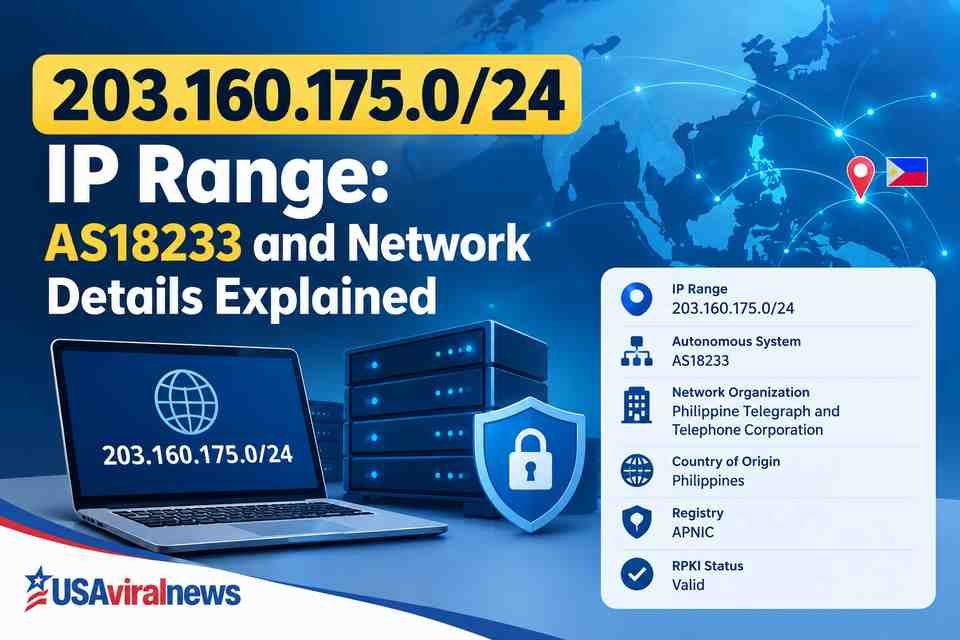
When you search for 203.160.175.0/24 IP range, you may want to identify the network behind a particular IP address, understand its ownership information, or investigate a connection involving a specific port. These details can help network administrators, website owners, and security researchers understand how public IP addresses are organized.
IPinfo lists the 203.160.175.0/24 network under AS18233, associated with Philippine Telegraph and Telephone Corporation. However, identifying a network range is only the first step. It does not automatically reveal which application runs on an individual IP address or whether a particular network port is open.
This guide explains the IP range, autonomous system information, CIDR notation, and the checks you can perform when investigating a network endpoint.
What Is the 203.160.175.0/24 IP Range?
The 203.160.175.0/24 IP range is a block of IPv4 addresses represented using CIDR notation. The /24 suffix describes the size of the network prefix and indicates that the first 24 bits identify the network.
In this case, the range extends from 203.160.175.0 through 203.160.175.255. That gives the block 256 total IPv4 addresses.
A range is different from an individual IP address. For example, 203.160.175.158 is one address within the broader 203.160.175.0/24 block.
This distinction matters when reading network databases. A provider may announce or manage a range containing many addresses, but that information does not tell you which device or service uses every address inside it.
Understanding CIDR Notation
CIDR stands for Classless Inter-Domain Routing. It is a standard method of describing IP networks with a network address and a prefix length.
For example:
203.160.175.0/24identifies the network block.203.160.175.158identifies one IPv4 address inside that block./24means that 24 of the 32 IPv4 bits form the network prefix.
A /24 contains 256 total addresses. Traditional IPv4 subnetting usually reserves the first and last addresses for network and broadcast purposes, leaving 254 conventional host addresses. Public routing and provider allocation practices may affect how a range is used.
Who Owns or Operates the 203.160.175.0/24 Network?
IPinfo associates the 203.160.175.0/24 range with AS18233, Philippine Telegraph and Telephone Corporation. Its network information also identifies the registry as APNIC and marks the prefix as RPKI valid.
These details help describe the network’s registration and routing context. They do not prove that a particular person owns an individual IP address or operates a service on it.
An internet service provider or network organization may manage a block used by customers, business systems, hosting services, or other network infrastructure. To understand a particular endpoint, you need more specific evidence than the organization name alone.
You can review the published network details on the IPinfo page for 203.160.175.0/24.
What Is AS18233?
AS18233 is an autonomous system number associated with Philippine Telegraph and Telephone Corporation in the IPinfo listing.
An autonomous system is a group of IP networks managed under a common routing policy. Autonomous system numbers help identify these networks when routers exchange information about internet routes.
An ASN can help researchers understand which network announces a particular IP prefix. However, an ASN does not identify every device, customer, application, or person using an address in that range.
For accurate research, compare the ASN information with the specific IP record and other reliable network sources.
What Does IPinfo Tell Us About This Network?
IPinfo provides network intelligence that can help users investigate IP addresses, network ranges, and autonomous systems.
For the 203.160.175.0/24 prefix, the available listing provides several useful details:
| Network field | Reported information |
|---|---|
| IP range | 203.160.175.0/24 |
| Autonomous system | AS18233 |
| Network organization | Philippine Telegraph and Telephone Corporation |
| Country of origin | Philippines |
| Registry | APNIC |
| RPKI status | Valid, according to IPinfo |
| Parent range | 203.160.160.0/19 |
The country field needs careful interpretation. IPinfo explains that the country of origin reflects where the resource holder is legally based and may not match the location where an IP address is actually used.
Likewise, RPKI validity indicates that the prefix is covered by a valid Route Origin Authorization. It does not mean that every host in the range is secure, trustworthy, or operating correctly.
You can use the IPinfo network record as a starting point for further investigation.
What Is 203.160.175.158:14001?
The endpoint 203.160.175.158:14001 combines an IPv4 address with a port number.
The address identifies a network destination, while the port identifies a particular communication endpoint on that host. Applications use ports to direct traffic to the appropriate service.
Port 14001 falls within the registered port range, which spans 1024 through 49151. However, that classification does not establish that a particular application uses port 14001 on this IP address.
The actual service depends on how the system has been configured. Without a verified service response or reliable technical documentation, it would be inaccurate to identify this endpoint as a particular website, application, game server, or administrative panel.
For a more detailed explanation of the endpoint and troubleshooting, see our guide to 203.160.175.158:14001 server configuration and network ports.
How to Check an IP Address and Port
If you are investigating a network endpoint that you own or are authorized to test, a few standard checks can help distinguish basic connectivity problems from application issues.
1. Review the IP Registration Details
Start by checking the individual address and its associated network range in a reputable IP information service.
Compare the reported organization, ASN, prefix, and registry information. Remember that registration details describe network allocations rather than the identity of every device using the range.
2. Check Basic Network Reachability
A ping test can help determine whether a host responds to ICMP echo requests:
ping 203.160.175.158
A successful response indicates that the host responded to the test. A timeout does not necessarily mean the system is offline because firewalls and network policies can block ICMP traffic.
Ping also does not establish whether port 14001 is accepting connections.
3. Test the Specific Port on an Authorized System
If you administer the destination or have permission to test it, you can use a standard TCP connection check.
For example, with Netcat:
nc -zv -w 5 203.160.175.158 14001
A successful connection indicates that a TCP connection was accepted at the time of testing. A refusal or timeout can have several causes, including an inactive service, a firewall rule, or a routing restriction.
Only test systems you own or are authorized to assess. A port test alone cannot identify the software behind the service or prove that it is safe.
4. Review the Application Response
If you know the endpoint is intended to serve HTTP, you can inspect its response using an appropriate HTTP client.
For example:
curl -I http://203.160.175.158:14001
This command requests response headers from an HTTP service. It will not provide useful HTTP information if the port runs a different protocol or if the connection is blocked.
Do not assume that a service supports HTTPS merely because it accepts connections on a particular port. Confirm the expected protocol from the system’s configuration or documentation.
Is the 203.160.175.0/24 IP Range Safe?
An IP range cannot be classified as safe or unsafe from its registration information alone.
The organization name, ASN, and country field help describe the network. They do not establish whether an individual server is compromised, whether a connection is legitimate, or whether a particular application is trustworthy.
If an unfamiliar IP address appears in your server logs or security alerts, consider the surrounding evidence:
- Check the timestamp and destination port.
- Review the application or firewall logs.
- Determine whether the connection was expected.
- Look for repeated failed authentication attempts.
- Compare the event with other security alerts.
- Apply firewall restrictions where appropriate.
A single connection attempt is not enough to prove malicious activity. Likewise, a valid network registration does not guarantee that every system using the network is secure.
For practical defensive advice, explore our cybersecurity guides.
How Network Administrators Can Protect Exposed Services
If you manage a server that accepts connections from the internet, follow basic security practices to reduce unnecessary exposure.
Use Firewall Rules
Allow only the traffic required for your application. Where possible, restrict administrative services to trusted source addresses or a private management network.
Use Encrypted Connections
Use correctly configured TLS for web services that handle sensitive information. Avoid sending credentials or confidential data through unencrypted connections.
Keep Applications Updated
Install security patches for operating systems, network services, and application software. Remove services that are no longer required.
Monitor Logs
Review authentication events, connection failures, and unexpected changes in network traffic. Monitoring helps you investigate unusual activity before drawing conclusions about its cause.
Restrict Administrative Access
Administrative interfaces should not be publicly accessible unless there is a clear operational need and appropriate protection. VPN access, strong authentication, and least-privilege permissions can reduce risk.
These measures apply to servers across many networks. The registration details of 203.160.175.0/24 do not, by themselves, indicate whether any particular host has implemented them.
Frequently Asked Questions
What is 203.160.175.0/24?
It is an IPv4 network range containing 256 total addresses, from 203.160.175.0 through 203.160.175.255.
What organization is associated with AS18233?
IPinfo associates AS18233 with Philippine Telegraph and Telephone Corporation.
Where is the 203.160.175.0/24 range registered?
IPinfo lists APNIC as the registry. Its country-of-origin field says Philippines, but that does not guarantee the physical location of every system using the range.
What does 203.160.175.158:14001 mean?
It represents an IPv4 address paired with port 14001. The port identifies a communication endpoint, but the notation alone does not reveal which application is running there.
Does port 14001 always belong to a specific application?
No. Port 14001 is within the registered port range, but its use depends on the software and system configuration.
Does RPKI validity mean an IP address is safe?
No. RPKI validity concerns route-origin authorization for a prefix. It is not a general security rating for every host or service using that prefix.
How can I investigate an unfamiliar IP address?
Start with a reputable IP information service, review relevant logs, and check the context of the connection. If testing a port, make sure you have authorization to do so.
Conclusion
The 203.160.175.0/24 IP range provides a useful example of how IP addresses, network prefixes, and autonomous systems fit together.
IPinfo associates the range with AS18233 and Philippine Telegraph and Telephone Corporation. Its listing also provides registry, parent-range, and RPKI information that can help with network research.
However, these records do not identify every host or application within the range. The endpoint 203.160.175.158:14001 requires separate technical verification before anyone can confidently identify its service or security status.
By combining reliable registration data with authorized connectivity checks and careful log analysis, network administrators can build a more accurate picture of an endpoint without making unsupported assumptions.
You may also read:What is 203.160.175.158.14001