
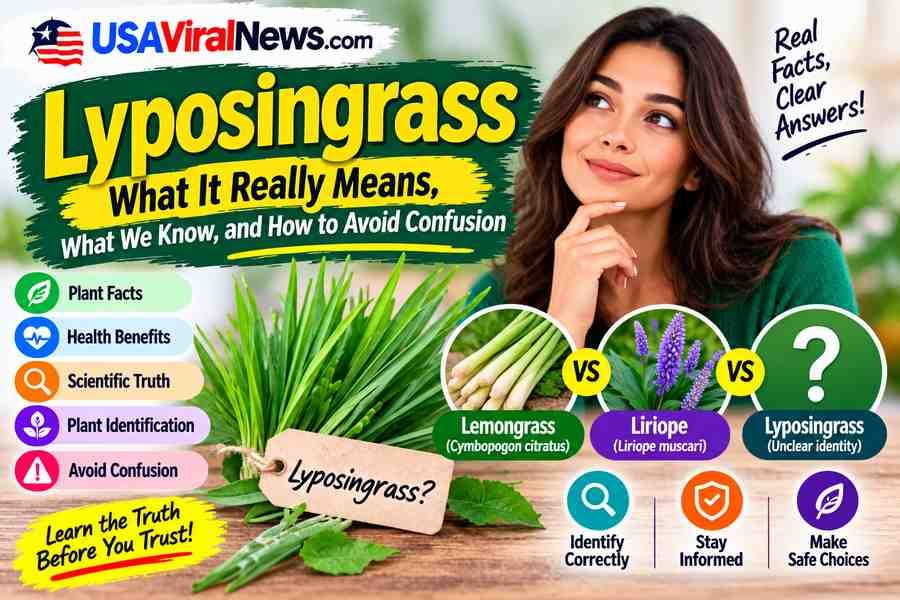
If you searched for lyposingrass expecting to find a recognized plant, herb, supplement, or wellness ingredient, the confusing search results are not your imagination. Different websites currently use the word for different things.
Some describe lyposingrass as a wellness herb or supplement. Others connect it with lemongrass. Some gardening pages use the name for Liriope, while still others present it as a general grass-like plant. The problem is that these descriptions do not establish one identifiable species.
The most defensible answer is simple: lyposingrass is not currently a clearly established botanical name for one recognized plant species. Searches of major botanical resources do not produce an accepted species under that exact name. By contrast, recognized plants that are sometimes associated with the term, such as lemongrass and Liriope, have identifiable scientific classifications.
That distinction matters, especially if the word appears on something you are considering eating, drinking, applying to your body, or buying as a supplement.
What is lyposingrass?
Lyposingrass appears to be an emerging or informal internet term rather than the established common name of a single scientifically identified plant.
The current online results show several competing interpretations. Some pages associate it with lemongrass, some with Liriope or lilyturf, and others describe it as a wellness ingredient or supplement without identifying a specific botanical species.
That inconsistency is important evidence in itself.
A plant can have multiple common names, of course. But a reliable identification should ultimately connect the common name to an identifiable organism. A scientific name such as Cymbopogon citratus gives researchers, growers, manufacturers, and consumers a much more precise identity than a vague label such as “grass.”
Kew’s Plants of the World Online, for example, recognizes Cymbopogon citratus as an accepted species of the grass family Poaceae. It describes the plant as a perennial aromatic grass commonly known as lemongrass.
There is no equivalent established botanical classification for “lyposingrass.”
Why are so many websites describing it as a real plant?
The recent search results illustrate how an unfamiliar term can acquire several different meanings online.
Once one article associates a new word with a familiar plant, subsequent articles may repeat that association. Other publishers may then add characteristics, benefits, growing advice, or nutritional claims. Eventually, repetition can make an uncertain description appear authoritative.
But repetition does not establish botanical identity.
Several recent articles explicitly acknowledge that the term is inconsistently defined. Others nevertheless assign characteristics that cannot be traced back to a clearly identified species.
This creates a particularly important problem: information about one plant cannot automatically be transferred to another plant simply because both are described as “lyposingrass.”
Is lyposingrass the same as lemongrass?
There is no good basis for treating lyposingrass and lemongrass as established synonyms.
Lemongrass is a well-documented plant. Its accepted scientific name is Cymbopogon citratus. Kew classifies it in the family Poaceae and describes it as a tall, aromatic perennial grass used in food, beverages, traditional medicine, perfumery, and other applications.
The connection between the two names appears to come largely from online descriptions rather than from an established botanical authority.
That means information about lemongrass can be useful only if the material being called lyposingrass is independently confirmed to contain or actually be lemongrass.
This is a crucial distinction.
If a product says “lyposingrass” but does not provide Cymbopogon citratus or another identifiable botanical name, you should not assume that research on lemongrass applies to it.
Could lyposingrass be Liriope?
Another interpretation appearing online connects lyposingrass with Liriope, sometimes called lilyturf or monkey grass.
Liriope is also a genuine botanical group, but it is not the same thing as lemongrass.
Kew recognizes the genus Liriope and lists accepted species including Liriope muscari and Liriope spicata. Liriope muscari belongs to the family Asparagaceae and has a native range extending from China into temperate East Asia.
That makes the distinction especially important:
| Name | Scientific identity | What it is |
| Lyposingrass | No clearly established botanical identity | Informal or inconsistently used term |
| Lemongrass | Cymbopogon citratus | Aromatic perennial grass |
| Liriope | Liriope genus | Grass-like ornamental plants |
| Liriope muscari | Accepted species | Perennial plant in Asparagaceae |
| Liriope spicata | Accepted species | Another recognized Liriope species |
So if a website claims that lyposingrass is Liriope, that should be treated as an identification claim requiring evidence, not as an established botanical fact.
Does lyposingrass have proven health benefits?
There are no established health benefits that can safely be attributed specifically to an unidentified substance called lyposingrass.
This is where many online articles become unreliable. Some associate the term with digestion, detoxification, metabolism, weight management, antioxidants, immunity, or general wellness. But if the underlying plant or ingredient is not established, those claims cannot simply be treated as evidence about lyposingrass itself.
There is an important scientific principle behind this.
Research applies to the material that researchers actually studied.
If a clinical or laboratory study examined lemongrass, the findings concern the preparation and species used in that research. They do not automatically establish the effectiveness of an unidentified product marketed under another name.
The same applies to Liriope or any other botanical.
A claimed association is not the same thing as evidence.
What if lyposingrass is being sold as a supplement?
This is the situation where caution matters most.
A supplement label should give you substantially more information than an unusual marketing name. In the United States, dietary supplement labeling requirements include information such as the product identity, serving size, dietary ingredients, and, when a botanical is used, the scientific name or an accepted common name and the plant part used.
If you encounter a product marketed as lyposingrass, look for:
- The scientific name of the plant
- The plant part used
- The amount per serving
- A complete ingredient list
- The manufacturer or distributor
- Directions for use
- Warnings and contraindications
- Batch or lot information
- Appropriate quality testing where available
If the label gives only “lyposingrass” and makes broad health claims without identifying what the ingredient actually is, there is a significant information gap.
That does not prove that the product is dangerous or fraudulent. It means there is not enough identity information to evaluate it confidently.
Is a natural lyposingrass product automatically safe?
No.
The word “natural” does not establish safety. The National Institutes of Health Office of Dietary Supplements notes that the safety of a botanical depends on factors including its chemical composition, preparation, how it acts in the body, and the amount used. Different preparations of the same botanical can also differ substantially in concentration.
This is why an unidentified botanical deserves extra scrutiny.
A tea, powdered plant, concentrated extract, essential oil, and multi-ingredient supplement are not interchangeable simply because they originate from a similar plant.
The practical rule is straightforward:
Identify the ingredient before evaluating its benefits or risks.
How to verify what “lyposingrass” actually refers to
If you encounter the word on a website, package, social media post, or supplement advertisement, do not begin by searching for its claimed benefits. Start with identification.
1. Find the scientific name
Look for a genus and species, such as Cymbopogon citratus.
A scientific name provides a much stronger starting point for verification than an invented or informal product name.
2. Check the plant part
A label should ideally identify whether the product contains leaves, stems, roots, flowers, seeds, or another part.
This matters because different plant parts can contain different constituents.
3. Determine whether it is a single ingredient
Some products use proprietary blends. In those cases, the word lyposingrass may describe a commercial mixture rather than a particular plant.
4. Check who makes it
A transparent manufacturer should provide enough information for consumers to identify the company and understand what is actually being sold.
5. Separate the marketing name from the ingredient
A product can have a memorable commercial name without that name being the scientific identity of its contents.
This is common enough that the product label deserves more attention than the promotional headline.
Why the scientific name matters
Imagine two products that both contain something described simply as “grass.”
One could contain lemongrass. Another could contain an ornamental grass. A third could contain a mixture of several powdered plants.
They might look similar in a photograph, but that tells you very little about their chemistry or safety.
Scientific identification creates the bridge between the physical material and the research literature.
For example, Cymbopogon citratus has a documented botanical identity and a substantial history of culinary and traditional use. Kew records its morphology, distribution, classification, and uses.
That level of documentation is very different from assigning a collection of characteristics to an undefined internet term.
What should you believe about lyposingrass right now?
The safest interpretation is that lyposingrass is an ambiguous term whose meaning has not been standardized.
You can confidently say that the word is being used online. You cannot confidently assume that every website using it is describing the same plant.
The evidence currently supports several conclusions:
- Lyposingrass is appearing increasingly in online content.
- The term is being used inconsistently.
- No clearly established botanical species corresponds to the exact term in the major botanical sources searched.
- Lemongrass is a real, separately classified plant, Cymbopogon citratus.
- Liriope is also a real and separately classified group of plants.
- Health claims made specifically for lyposingrass cannot be treated as established simply because similar claims exist for other botanicals.
- A product sold under the name should be evaluated from its actual ingredient and scientific identity, not from the name alone.
Frequently asked questions
Is lyposingrass a real plant?
The word is real in the sense that it is being used online, but there is no clearly established botanical species recognized under the exact name lyposingrass in the major plant references searched.
Is lyposingrass another name for lemongrass?
Not as an established botanical synonym. Lemongrass is Cymbopogon citratus, a recognized species.
Is lyposingrass the same as Liriope?
There is no established evidence that makes the terms interchangeable. Liriope is a recognized genus with its own accepted species and classification.
Can lyposingrass help with weight loss?
There is insufficient evidence to make that claim specifically for an unidentified substance called lyposingrass. Claims about metabolism or weight management should be evaluated against the actual identified ingredient and relevant human research.
Can you eat lyposingrass?
Do not assume that something is edible because it has “grass” in its name. First identify the plant or product and verify its intended use. An unidentified botanical should not be treated as food or medicine simply because an online article describes it as natural.
Should you buy a lyposingrass supplement?
The name alone is not enough to make that decision. A transparent product should identify its ingredients, botanical names where appropriate, amounts, manufacturer, directions, and relevant warnings. NIH guidance also emphasizes that botanical safety depends on the specific substance, preparation, and dose.
The bottom line
Lyposingrass currently looks more like an ambiguous internet term than a clearly established plant name.
That does not mean every product or plant described with the word is necessarily fake. It means the name itself does not tell you enough about what you are dealing with.
If you encounter lyposingrass in a wellness article, gardening guide, or product listing, the most useful question is not “What are its benefits?” It is “What exactly is it?”
Find the scientific name, identify the plant part or ingredients, verify the manufacturer, and then evaluate the evidence for that specific material.
Until that identity is established, claims about lyposingrass should be treated cautiously rather than transferred from unrelated plants such as lemongrass or Liriope.
You may also read:Lexie Wiggly