
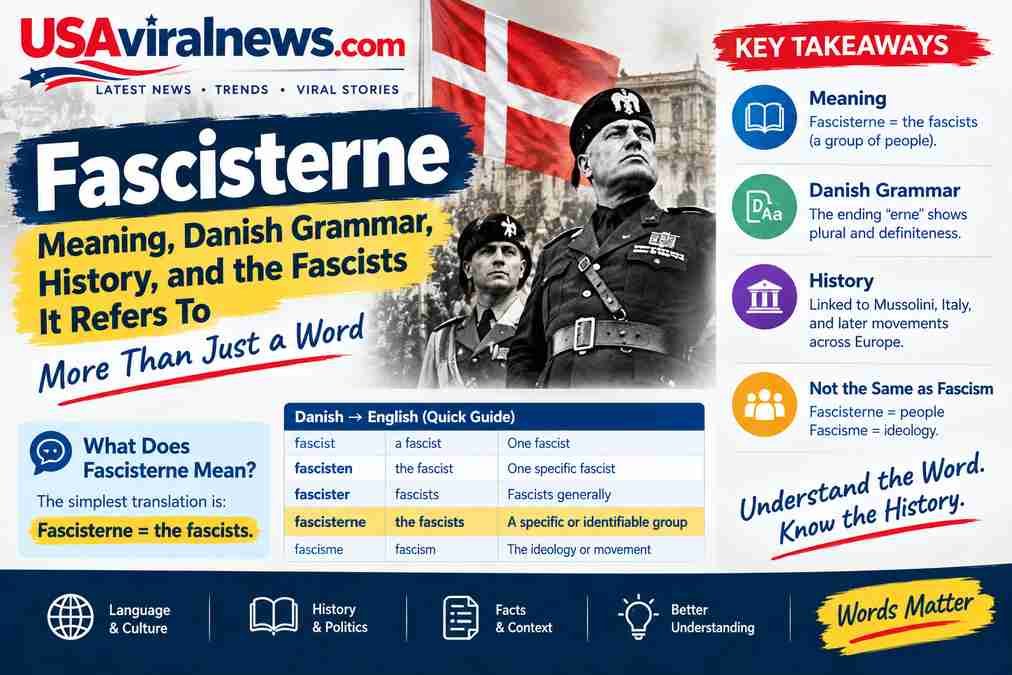
Fascisterne is a Danish word that means “the fascists” in English. It is the definite plural form of fascist, so it refers to a particular or identifiable group of people described as fascists. It is not the name of a specific political party, organization, or ideology by itself.
That distinction matters because the word can appear in very different contexts. A Danish history text might use fascisterne when discussing Italian Fascists, Danish fascists, or fascist movements elsewhere in Europe. A modern political discussion may use the same word more loosely as a political accusation. The surrounding context determines exactly whom the writer means.
What Does Fascisterne Mean?
The simplest translation is:
Fascisterne = the fascists
The word comes from the Danish noun fascist, which refers primarily to a person who supports fascism. Danish expresses grammatical definiteness through noun endings, which is why the English word “the” is represented by the ending in fascisterne. Historical Danish dictionaries also document the word in this form.
A useful breakdown is:
| Danish | English | Meaning |
| fascist | a fascist | One fascist |
| fascisten | the fascist | One specific fascist |
| fascister | fascists | Fascists generally |
| fascisterne | the fascists | A specific or identifiable group |
| fascisme | fascism | The ideology or political movement |
The key distinction is between people and ideology. Fascisterne refers to people. Fascisme refers to fascism itself.
This is easy to overlook if the word is encountered outside Danish.
Why the Ending “erne” Matters
The ending is grammatical, not ideological.
In Danish, nouns can take endings that indicate number and definiteness. In this case, fascister is the plural form, while fascisterne is the definite plural.
So the progression is:
fascist → fascister → fascisterne
The English equivalent changes from “a fascist” to “fascists” to “the fascists.”
This means Fascisterne should not be interpreted as though it were the proper name of a movement called “Fascisterne.” It is an ordinary Danish noun form. The exact group being discussed has to be established from the sentence or wider text.
Older Danish dictionary material provides historical examples of fascisterne in descriptions of fascists in Italy and elsewhere, demonstrating that the form has long been used as a normal plural noun rather than as the name of a single organization.
Fascisterne Is Not the Same as Fascism
One of the most important distinctions is:
Fascisterne means “the fascists.”
Fascisme means “fascism.”
The first describes people. The second describes a political ideology and movement.
Fascism emerged as a major political force in early twentieth century Europe. The United States Holocaust Memorial Museum describes it as a far right political philosophy that places the nation above the individual and opposes liberal democratic political traditions. It became particularly successful in Italy and Germany.
This distinction helps prevent a common translation error. If a Danish text says that fascisterne did something, the original writer is talking about people or a group of people. Translating it simply as “fascism” changes the grammatical and historical meaning.
Where Did Fascism Come From?
Modern fascism is most closely associated with Benito Mussolini and Italy.
Mussolini founded the first major fascist movement in Italy after the First World War. The movement eventually became a governing force, and Mussolini ruled Italy as its dictator. The Holocaust Encyclopedia identifies Mussolini as the founder of Italian Fascism and notes that his takeover became an important inspiration for Adolf Hitler and the Nazi Party in Germany.
Fascism developed in a period marked by political instability, social conflict, economic uncertainty, and widespread fear of revolutionary communism. Fascist movements presented themselves as alternatives to parliamentary politics and class conflict. They emphasized national unity, authority, discipline, and strong leadership while suppressing political opposition.
The exact form of fascism differed between countries. That is why it is misleading to treat every authoritarian government or nationalist movement as identical to Italian Fascism.
What Did Fascists Believe?
Historical fascist movements differed from one another, but several recurring features are important for understanding the term.
These commonly included:
- intense nationalism
- rejection or destruction of liberal democratic institutions
- strong centralized leadership
- suppression of political opposition
- glorification of national unity and political loyalty
- acceptance or promotion of political violence
- hostility toward communism and other perceived political enemies
- extensive propaganda
- subordination of individual interests to an idealized national community
The exact combination varied by country and period. Nazism, for example, developed a particularly radical racial and antisemitic worldview that cannot simply be treated as interchangeable with every other form of fascism. The Holocaust Encyclopedia classifies Nazi Germany as a fascist government while also describing the distinctive ideological characteristics of Nazism.
That historical distinction is important when interpreting the Danish word fascisterne. The word itself does not tell you whether the writer means Italian Fascists, Danish fascists, Nazis, or another group described as fascist.
Fascisterne and Denmark
The word has a particularly relevant historical context in Denmark because Denmark had its own Nazi political movement during the interwar period and German occupation.
The most important organization was Danmarks Nationalsocialistiske Arbejderparti, usually abbreviated DNSAP. The party was founded on November 16, 1930, by Cay Lembcke. Frits Clausen became its leader in 1933. The organization was strongly modeled on Adolf Hitler’s German NSDAP, including its organizational structure, symbols, nationalism, antisemitism, and opposition to parliamentary democracy.
DNSAP remained politically marginal despite its growth in membership.
At the 1939 Danish parliamentary election, the party won about 1.8 percent of the vote and three seats. During the German occupation, it failed to turn its increased organizational activity and German support into a national political breakthrough. At the 1943 election, it again won only three parliamentary seats, with about 2.1 percent of the vote.
This is an important part of the Danish context. Not every reference to fascists in Denmark means that DNSAP controlled Denmark or represented the majority of Danish society. The historical record shows that the party remained a minority movement.
DNSAP and the German Occupation
Germany occupied Denmark beginning in 1940, creating a complicated political environment for Danish Nazi activists.
DNSAP hoped to use the occupation to gain political power. The party also participated in recruitment for German military formations, including Waffen SS units and Frikorps Danmark. Its dependence on Germany became one of the central contradictions of its political identity because it presented itself as a Danish nationalist movement while closely following German Nazism.
The party’s failure to achieve a decisive political breakthrough became especially clear in 1943. After its poor election result, its political influence declined further, and the organization ultimately disappeared in 1945.
This history explains why fascisterne may appear in Danish historical writing alongside terms concerning Nazism, occupation, resistance, collaboration, antisemitism, and political violence. But those terms should not automatically be treated as synonyms.
Fascism and Nazism Are Related, but Not Identical
It is common to see fascism and Nazism discussed together because Nazi Germany shared important characteristics with other fascist movements.
There are nevertheless important differences.
Fascism is a broader category associated historically with movements such as Italian Fascism and other authoritarian nationalist movements.
Nazism refers specifically to the ideology and political movement associated with Adolf Hitler and the German National Socialist German Workers’ Party. Nazi ideology placed an exceptionally strong emphasis on racial hierarchy, antisemitism, racial purity, territorial expansion, and the persecution and destruction of groups defined as racial or political enemies.
Therefore, if a Danish source uses fascisterne, you should not automatically translate the term as “Nazis.”
Context decides the reference.
How Fascisterne Is Used in Modern Danish
The historical meaning is not the only possible use.
Political language sometimes extends words beyond their strict historical definitions. Danish dictionary evidence records a broader transferred use of fascist associated with strongly authoritarian or nationalist political attitudes and suppression of people who disagree.
That means a contemporary sentence containing fascistians may not be describing members of a historical fascist organization.
It could instead be using the term rhetorically.
This creates an important interpretive rule:
Do not assume that every modern use of “the fascists” is a precise historical classification.
Ask who is being described, what actions or beliefs are being discussed, and what evidence supports the label.
A historical text identifying members of an established fascist organization is making a different kind of statement from a political commentator calling opponents fascistened during a modern argument.
Why Context Is Essential
Suppose you encounter fascisterne in a Danish article without knowing the surrounding paragraph.
The word tells you that the writer means “the fascists,” but it does not tell you:
- which country they belong to
- which organization they belong to
- which historical period is being discussed
- whether the term is being used historically or rhetorically
- whether the writer means fascists in the strict ideological sense
- whether the reference concerns Italian Fascism, German Nazism, Danish Nazism, or another movement
The surrounding text supplies that information.
For example, a sentence about Mussolini and Italy points toward Italian Fascists. A discussion of DNSAP and the German occupation points toward Danish Nazism. A modern newspaper debate may use the term as a political description that requires additional scrutiny.
The grammar stays the same. The historical reference changes.
How to Translate Fascisterne Correctly
In most contexts, the safest English translation is:
“the fascists”
Avoid translating it automatically as:
- fascism
- fascist ideology
- Nazis
- the Fascist Party
- a specific Danish fascist organization
Those translations add information that is not necessarily contained in the word itself.
A translator should first preserve the grammatical meaning, then use context to determine the historical reference.
This is especially important when translating historical documents. A precise translation should not turn a general reference to fascists into the name of a specific organization that the original Danish text never identified.
Why the Term Can Be Misleading Online
Search results for fascisterne can make the word look like the name of a specific historical movement because many pages discuss the term alongside fascism, Mussolini, Nazism, Denmark, and the Second World War.
The distinction is simpler:
Fascisterne is a Danish grammatical form.
It means “the fascists.”
It does not independently identify one political party.
The historical subject behind the word must be established from context.
That small distinction produces a much more accurate understanding of Danish historical and political writing.
Frequently Asked Questions
What does fascisterne mean in English?
Fascisterne means “the fascists.” It is the definite plural form of the Danish noun fascist.
What language is fascisterne?
Fascisterne er danske.
Is fascisterne a political party?
No. Fascisterne is a grammatical noun form meaning “the fascists.” It is not, by itself, the name of a political party or organization.
What is the singular form of fascisterne?
The indefinite singular is fascist. The definite singular is fascisten. The indefinite plural is fascister, and the definite plural is fascisterne.
What is the Danish word for fascism?
The Danish word is fascisme. Fascisterne refers to people, while fascisme refers to the ideology or political movement.
Does fascisterne always mean Nazis?
No. Fascism and Nazism are historically related, but they are not identical terms. Fascisterne can refer to different groups depending on the context.
Was there a fascist or Nazi movement in Denmark?
Yes. Denmark had the DNSAP, a Nazi political party founded in 1930 and strongly modeled on Hitler’s NSDAP. It remained a marginal electoral force despite gaining members and operating during the German occupation.
When was DNSAP founded?
DNSAP was founded on November 16, 1930, initially under Cay Lembcke. Frits Clausen became its leader in 1933.
Why does fascisterne end with “erne”?
The ending marks the definite plural. It changes fascister, meaning “fascists,” into fascisterne, meaning “the fascists.”
Can fascisterne be used in modern political discussion?
Yes. The term can appear in contemporary political language, including broader or rhetorical uses of the word fascist. Such usage should be distinguished from a precise historical identification of a fascist organization or movement.
The Bottom Line
Fascisterne means “the fascists” in Danish. It is the definite plural of fascist, not the name of a particular ideology or organization.
Its meaning becomes more specific only when you examine the surrounding context. In historical writing, it may refer to followers of Italian Fascism, Danish fascists, Nazi activists, or another group identified as fascist. In modern political language, it can also function as a broader label.
The most reliable way to understand the word is therefore to separate three things: the Danish grammar, the people being described, and the historical or political context. Once those are kept distinct, fascisterne is much less mysterious and much easier to translate accurately.
You may also read:Tulip Victoria Khaury