
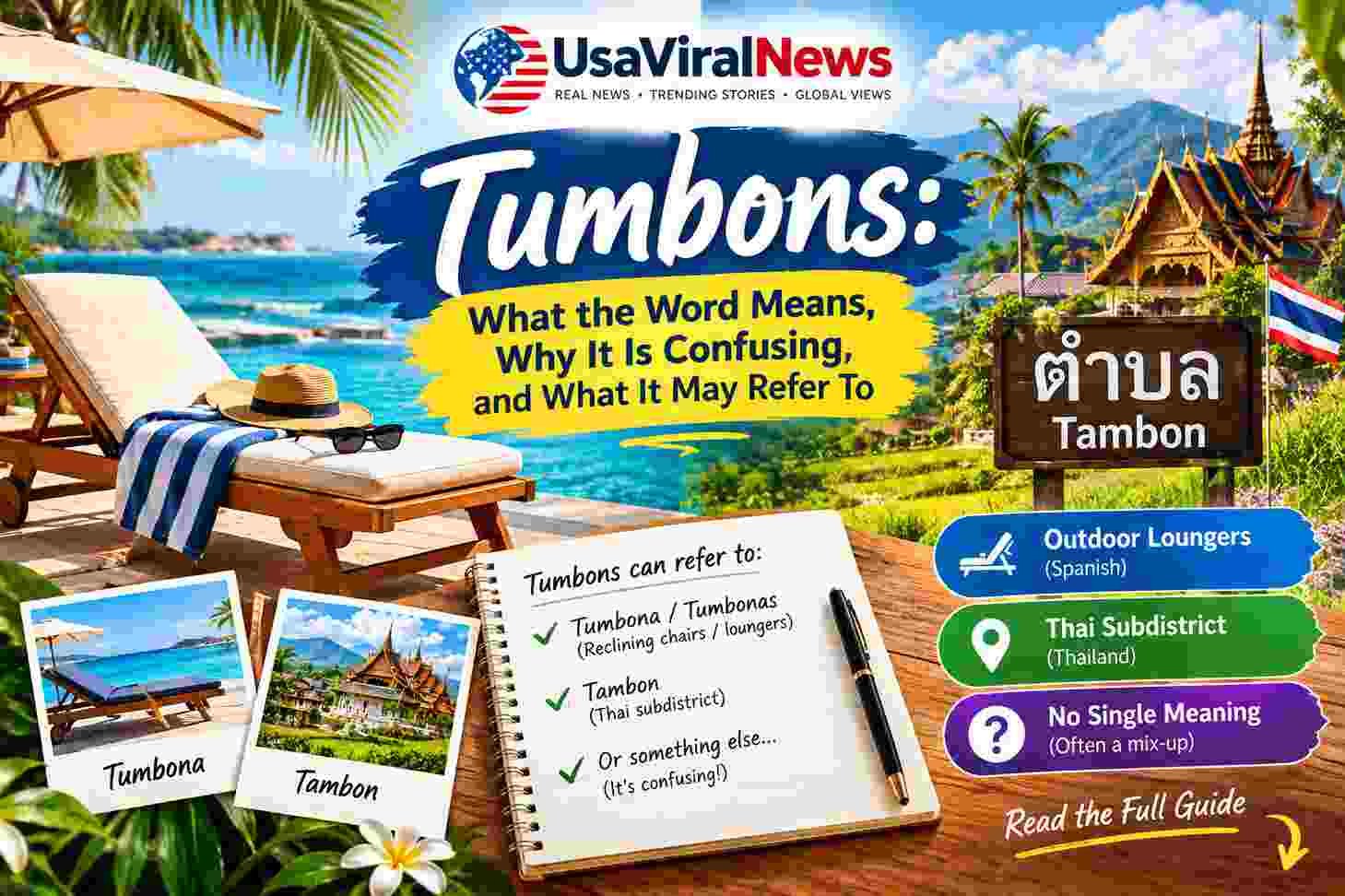
If you searched for tumbons, you may have noticed that the results do not agree on what the word means. Some pages connect it with outdoor loungers, others use it in discussions about Thailand, and some describe it as a broader lifestyle or design concept. That inconsistency is important because tumbons is not a well established English term with one universally accepted definition.
The most useful way to understand the word is to separate the terms it may be confused with. Depending on context, you may actually be looking for tumbona or tumbonas, the Spanish words associated with reclining outdoor furniture, or tambon, the established term for a Thai administrative subdistrict.
What does “tumbons” mean?
There is no strong evidence that “tumbons” has a single standard definition in English.
Current online usage is inconsistent. Some recent articles describe tumbons as reclining chairs or loungers, while others use the spelling in connection with Thai subdistricts. Still others assign the word newer meanings related to lifestyle, textiles, design, or community concepts. These interpretations are not supported equally by established dictionaries or official sources.
Two established words are particularly relevant:
| Term | Established meaning | Context |
| tumbona | A reclining chair or lounger | Spanish, furniture |
| tumbonas | Plural of tumbona | Spanish, furniture |
| tambon | A subdistrict in Thailand | Thai administration |
| tumbons | No single established meaning | Often appears as an inconsistent online spelling |
So if you encountered “tumbons” without any context, it is safer to identify the intended word before accepting a definition.
Tumbons may refer to “tumbona” or “tumbonas”
One likely source of confusion is the Spanish word tumbona.
Cambridge defines tumbona as a reclining chair with a long back and gives English equivalents including recliner, deckchair, sunbed, and sun lounger.
The plural form is tumbonas.
A tumbona is generally the kind of chair associated with beaches, swimming pools, patios, gardens, terraces, and other places where people relax outdoors. Depending on the design, it may have an adjustable backrest that lets the user sit upright, recline, or lie down.
Common English equivalents include:
- sun lounger
- deck chair
- deckchair
- recliner
- lounge chair
- beach chair
- chaise longue
The exact English translation depends on the design and regional usage. Cambridge, Larousse, Collins, and other dictionaries all associate tumbona with reclining or outdoor seating.
What does a tumbona look like?
A typical tumbona has a longer seating surface than an ordinary chair. The back section can often be adjusted to different angles.
Some models include:
- Adjustable backrests
- Armrests
- Head cushions
- Foot sections
- Wheels
- Folding frames
- Sun shades
- Removable cushions
- Weather resistant materials
The exact design varies considerably. A simple folding beach chair and a substantial poolside lounger can both fall within the broad category of reclining outdoor furniture.
Tumbons may also be confused with “tambon”
A completely different possibility is tambon, a Thai administrative term.
Thailand’s official open data system uses the term Tambon for Thai subdistrict names and provides those names in Thai and Romanized forms. The dataset is maintained by a government institution associated with Thailand’s Royal Society.
A tambon is an administrative division below the district level, commonly called a subdistrict in English. Thai administrative references use the spelling Tambon, not “tumbon” as the standard English form. Government statistical material also routinely labels these units as “Tambon.”
The hierarchy can be simplified as:
Province → District → Tambon → Village
A district is known as an amphoe, while a village is commonly referred to as a muban. A tambon therefore represents a geographic and administrative unit within Thailand rather than a type of furniture.
Why might “tumbons” appear in searches about Thailand?
Romanization and spelling can create confusion when words move between Thai and English. Thailand’s government maintains official Romanized names for tambons, and government datasets consistently use the spelling Tambon.
Therefore, if you see “tumbons” in a discussion about Thai addresses, geography, local government, or villages, tambons or tambon is probably the term being intended.
Why is the word “tumbons” so confusing?
The problem is not simply spelling. Several different words and concepts can become mixed together.
1. Spanish furniture terminology
Tumbona is an established Spanish word for a reclining chair. Its plural is tumbonas.
2. Thai administrative terminology
Tambon is an established term for a Thai subdistrict. Thai government data uses this spelling.
3. Online reinterpretation
A growing number of low authority web pages use “tumbons” as though it were an established English noun. These pages do not agree with one another. Some describe furniture, some describe Thai administration, and others introduce meanings involving textiles, lifestyle, design, or abstract concepts.
That means repeating one of those definitions as an unquestionable fact can create a misleading explanation.
Is “tumbons” the correct spelling for a lounger?
Generally, no.
If you are talking about the Spanish furniture term, tumbona is the established singular form and tumbonas is the plural. Dictionaries translate tumbona as terms such as deck chair, sun lounger, and recliner.
For an English article about the furniture, terms such as sun lounger, outdoor recliner, chaise longue, or deck chair will usually be clearer to an English speaking reader.
Using “tumbons” as though it were a standard English furniture category may therefore create more confusion than clarity.
Is “tumbons” the correct spelling for Thai subdistricts?
The established English spelling is tambon.
Thailand’s government open data resources explicitly use “Tambon” when identifying subdistrict names. Government statistical publications use the same spelling in English tables.
For example, a Thai location can be identified through its province, district, and tambon. The tambon can therefore be important when interpreting an address or identifying a particular local area.
If your search concerns Thailand, replacing “tumbons” with tambon will usually produce more reliable results.
What is a tumbona used for?
If your intended meaning is the Spanish furniture term, a tumbona is primarily designed for reclining and relaxation.
Typical uses include:
- Reading outdoors
- Resting beside a swimming pool
- Sitting on a patio or terrace
- Relaxing in a garden
- Sunbathing
- Taking a short nap
- Reclining at a beach or resort
- Creating additional outdoor seating
The important distinction is that a tumbona is designed around a reclined body position, rather than the upright posture of an ordinary dining or patio chair.
That makes the backrest mechanism and the length of the seating surface especially important when evaluating one.
What should you look for in an outdoor lounger?
If “tumbons” brought you to reclining outdoor furniture, the name itself is less important than the actual construction.
Consider these factors:
| Factor | Why it matters |
| Backrest adjustment | Determines how easily you can switch between sitting and reclining |
| Frame material | Affects durability, weight, and maintenance |
| Fabric or surface | Determines comfort and resistance to outdoor conditions |
| Foldability | Useful when storage space is limited |
| Weight | Important if the lounger needs to be moved frequently |
| Wheels | Helpful for moving heavier models |
| Cushioning | Can improve comfort during extended use |
| Weather resistance | Important for outdoor storage and exposure |
| Size | Determines whether it fits the intended space |
| Stability | Reduces the risk of unwanted movement while reclining |
There is no single best design for everyone. A lightweight folding lounger may make sense for a beach or camping trip, while a heavier model may be better suited to a permanent patio or pool area.
What if you encountered “tumbons” in a Thai address?
Look for Tambon.
Thai addresses can contain several administrative levels, and the tambon identifies a subdistrict within the country’s geographic and administrative system. Official Thai data specifically provides standardized names for tambons in both Thai and Romanized forms.
If you are translating, checking a map, researching property information, or trying to understand a Thai location, do not automatically interpret “tumbons” as furniture. The surrounding words should determine the intended meaning.
What about claims that tumbons are a lifestyle or cultural concept?
These claims should be treated cautiously.
Some websites currently present “tumbons” as a philosophy involving relaxation, balance, adaptability, community, or modern design. Other pages connect it with textiles or traditional cultural practices. The problem is that these definitions are not consistent with one another, and the pages making the claims often provide little evidence for an established linguistic or historical meaning.
That does not prove that nobody has ever used the word in those ways. It means the usage should not automatically be presented as a recognized dictionary definition, established cultural tradition, or historical fact.
A careful explanation should distinguish documented terminology from newer internet usage.
The simplest way to interpret “tumbons”
Context usually provides the answer.
If the subject is furniture: you probably mean tumbona or tumbonas, a reclining chair or sun lounger in Spanish.
If the subject is Thailand: you probably mean tambon, a Thai subdistrict. Official Thai data uses this spelling.
If a website uses “tumbons” as a new concept: check its definition and supporting evidence rather than assuming the term has a universally recognized meaning.
Frequently asked questions
Is tumbons a real word?
“Tumbons” appears online, but it does not have one clearly established meaning in standard English. Current web usage applies the spelling to several unrelated ideas. Established terms that may be confused with it include Spanish tumbona and Thai tambon.
What is a tumbona?
A tumbona is a Spanish term for a reclining chair. English translations include sun lounger, deck chair, recliner, and lounge chair.
What is the plural of tumbona?
The Spanish plural is tumbonas. It refers to multiple reclining chairs or loungers.
What is a tambon in Thailand?
A tambon is a subdistrict level administrative unit in Thailand. Official Thai government data uses the Romanized spelling “Tambon.”
Are tumbons and tambons the same thing?
Not necessarily. “Tumbons” is an inconsistent online spelling, while tambon is the established term used for Thai subdistricts. The intended meaning depends on the context.
Are tumbons and tumbonas the same thing?
They should not automatically be treated as the same word. Tumbona is an established Spanish furniture term, while “tumbons” is not a standard English plural of it. The Spanish plural is tumbonas.
The bottom line
“Tumbons” does not have one reliable, universally accepted meaning. If you encountered the term while researching outdoor furniture, the intended word may be the Spanish tumbona, meaning a reclining chair or sun lounger. If you encountered it while researching Thailand, the intended term is more likely tambon, meaning a subdistrict.
That distinction matters because the two established terms describe completely different things. A tumbona is furniture for reclining and relaxation, while a tambon is part of Thailand’s administrative geography. Treating “tumbons” as a fixed definition without considering the context can lead to inaccurate information.
You may also read:Tulip Victoria Khaury